
A Federal Judge Ordered Fort Bragg to Hand Over a 2014 Mill Site Contamination Letter
The public still can't read it
The City of Fort Bragg spent months trying to keep an eleven-year-old letter to Georgia-Pacific out of a federal toxics lawsuit, invoking a “mediation privilege.” A judge has now ordered it produced — and stamped confidential.
On September 10, 2014, the City of Fort Bragg sent a letter to Georgia-Pacific, the company whose lumber mill left a legacy of contamination on the coastal bluffs at the edge of town. About a month later, the city and Georgia-Pacific settled a toxic-cleanup dispute, on terms that were never made public.
Nearly twelve years later, that letter set off a tug-of-war in federal court between the city and Mendocino Railway, the new owner of the millsite, with the city spending months fighting to keep the letter out of public view.
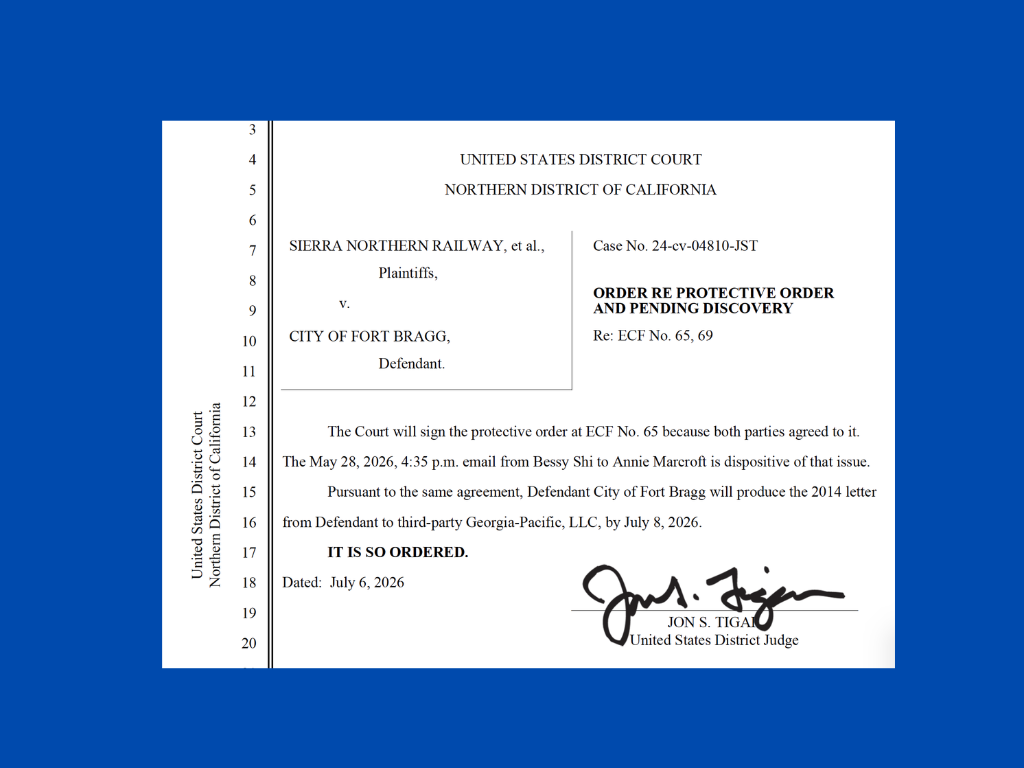
On July 6, U.S. District Judge Jon S. Tigar ordered Fort Bragg to turn the 2014 letter over to Mendocino Railway and Sierra Northern Railway — who are jointly suing the city. But Tigar let the city produce the letter under a protective order. That means the letter is stamped “confidential” and goes to the plaintiffs’ attorneys directly. Fort Bragg residents who want to know what’s in the letter can’t read it.
The lawsuit behind the letter
Mendocino Railway and Sierra Northern Railway sued the City of Fort Bragg in August 2024 in U.S. District Court for the Northern District of California, invoking the federal Superfund law known as CERCLA or the Comprehensive Environmental Response, Compensation, and Liability Act. The law authorizes the U.S. Environmental Protection Agency to identify hazardous waste sites, compel polluters to clean them up, and funds cleanups when no responsible party can be found. CERCLA also lets private parties who face cleanup costs sue to recover them — the basis for this lawsuit.
According to the railways’ complaint, the case concerns dioxins and furans in the former mill site’s Mill Pond. The railways want the city to pay the cleanup costs; the city has denied liability and filed its own counterclaims. A trial is not expected until 2028.
The tussle over the letter dates back to February 2026, when the railways subpoenaed Georgia-Pacific for a copy. Georgia-Pacific is not a party to the current lawsuit. The city objected, asserting that the letter is covered by a mediation privilege. Georgia-Pacific made no such assertion.
The two sides spent months arguing about the letter. In a May 28 email later filed in court, Anna Marcroft, the railway’s attorney, called the city’s claim of a mediation privilege “completely unsubstantiated.” She wrote that “Georgia-Pacific does not even claim that the letter is privileged. The city “simply has no leg to stand on,” she wrote.
Eventually, Fort Bragg agreed to produce the letter — but only if the railways first signed a protective order governing how confidential documents would be handled in the case. The railways agreed to a standard protective order, while expressly reserving the right to later challenge the city’s designation of the letter as confidential.
What followed was a procedural brawl about the order’s fine print. The city’s attorney accused the railways’ attorney of adding her signature to a proposed order without her consent and demanded changes at the last minute. The railways’ attorney responded by threatening a sanctions motion.
Judge Tigar cut through the back and forth on July 6. He found that a May 28 email from the city’s lawyer stating “We will sign the PO and produce the letter after you sign” to be “dispositive.” That means it settled the issue.
Notably, the changes the city was pushing for would have made the order more restrictive by making it harder to put sealed documents on the record.
Why the letter is still secret
The letter is covered by a protective order, which is different from an order to seal the document. A protective order is a discovery tool that governs how the parties can use the document in the lawsuit. But as a practical matter, its "confidential" designation keeps the letter out of the public court record: it passes only between the parties' attorneys, and if either side tried to file it, the designation would force a separate sealing motion before it could appear publicly — a request the judge could grant or deny.
MendoLocal.News has requested the letter under the California Public Records Act. The city has ten days to respond. The period has not elapsed, and we have not yet heard back.
The public began paying close attention to the case on June 22 — after the proposed protective order was filed just hours before a special closed session meeting of the Fort Bragg City Council. Jade Tippett, who maintains the savenoyoheadlands.org repository, and Jacob Patterson, an attorney, warned the council that the order, as written, would allow either party to stamp evidence as “confidential” and keep it from public view even after the case concluded.
Fort Bragg City Manager Isaac Whippy responded to questions from MendoLocal.News on Friday. “Because this matter involves pending litigation, the city is necessarily limited in what it can discuss publicly,” he wrote. “The document at issue was created in 2014 as a confidential mediation and settlement communication in connection with prior litigation involving the former Georgia-Pacific mill site. It was expressly designated as confidential when it was created.
“The city produced the document pursuant to a court order governing discovery in the current litigation and under a protective order that preserves its existing confidential status. The protective order does not create confidentiality, rather it allows the parties to comply with the court’s discovery process while maintaining the confidentiality protections that have existed since the document was created.”
The matter is expected to be addressed at the next city council meeting on July 27.
Read our previous coverage of the former Georgia-Pacific mill site:
Who Owns the Mill Site in Fort Bragg (April 24, 2026)
Private Equity Acquires Skunk Train Owner, Settlement Talks Continue with Fort Bragg (April 8, 2026)
Federal Rail Rulings Stack up in Against State Regulators in Fort Bragg Mill Site Dispute (March 23, 2026)
Federal Railroad Board Blocks Great Redwood Trail Abandonment Motion (February 20, 2026)
Skunk Train Chief Details Freight Operations, Federal Oversight Amid Eminent Domain Dispute (December 16, 2026)
California Appeals Court Says Public Utilities Need Not Serve Active Customers (December 16, 2026)
Should the Skunk Train be Part of the Regional Transporation Plan? (December 3, 2025)
California AG Bonta Challenges Mendocino Railway’s Federal Carrier Status (December 1, 2025)
Mendocino Railway Rejects Fort Bragg’s Bid for Yearlong Pause in Litigation (November 5, 2025)
Fort Bragg Plans Public Study Session, Website to Boost Transparency on Mill Site Development (October 28, 2025)
Skunk Train, Fort Bragg Jointly Agree to Set Aside Default in Mill Site Suit (October 13, 2025)
U.S. Supreme Court denies Skunk Train appeal (October 7, 2025)
Federal Railway Agency Affirms Mendocino Railway’s Carrier Status (September 27, 2025)
Default Notice Issued as Stormwater Contamination Battle with Fort Bragg Escalates (September 11, 2025)