
Private Equity Acquires Skunk Train Owner, Settlement Talks Continue with Fort Bragg
Ownership change will not affect Mendocino Railway, CEO says
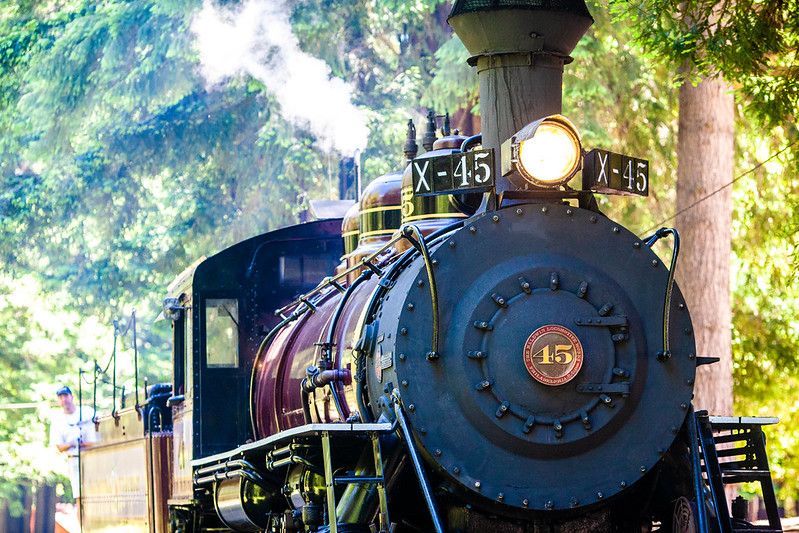
A private equity firm specializing in infrastructure investment has acquired the Sierra Railroad Company, owner of the Mendocino Railway, in a multistep transaction that transfers control of the company to new management and converts the company from a California entity to a Delaware Corporation.
Ridgewood Infrastructure, a prominent private asset management firm headquartered in New York City, completed the transaction on March 6. Ryan Stewart, a partner at Ridgewood Infrastructure, replaced Michael Hart as CEO of the Sierra Railroad Company. Two other Ridgewood Infrastructure partners, Douglas Boyd and Ross Posner, replaced Torgny Nilsson and David Macaw as secretary and chief financial officer.
An employee of Ridgewood Infrastructure reached by phone said Stewart was on vacation. Stewart did not respond to an email sent to his work address requesting comment on the transaction.
In response to questions from MendoLocal.News, Robert Pinoli, president and CEO of Mendocino Railway, said in an email that ownership change will have no impact on Mendocino Railway. “Mendocino Railway’s officers, directors, and ultimate shareholders remain the same as what they were,” he wrote.
Isaac Whippy, the Fort Bragg city manager, said in an email, “The ownership shift does not impact our current settlement discussions. We continue to stay focused on our path forward and maintaining open lines of communication as we work toward a broader resolution.”
The City of Fort Bragg, Mendocino Railway, and the Coastal Commission all agreed on March 27 to a 90 day “stay of action” to continue settlement talks. A mandatory settlement conference set for April 15 was rescheduled for June 26.
“The parties agree that continued settlement discussions could still prove fruitful, and could dispose entirely of this action, or significantly narrow down the issues for trial,” the joint stipulation agreement states.
From Humble Beginnings
The company now known as Sierra Railroad Company was incorporated in California on May 2, 1994, under the name Coast Enterprises Inc., with a modest authorization of just 100,000 shares of common stock. Its initial registered agent was Walter Hoefler, listed at a San Jose address.
Within two years, the company had grown sufficiently to warrant a 9-for-1 stock split, expanding its authorized shares to 1.5 million, according to a 1995 amendment to its articles of incorporation signed by Walter Hoefler as president and Mary R. Hoefler as secretary.
Then, in January 1997, the company shed its generic corporate identity entirely. With the written consent of a similarly named firm, Sierra Railcar Inc. of Rancho Cordova, Coast Enterprises Inc. renamed itself Sierra Railroad Company — a name it retains today. Michael G. Hart was listed as president at the time of that filing, with Mary R. Hoefler continuing as secretary.
A Merger and a New Leadership Team
A Statement of Information filed the same day as the merger documents listed an entirely new set of officers: Ryan Stewart as chief executive officer, Douglas Boyd as secretary and vice president, and Ross Posner as chief financial officer and vice president. The new board of directors consisted solely of Stewart, Boyd, and Posner — with none of the previous directors remaining.
The mechanism for the transition was a merger with RW Whitney Merger Sub Inc., a newly formed California corporation with entity number B20260071701, which was merged into Sierra Railroad Company, with Sierra surviving.
Under the terms of the agreement of merger, each share of RW Whitney Merger Sub was converted into one share of Sierra Railroad common stock. Critically, existing Sierra Railroad shareholders saw 66.8% of their shares canceled in exchange for cash, while the remaining 33.2% of their holdings were preserved.
The merger was approved by holders of 67.52% of Sierra Railroad’s outstanding shares — 878,699 shares of common stock — and by 100% of RW Whitney Merger Sub’s 586,970.93 outstanding shares.
Michael Hart and Torgny Nilsson signed the merger approval certificate on behalf of Sierra Railroad, representing what appears to be their final official act for the company.
Reincorporating in Delaware
Simultaneously with the merger, Sierra Railroad filed a certificate of conversion with the California Secretary of State, converting the corporation from a California entity to a Delaware corporation — a common move for companies seeking more flexible corporate governance frameworks or preparing for outside investment.
The conversion was authorized by a vote of Sierra Railroad’s common stockholders, with 50.1% approval required. The agent for service of process in California was changed to Corporation Service Company, doing business as CSC – Lawyers Incorporating Service, replacing the longtime individual agent Torgny Nilsson.
The amended and restated articles of incorporation, attached to the merger agreement, expanded the company’s authorized share count to 5,000,000 shares of common stock and added provisions consistent with a company anticipating future equity activity, including a clause allowing stock repurchases from employees and consultants even if the company owes dividends to preferred shareholders.
The Motivation for the Deal
Ridgewood Infrastructure, a subsidiary of Ridgewood Companies, describes itself as a manager of “lower middle-market essential infrastructure” — water, energy, transportation, and utilities. According to SEC filings, the firm has $1.8 billion regulatory assets under management.
Ridgewood Infrastructure explained its interest in the Sierra Railroad Company and its subsidiaries in a March 10 press release.
As part of the transaction, the release stated, Sierra Railroad will acquire Central Valley Ag Transport, a facility operator that provides transloading services for agricultural products along the rail network. The deal is intended to integrate rail and agricultural logistics operations more closely, particularly in support of California’s dairy and farming industries.
Sierra’s primary operating subsidiary, Sierra Northern Railway, manages about 130 miles of track and provides freight, switching, storage and transloading services. Its network connects agricultural regions with major West Coast ports and industrial centers, and links to national rail systems through interchanges with Union Pacific Railroad and BNSF Railway.
The acquisition also includes Railpower Inc., a Sierra subsidiary that operates what the company describes as the only hydrogen-powered locomotive approved by the Federal Railroad Administration, highlighting a focus on lower-emissions rail technology.
Ridgewood said the investment will support growth in freight volumes, expansion of transloading capacity and further development of rail innovations. Company executives described the deal as positioning Sierra to expand service to existing customers while attracting new business across industrial and agricultural supply chains.
“In selecting a partner for Sierra, it was critical to find an investor with the sector expertise, aligned strategic perspective and financial capacity to support the company’s next phase of growth,” said Mike Hart. “Sierra had reached a point where meaningful near-term investment was required to pursue identified opportunities.”
Mendocino Railway was not mentioned in the release. Financial terms of the deal were not disclosed.
Read MendoLocal.News’ coverage of Mendocino Railway and the mill site dispute:
Federal Rail Rulings Stack up in Against State Regulators in Fort Bragg Mill Site Dispute
Federal Railroad Board Blocks Great Redwood Trail Abandonment Motion
Skunk Train Chief Details Freight Operations, Federal Oversight Amid Eminent Domain Dispute
California Appeals Court Says Public Utilities Need Not Serve Active Customers
Should the Skunk Train be Part of the Regional Transporation Plan?
California AG Bonta Challenges Mendocino Railway’s Federal Carrier Status
Mendocino Railway Rejects Fort Bragg’s Bid for Yearlong Pause in Litigation
Fort Bragg Plans Public Study Session, Website to Boost Transparency on Mill Site Development
Skunk Train, Fort Bragg Jointly Agree to Set Aside Default in Mill Site Suit
U.S. Supreme Court denies Skunk Train appeal
Federal Railway Agency Affirms Mendocino Railway’s Carrier Status
Default Notice Issued as Stormwater Contamination Battle with Fort Bragg Escalates