
Supervisors Approve Balanced Budget Proposal While Staff Warns of Future Deficits, Federal Cuts
County employees protest "insulting" contract proposals
Updated: Information about the date the board will vote on the final resolution was added to the bottom of the story, and additional clarification was added to the opening paragraph and headline, June 9, 2025 (8:19 a.m.)
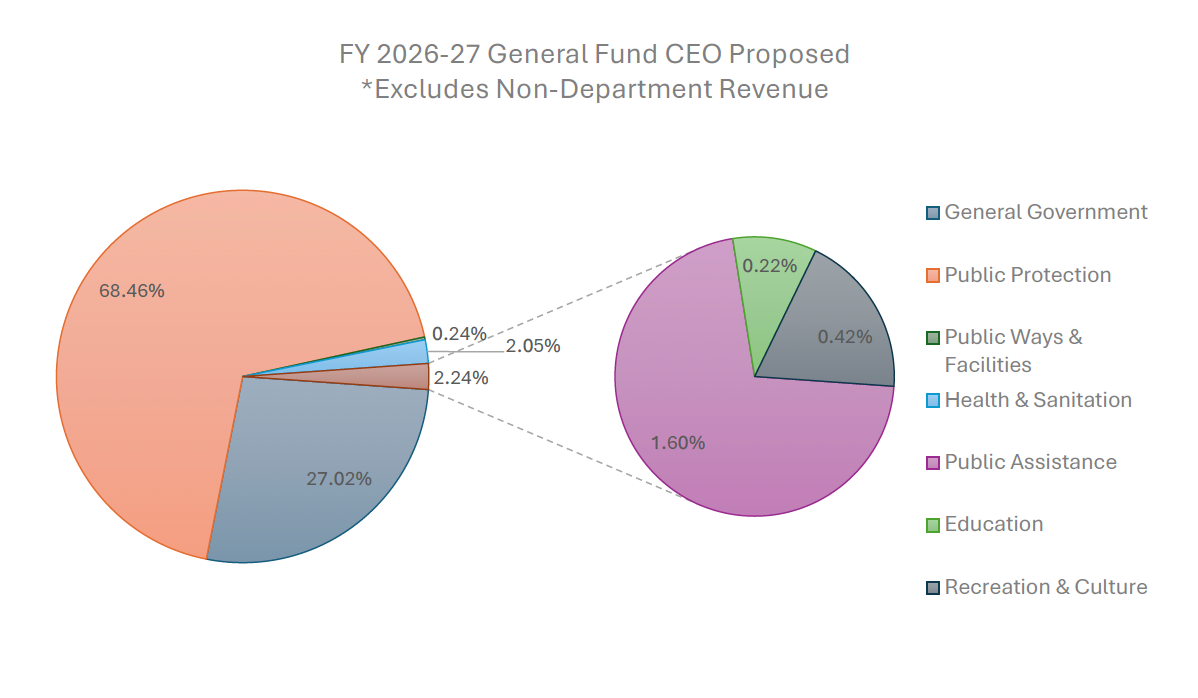
The Mendocino County Board of Supervisors unanimously adopted a balanced budget proposal last week that relies on a one-time cash infusion to close an ongoing structural deficit and does not account for potential costs associated with recent federal policy changes or the City of Ukiah’s proposed annexation plans.
The county’s $95 million General Fund budget relies on $2.6 million in one-time funding, much of it generated through a recent accounting change that allowed the county to capture an additional month of state and federal reimbursements.
If the county does not identify new revenue sources or reduce expenditures, the projected shortfall for fiscal year 2027-28 is expected to reach $2.2 million.
The budget discussion followed roughly 30 minutes of impassioned public comment from county employees, many of whom criticized ongoing contract negotiations and proposed reductions to employee compensation.
Megan Wolf, a library assistant and secretary of the union’s executive board, called the proposed elimination of longevity pay “a slap in the face,” noting that employees receive just a 1% increase after 10 years of service.
“Right now you are saying we can’t even have that?” Wolf said. “It was already low and embarrassing.”
Rebecca Britton described commuting from Lake County because she cannot afford housing in Ukiah.
“Now it’s $20 more every time I fill up my gas tank,” Britton said, describing the financial pressures that have led her to consider seeking work closer to home.
Tracy Wright, a county employee of 26 years, got straight to the point. “We have workers coming in getting trained, and leaving our county,” she said. “What is that saying about our county?”
“Shame on all of you,” Wright told the board. “We are barely surviving.”
Later, during public comment on the budget itself, Patrick Hickey, a field representative for SEIU Local 1021, questioned whether the county’s structural deficit reflects a spending problem or a revenue collection problem.
Hickey noted that the county’s total fund balance has increased from $29.5 million to $80.5 million over the past seven years.
“The county has acknowledged that there are roughly $30 million in uncollected property taxes and has recently decided to stop pursuing some delinquent cannabis tax revenue,” Hickey said. “It’s not a revenue problem. It’s a collection problem.”
Deputy CEO Tony Rakes directed the board’s attention to changes resulting from HR 1, which was enacted last year. County officials said the measure is expected to increase demand for indigent health care services, which require a county match, as its provisions are phased in.
In addition, a proposed asset test could reduce the number of people who qualify for in-home supportive services, which could also mean less federal and state funding, Rakes said.
“It’s very worrisome, all these changes that are happening at once,” CEO Darcie Antle said.
Antle noted that California’s Welfare and Institutions Code Section 17000 requires counties to provide basic relief and support to indigent residents who have no other means of support and do not qualify for other assistance programs.
During public comment, Sheriff Matt Kendall raised concerns about the financial impact of the City of Ukiah’s proposed annexation of county territory, costs that are not reflected in the 2026-27 budget.
“I’d like to know how much that is going to cost us,” Kendall said, citing one estimate that projected a first-year cost of $150,000.
“That’s a deputy sheriff that we will lose in the first year,” Kendall said. “What’s it going to look like in the second year? What will it look like in the third year? I think that we need to take a good hard look at this and make a decision: Can we make this net zero?”
Supervisor Mo Mulheren, whose district includes the City of Ukiah, questioned whether the county’s analysis of the annexation could be technically accurate while still failing to capture the full picture.
Mulheren argued that annexation would shift law enforcement responsibilities in high-call-volume areas from the Mendocino County Sheriff’s Office to the Ukiah Police Department, potentially allowing sheriff’s deputies to focus on underserved areas elsewhere in the county. She also noted that annexation could reduce county obligations for road maintenance and other infrastructure costs.
“I’ve spent the last six years trying to improve transparency and change the culture around how information is shared,” Mulheren said. “I’ve advocated for more context, more collaboration, and more open discussion. I thought we were making headway with that in this budget.”
Assistant CEO Sara Pierce said the county’s analysis to date has focused primarily on the loss of sales tax and transient occupancy tax revenue associated with annexation.
“We would welcome an independent consultant to vet it on both sides,” Pierce said.
Following the discussion the supervisors voted unanimously to directo the auditor-controller to prepare a final budget resolution for adoption by the board on June 23, 2026.
Read our coverage of the county budget:
Understanding the Accounting Shift That is Balancing the County Budget for the Next Six Months (March 5, 2026)
Mendocino County Overhauls Reserve Policy (March 30, 2026)
Proposed Ukiah Annexation Could Cost Mendocino County as Much as $27 Million Over 16 Years (May 6, 2026)
Former San Francisco Controller Says Mendocino County Must Overhaul Financial System (June 5, 2026)