
Mendocino County reviews its budget every six months to ensure projected expenses are tracking with expected revenue. This year’s midyear review showed the county facing trouble.
The fiscal year 2025-26 budget assumed department heads would carry out required cost-cutting measures. Some did. Some did not.
The result was a shortfall of about $2.8 million — the gap between what the county expected to spend and what it expected to bring in. With expenses continuing to outpace revenue, officials needed a way to bring the budget closer to balance, at least on paper.
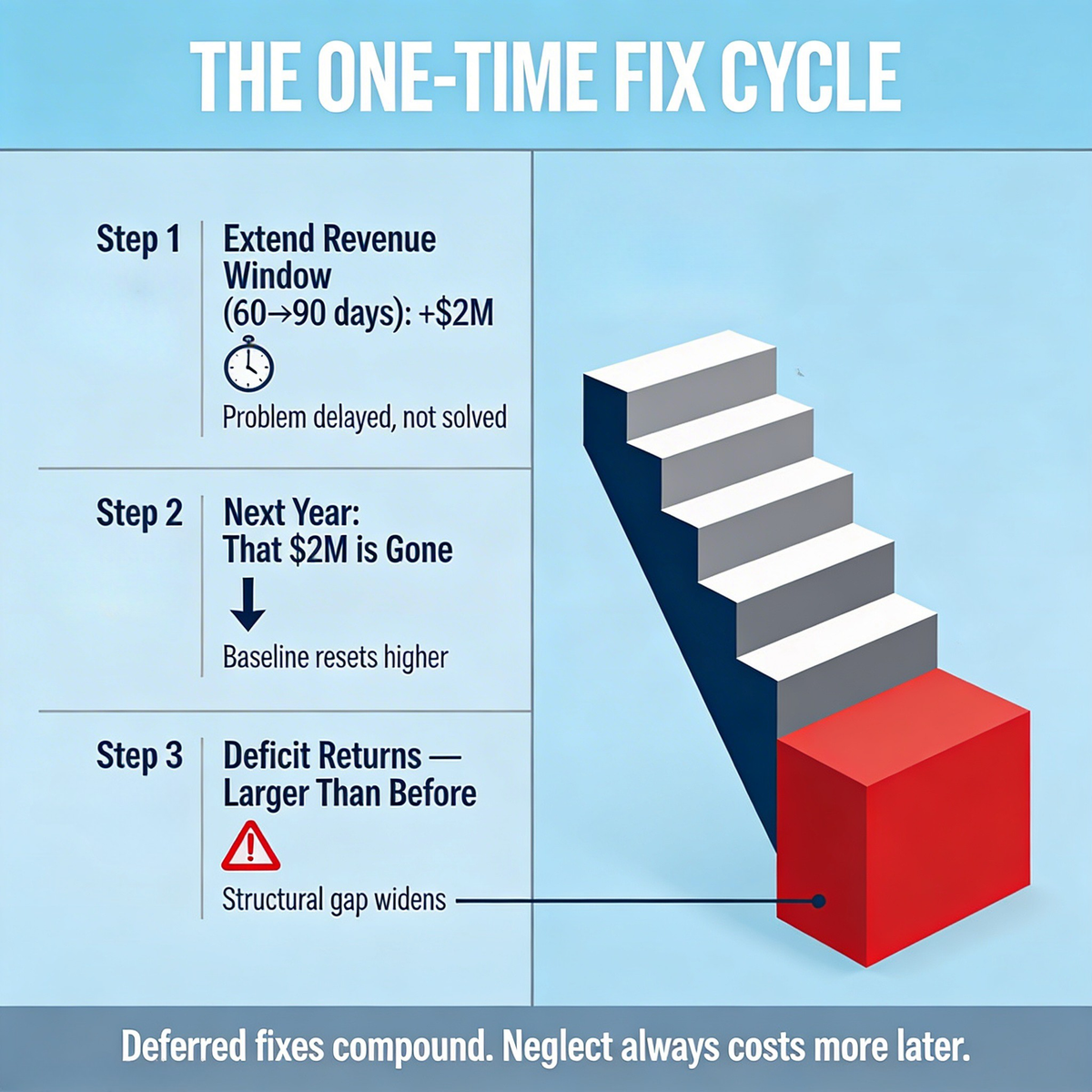
Auditor-Controller/Treasurer-Tax Collector Chamise Cubbison proposed extending the county’s revenue recognition period — the window after the June 30 fiscal year end during which incoming money can still be counted as revenue for the year just closed.
The county had been using a 60-day window. Cubbison recommended extending it to 90 days, through the end of September, to capture state and federal reimbursements that often arrive late but are tied to services delivered in the previous fiscal year.
The change allowed the county to move $2,039,746.61 from the “unavailable” revenue column into fiscal year 2024-25, narrowing the shortfall forecast for 2025-2026. An increase in property taxes and in transient occupancy taxes paid by lodging providers also helped close the gap.
Cubbison told the Board of Supervisors the benefit from the change in the revenue recognition period is strictly one-time.
“As we go forward, if we consistently use the end of September as our cutoff for revenue recognition, we won’t have that kind of shift again,” she said.
The adjustment effectively gives the county six months of breathing room and passes the buck to next year’s budget.
By counting September reimbursements in fiscal year 2024-25, the county has effectively borrowed from its own future. Those extra dollars will not be available to provide a boost in fiscal year 2026-27.
Public finance expert Mark Moses said the move is technically permissible but does not solve the underlying problem.
“There’s nothing nefarious about this from an accounting point of view,” Moses said. “It’s within the authority of the agency to decide whether it wants to do a 60-day or 90-day accrual.”
But he said the accounting change provides only a temporary benefit.
“If you’re not addressing the structural deficit, it’s a desperate move that leaves some people with the impression that something really positive has been done,” he said. “But with respect to the structural deficit, nothing positive has been done.”
Moses said the pattern is common across California governments. When expenses consistently exceed revenue and one-time fixes are used to close the gap, the underlying problem grows.
Deferred road maintenance, aging public buildings and vacant positions used to generate savings are common warning signs, he said.
“You let road repair go another year, and then another year, and eventually it costs more to rebuild that road than if you had done the proper maintenance all along,” he said.
According to Moses, governments facing structural deficits ultimately have three choices: reduce costs, reduce services or raise taxes.
Finding efficiencies is often discussed but rarely defined, he said.
“Everyone understands there must be efficiencies out there,” Moses said. “But when agencies say they’re going to use efficiencies to cover the gap, they’re rarely specific about how or when.”
Labor contracts and interagency agreements often limit how much managers can change how work is done, he said.
Reducing services is politically difficult and often avoided, even though it may reveal programs that are no longer essential or no longer match community needs.
“The mantra seems to be, ‘We’re going to make cuts, but not at the expense of service,’” Moses said.
Tax increases are the option most often pursued across California, he said, including parcel taxes and sales-tax measures. But those typically provide only temporary relief.
“They’re usually passed in the name of curing budget problems,” Moses said. “But all they really do is get the agency by another two or three years before it’s back looking at revenue again.”
“The problem isn’t that taxes are too high,” he said. “It’s that under the way these agencies operate, they will always have to go higher.”
Read our recent coverage of Mendocino County government finances:
Money for Lobbyists and Lawyers or for Fixing County Roads? (February 25, 2026)
Mendocino County’s Structural Deficit Continues to Widen (February 25, 2026)
Mendocino County Faces Worsening Statewide Liability Climate, but Limited Local Data Show a Mixed Picture (January 14, 2026)
Fewer Homicides, Harder Math for Mendocino County Public Safety (January 14, 2026)