
Mendocino County’s Structural Deficit Continues to Widen
Spending on sheriff and jail continues to dominate at the expense of roads and facility maintenance
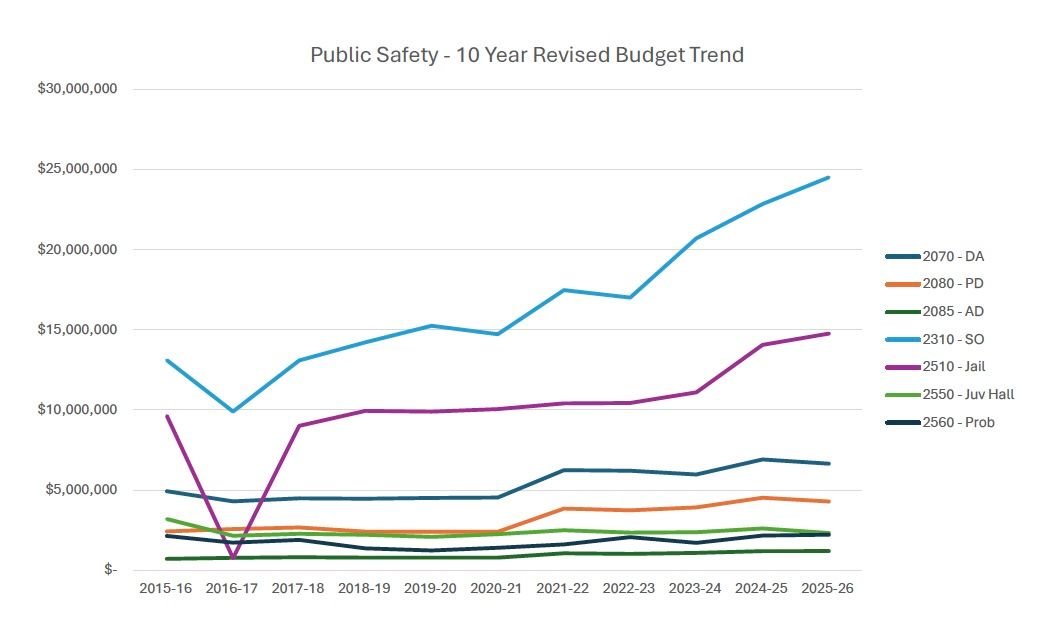
Mendocino County is facing a deepening structural deficit, with projected expenses continuing to outpace revenues through at least 2030, according to a recent mid-year budget review and preliminary forecasts for fiscal year 2026–27.
County officials warned that while this year’s books may technically balance, that balance depends on one-time revenue, optimistic assumptions and ongoing deferral of long-term obligations — particularly road maintenance and capital improvements.
Mendocino County has operated under a structural deficit for many years,” County CEO Darcie Antle said, addressing the board of supervisors on Tuesday. “Long-term sustainability will require a deliberate and disciplined reset of county finances.”
A $4.5–$5 Million Starting Hole
Looking ahead to 2026–27, the executive office estimates the county will begin the budget cycle with a deficit between $4.5 million and $5 million — before factoring in any new departmental requests.
Salary and benefit costs alone are projected to climb from $90.9 million this year to roughly $93.5 million next year, an increase of $2.5 to $2.6 million. That figure includes:
- Step increases and new retirement rates
- A projected 10% increase in health plan costs
- $1.8 million for new jail staffing
- The cost of adding a newly elected position
Notably, the projection does not include potential cost-of-living adjustments (COLAs), meaning the final number could climb higher.
Operating expenses are also trending upward. The county anticipates nearly $2 million in additional ongoing costs next year, including:
- A $19,000 to $20,000 increase in the CalFire dispatch contract
- An estimated $500,000 increase in CMSP/indigent care costs
- A 7% factor applied to utilities
- A 10% projected increase in jail medical services
While average revenue growth is estimated at approximately 4.8%, the current budget model assumes only a 3% annual growth in expenses — a figure Supervisor Ted Williams called unrealistic. He asked the staff to come back with best estimates for inflation.
Public Safety Drives Spending Growth
Over the past several decades, spending on the Sheriff’s Office and jail has grown far faster than property tax revenue, which makes up the bulk of the county’s discretionary income.
During the meeting, supervisors reviewed historical charts showing jail and sheriff spending rising steeply since Proposition 13 limited property tax growth in 1978, while road funding steadily declined.
“We’ve defunded roads in our county pretty much on a consistent path since 1978,” Williams said.
The District Attorney’s Office is currently projected to exceed its budget by approximately $1.25 million this year. Supervisors acknowledged that reductions tied to a decrease in collection of the sales tax that helps fund the office, combined with salary increases under existing labor agreements, have compounded the problem.
The Sheriff’s Office is seeking outside funding sources to offset future jail staffing costs, including negotiations with the Department of State Hospitals and the Community Corrections Partnership. Without outside support, those costs would fall directly on the General Fund.
A $14 Million Reserve — Well Below Recommended Levels
The county’s General Fund reserve currently stands at approximately $14 million.
That figure falls significantly short of state audit and Government Finance Officers Association recommendations, which suggest unrestricted reserves between $25 million and $40 million for a county of Mendocino’s size.
County officials acknowledged that relying on one-time windfalls to balance budgets creates risk. This year, an unexpected $2.8 million infusion — largely from a change in the accounting period and additional property tax revenue — helped close the gap.
But supervisors cautioned that the county should not assume similar surprises in the future.
“If we didn’t have that, we’d be creating more of a structural mess,” Supervisor John Haschak noted.
Deferred Maintenance: The Hidden Deficit
Perhaps the most sobering discussion centered on deferred maintenance.
Supervisors acknowledged that “balanced” budgets often come at the expense of long-term infrastructure needs. Road maintenance has been chronically underfunded for decades. At least $8 million in deferred capital facility maintenance has been identified, and the total need for roads and county facilities may reach into the hundreds of millions.
“We say we have a balanced budget because we can make payroll,” Williams said. “But we’re hiding the discrepancy somewhere. We’re waiting for the crisis.”
The board recently allocated $1 million toward road work, though debate continues over whether those funds should support the county’s 20-year rehabilitation plan or be used for smaller, more geographically dispersed repairs.
Revenue Options on the Table
Staff presented preliminary estimates for a potential half-cent sales tax measure:
- Approximately $9.6 million annually if countywide
- Approximately $3.8 million if limited to unincorporated areas
Any countywide tax would require lifting sales tax caps in two cities that are already at the state maximum.
Supervisors emphasized that no decision has been made, but acknowledged that new revenue may be necessary if the county hopes to stabilize finances without further cutting services.
Structural Gap Through 2030
Even under conservative growth assumptions, projections show expenses outpacing revenue through at least 2030.
Board members directed staff to return with department-by-department growth projections using three- to five-year historical averages, rather than applying a flat 3% inflator across all costs. The goal, they said, is to create a more realistic model of the county’s financial trajectory.
For now, the message from the dais was clear: The structural deficit is widening and without new revenue, significant spending restraint, or both, the gap between what the county promises and what it can sustainably afford will continue to grow.
Read our recent county budget coverage:
Mendocino County Faces Worsening Statewide Liability Climate, but Limited Local Data Show a Mixed Picture (January 14, 2026)
Fewer Homicides, Harder Math for Mendocino County Public Safety (January 14, 2026)
State Audit of Mendocino County Finds Strained Finances and Fraying Systems (December 18, 2025)