
The Mendocino County Board of Supervisors has unanimously approved a major restructuring of its reserves and a rewrite of its reserve policy aimed at simplifying implementation of the policy and strengthening the county’s financial position.
Financial advisor Ben Rosenfield presented the proposed changes to the Board of Supervisors last week. The overhaul responds directly to criticism from the California State Auditor, whose recent report described the county’s reserve policy as obsolete and inadequate.
“Mendocino’s reserve policy is outdated and is not effective for guiding the county in its future consideration of how much to keep in reserve for unexpected circumstances,” the report found.
Rosenfield echoed that assessment, telling supervisors the policy suffers from “critical weaknesses.”
“The targets that are established in that reserve policy are well below recommended industry standards and those of peer counties,” he said. “This leaves the county severely exposed to negative shocks. We don’t know when those shocks will occur or what they will look like, but we know they will occur.”
Shocks could include recessions, natural disasters, or other emergencies. Some may be short-term disruptions affecting a single fiscal year, while others could take years to resolve.
Rosenfield also pointed to the current policy’s “administrative complexity,” saying it makes implementation difficult for the CEO’s office, the Auditor-Controller, and other staff.
“It also makes it very hard for the public to understand what the county’s current reserve position even is,” he said, “and what that means for the county’s finances.”
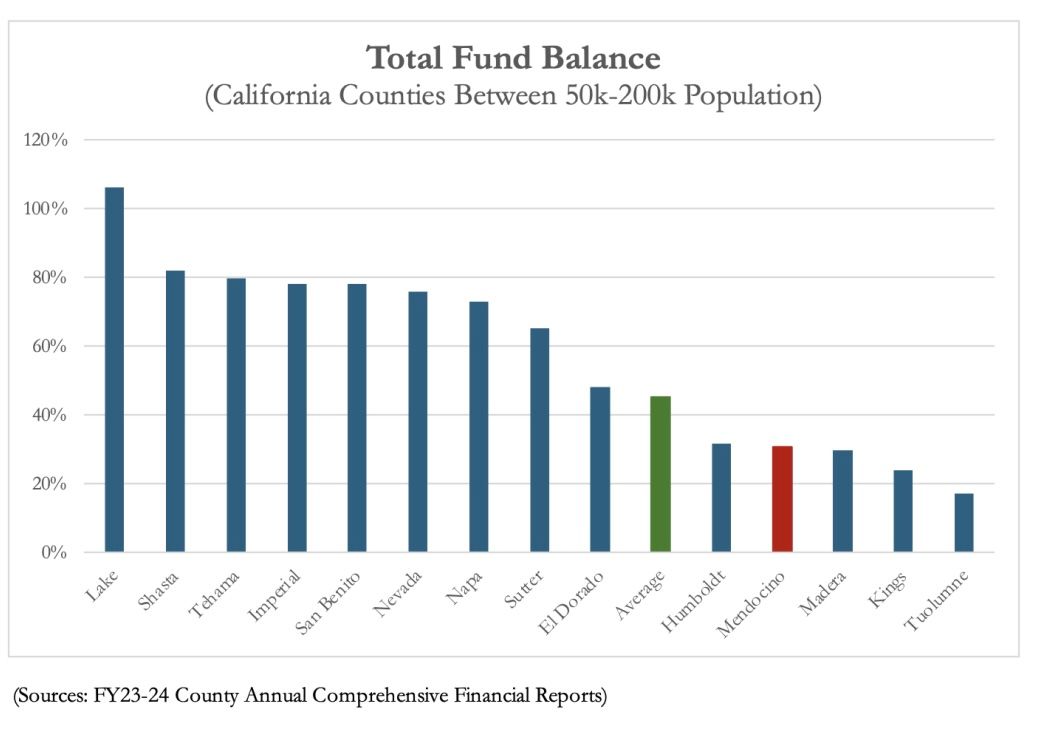
By one measure, the county lags behind its peers. Mendocino’s total fund balance ranks 10th out of 14 comparable counties and is roughly 30 percent below the average, an indicator of a relatively weak financial position.
The county’s reserve targets are also less than half the level recommended by the Government Finance Officers Association, which advises maintaining at least two months of operating expenditures in reserve. Current reserves fall short even of the county’s own existing targets.
To address these issues, Rosenfield proposed dividing reserves into three categories, each designed to manage a different type of financial risk:
Contingency Reserve
A short-term reserve to manage mid-year budget disruptions and prevent sudden service cuts. The recommended target is 5 percent of general fund expenditures. The Auditor-Controller would maintain the fund, with quarterly reporting from the CEO.
Rainy Day Emergency Reserve
A longer-term reserve intended to absorb the impacts of recessions, natural disasters, and other major events. It would grow during strong economic periods, receiving 50 percent of better-than-expected year-end balances when those existed. The fund would have no minimum balance — allowing it to be fully drawn down in emergencies — and a target of up to 15 percent during strong fiscal periods.
That target is calibrated to cover about half the revenue losses seen in a moderate recession, rather than a severe downturn like the 2008 financial crisis, which would require significantly higher reserves.
The Auditor-Controller would maintain the fund, with quarterly reporting from the CEO.
Infrastructure and Systems Reserve
This reserve would address deferred maintenance and long-term capital needs. The remaining 50 percent of year-end surpluses would flow into this fund. Unlike the rainy day reserve, these funds would be appropriated in the following year’s budget for priority projects, creating a more consistent funding stream for infrastructure and systems needs. The reserve is intended to replace the county’s current Policy 33.
Rosenfield said the restructuring would not require setting aside new money immediately. Instead, existing reserves would be reallocated.
Under the proposal, $8 million from current general reserves would be directed into the contingency reserve. The remaining $6 million would be split evenly between the infrastructure and systems reserve and the rainy day emergency reserve.
The CEO’s office has also recommended transferring a portion of the remaining 2024–25 fund balance into the infrastructure and systems reserve for use in the following fiscal year. The goal is to fully fund the contingency reserve while allowing the rainy day reserve to build gradually over time.
Supervisor Bernie Norvell asked a clarifying question about a reserve currently maintained under the now defunct Policy 33. Supervisor Madeline Cline expressed surprise that Lake County’s total fund balance, which ranked number one, was so much higher than that of Mendocino County. Supervisor John Haschak expressed support for the recommendations.
There was no public comment.