
State Toxics Regulators Send Railway's Mill Site Cleanup Plan Back for Revisions
State toxics regulators have told Mendocino Railway to rewrite its cleanup plan for the mill site's contaminated ponds, and to stop calling the fence around the largest pond effective until it is replaced.
FORT BRAGG, Calif. — State toxics regulators have told Mendocino Railway that its proposed plan for the contaminated ponds on the former Georgia-Pacific mill site needs to be rewritten, with new data, new engineering, and a written response to every one of roughly 50 comments. They told the company to stop describing the fence around the largest pond as effective until it is replaced.
The Department of Toxic Substances Control (DTSC) laid out its concerns in an 18-page letter dated Aug. 19 to a consultant for Mendocino Railway and Sierra Northern Railway. The letter responds to a draft "Feasibility Study Addendum" prepared for the railway by the firm Kennedy Jenks in April 2025, which weighs options for cleaning up dioxin-contaminated sediment in Pond 6, Pond 7, Pond 8, and the North Pond. The railway owns the site, having acquired it from Georgia-Pacific in 2021.
DTSC gave the railway 90 days from receipt of the letter to submit a revised addendum and a table responding to each comment. The letter was sent by email on Aug. 19, which puts the deadline at Nov. 17. DTSC also wrote that the railway's draft remedial action plan "is incomplete and will not be finalized," and that a new draft plan will follow the final addendum. No plan for the ponds has been approved.

The railway's draft also includes statements suggesting that stormwater from the city of Fort Bragg contributes dioxin to Pond 8. DTSC told the railway to strike the last three sentences of that passage, writing that the assertions "are not substantiated in the FS Addendum" and that "source attribution is outside the scope of the Feasibility Study."
The question of who is responsible for the contamination is separate from DTSC's review and is being litigated. Mendocino Railway and Sierra Northern Railway sued the city in federal court in 2024, alleging the city's stormwater contributed to the contamination in Pond 8, and pleaded that cleanup could cost $10 million to $50 million. The city denies responsibility. The case is set for trial in October 2028. DTSC's letters are regulatory actions, not rulings in that case.
DTSC has addressed the stormwater question once before, in a different context. In a Nov. 4, 2024 letter, the agency declined the railway's 2023 request to add the city as a party to the site's cleanup order, writing that the information presented was "insufficient to name the city as the source of the dioxin-furan contamination" and did not "warrant adding the city as a respondent to the Order at this time."
DTSC wrote that the railway's stormwater sampling, three events in 2011 and 2013, "merely names the city stormwater as a pathway" and lacked the context of Georgia-Pacific's historical operations, including boilers, conical burners, and open burning that the agency said released dioxins that "dispersed across the city." The city cited the letter in its October 2025 answer to the railways' complaint, asserting that DTSC had found insufficient evidence to name it as a source of the contamination; the railways' claims are unchanged in the pending case.
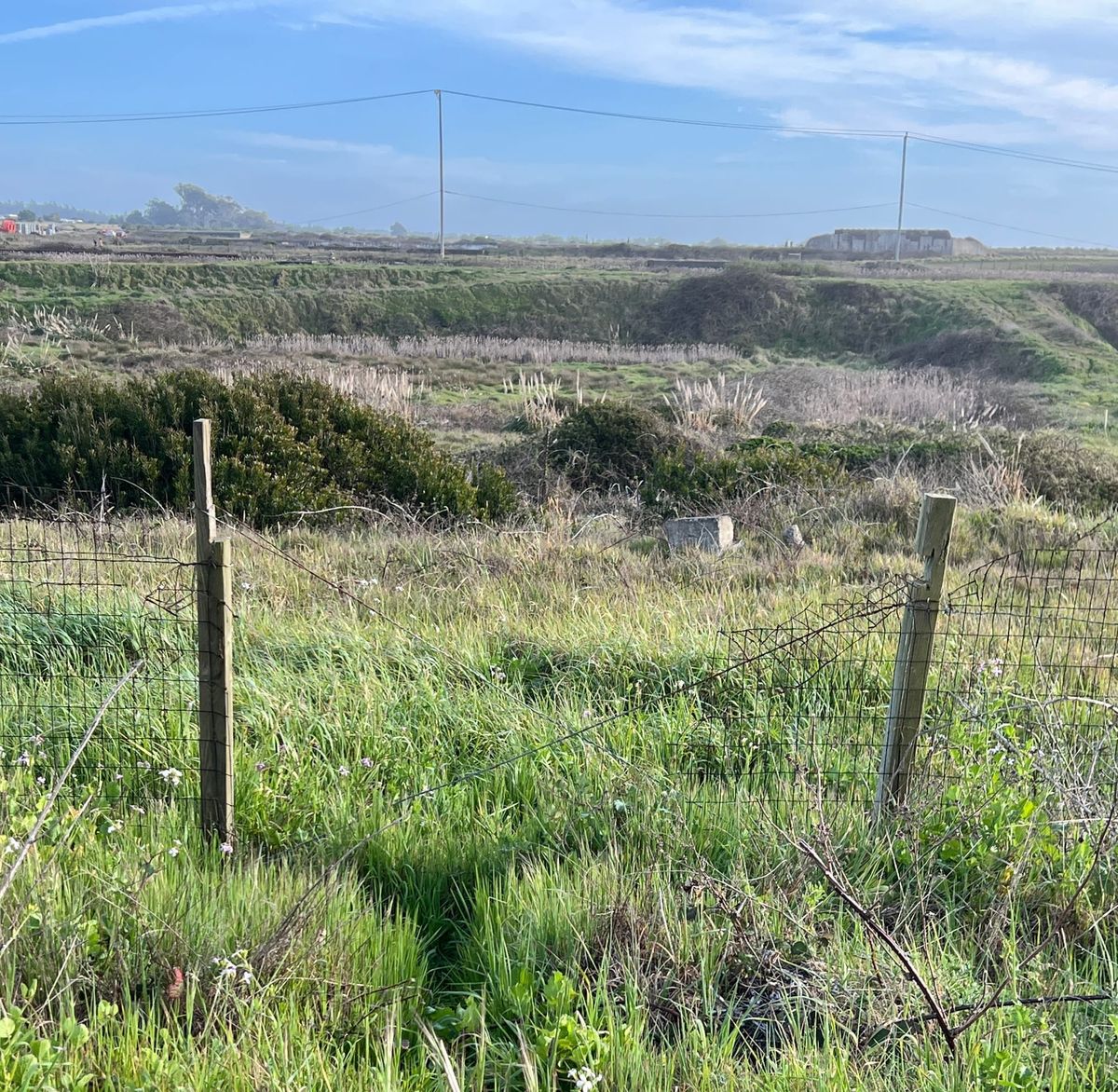
The letter's most concrete instruction concerns Pond 8. The railway's draft said access to the ponds is restricted by fencing and posted warnings. DTSC wrote that "based on photographs provided by members of the public, access restrictions have been intermittent because the fence surrounding Pond 8 is primitive, and frequently breached or in need of maintenance."
DTSC directed the railway to delete claims that Pond 8 is effectively restricted "until the fence is replaced" to comply with a 2022 amendment to the site's cleanup order, which states that "Fencing is required around Pond 8." The agency said it "will follow up with Mendocino Railway separately to ensure that the Pond 8 fencing effectively controls access and withstands the elements."
The railway's draft said the contamination in the sediment does not present significant risk to people under current conditions. DTSC wrote that this "does not accurately represent DTSC's risk management decision," and asked the railway to remove the language, state the actual risk estimates, and refer readers to the agency's 2015 risk assessment.
The agency's own toxicologists added a caution about that assessment: its cancer-risk and hazard figures are "now outdated due to updated toxicity criteria and default exposure factors." They wrote that the cleanup goal of 53 picograms per gram of dioxin remains protective, but that the estimated exposure concentrations of dioxin or arsenic in all four areas exceed the cleanup goals, and asked the railway to demonstrate how its recommended remedies protect human health anyway.
At Pond 7, where sediment was dug out in 2017 and covered with three feet of clean fill, the railway's draft describes the excavation as covering the pond's entire footprint. DTSC noted that the draft elsewhere says further digging "was not feasible," and that dioxin remains at 93 to 350 picograms per gram. DTSC asked the railway to clarify the conflict and state the risk that remains.
DTSC wrote that it is "unclear whether the alternatives meet California Coastal Commission law and the City of Fort Bragg's Local Coastal Plan" and asked for letters from the Coastal Commission, the city and the state Division of Safety of Dams confirming that the alternatives meet their requirements. It told the railway to evaluate sea level rise now rather than during design, and to keep open the possibility of someday restoring Alder and Maple creeks to the surface.
The agency asked the railway to keep on the table an option it had dismissed, an on-site lined cell to hold excavated sediment, noting that the city said in a Nov. 7, 2025 letter that such a cell could be permissible. It wrote that excavated material should be assumed hazardous for disposal purposes "unless there is positive evidence" otherwise, and that the drawbacks of leaving some sediment behind "are likely outweighed by the significant volume reduction obtained via excavation and offsite disposal."
The letter also says the railway's preferred approach for Pond 8, labeled "Institutional Controls," is "more than just institutional controls." It includes dam repairs, an earth-fill buttress, and a wall through the middle of the pond to divide it in two.
The Noyo Headlands Working Group, part of the GrassRoots Institute, published the letter Sept. 29 with a press release saying DTSC "rejected" the railway's proposal as written. The group had submitted its own 10-page comment letter, with supporting appendices, on the addendum in October 2025, with photographs of damaged fencing dated Aug. 2 and Sept. 5, 2025.
The railway's "assessment is fundamentally incomplete" and "the conclusions weren't supported," the group said in response to questions, calling DTSC's letter "a great opportunity" and saying the agency's response to community concerns "is significant." The group said it wants to see "actual data based engineering and actual solutions" that address sea level rise and community needs, and "an actual good faith effort on the part of the property owner."
The group said several of DTSC's directives track its own October 2025 comments: the condition of the Pond 8 fencing "as documented by community photos"; the railway's reliance on natural attenuation, for which the group says it wants "a science based estimate of how long that would take"; evaluating "every alternative" for sea level rise; and revised estimates of risk "given current standards."
The group said it would rather see the railway meet the 90-day deadline "than obtaining extensions," and invited the public to join it in monitoring the site, including the fence, and in analyzing the railway's revisions as they are produced.
Mendocino Railway's president, Robert Pinoli, declined to detail how the railway will respond to DTSC's comments, saying in an Oct. 3 email that "our dialogue with DTSC will occur as it has in the past, directly," and that its formal responses "will become part of the public record through the normal regulatory process." He characterized the review as "a routine and expected back-and-forth between an agency and an applicant," adding, "DTSC asks questions; we answer them. There is nothing unusual or concerning about it." Pinoli said it was "disappointing to see members of the press and public trying to manufacture 'news'" out of the exchange.
The City of Fort Bragg declined to comment.
Georgia-Pacific, which sold the site to the railway in 2021 and is copied on DTSC's letter, did not respond to a request for comment. The company declined to comment in August on separate questions about the city's 2014 letter.