
Ukiah Planning Commission Won't Back Annexation Plan
After more than three hours of testimony from a standing-room crowd, the Ukiah Planning Commission voted 4-1 on Aug. 26 to recommend that the City Council deny the pre-zoning that underpins the "Ukiah 2026 Reorganization."
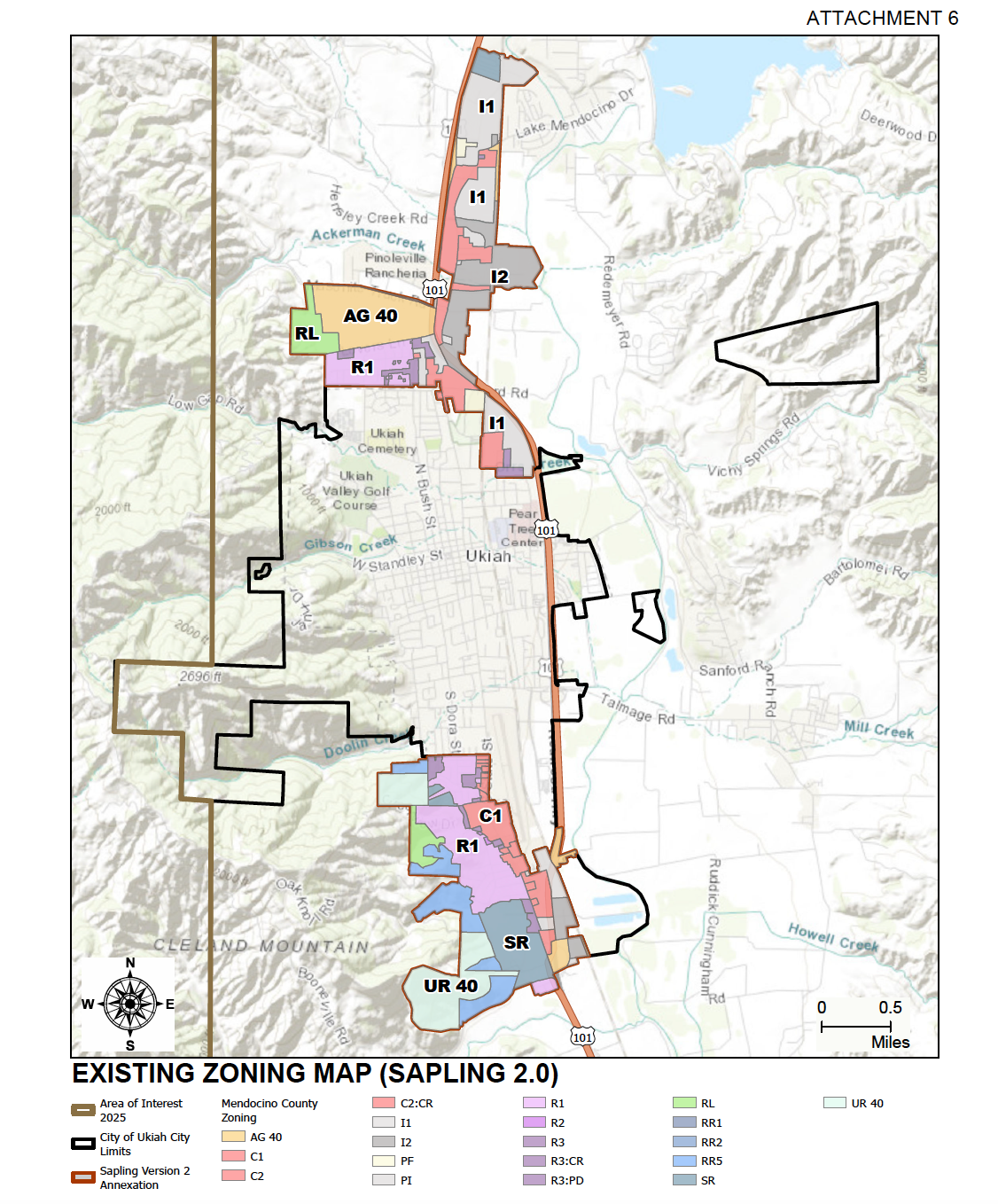
City staff framed the vote as a routine procedural step. The public, and ultimately the Planning Commission, treated it as a referendum on annexation itself.
After more than three hours of testimony from a standing-room crowd, the Ukiah Planning Commission voted 4-1 on Aug. 26 to recommend that the City Council deny the pre-zoning that underpins the "Ukiah 2026 Reorganization" — the city's plan to annex roughly 1,485 parcels north and south of the current city limits — and send staff back to redraw the map.
The commission's vote is only a recommendation. The City Council can still move the project forward, and any annexation would ultimately be decided by the Mendocino Local Agency Formation Commission, or LAFCO. But the commissioners used the vote to send an unmistakable signal that they were not prepared to endorse the plan as drawn.
Following the vote, the No Ukiah Annexation group put out a call on for volunteers to join them putting up door hangers on Thursday, August 27 (today). They are meeting at 5:15 p.m. at Factory Pipe on 1307 Masonite Road.
Chief Planning Manager Jesse Davis told the commission the request before it was narrow: pre-zoning assigns zoning designations to parcels outside city limits and takes effect only if annexation is later approved. Rather than apply city zoning, staff proposed keeping the county's existing inland zoning designations on annexed land, an approach Davis said would prevent properties from becoming nonconforming and would answer a recurring public complaint that "the city is changing my zoning." Of the 1,485 parcels identified, 88 carry mixed-use designations from the Ukiah Valley Area Plan, a county planning document the resolution would also fold into the city's General Plan.
More than 20 people spoke during two rounds of public comment, all but a few urging the commission to reject the plan.
Their concerns spanned money, services, and process. Several residents described sharp increases in water and sanitation bills — one North State Street-area resident said her Ukiah Valley Sanitation District bill jumped from $83 to $205 in a single month — and said they feared annexation would bring further city fees. Business owners warned that the city's gross-receipts business license tax would fall hard on the county's low-margin business. Eileen Russell, speaking for Mendocino Forest Products and Mendocino Redwood Company, asked that the Ukiah Sawmill Complex be removed from the annexation area, saying the proposal would split an integrated industrial operation across two jurisdictions.
Others questioned whether the city could serve a larger footprint when, they said, it struggles to serve the area it has now, citing police response times, road conditions, abandoned vehicles, and homelessness. Property owners of agricultural and rangeland parcels — including land under conservation easements such as the Lovers Lane Vineyard and the Bricarelli Ranch — asked to be excluded. Ross Liberty cited a community poll of about 90 respondents that he said found 76.9% opposed to annexation.
Speakers objected to the process itself: a 715-page staff packet released days before the meeting, the absence of a prior public hearing or workshop, and the LAFCO protest procedure, under which a resident who does not return a protest form is effectively counted as a yes.
When the commission returned to its own deliberations, members were broadly open to annexing the developed neighborhoods that already look and function like the city — but not to this map.
Commissioner Devery Montaño said that if a child were handed a crayon and a map, "I think we can all agree that it would include areas around the high school and areas around Grace Hudson." But she called the proposed boundary "financially motivated" and cited the "Strong Towns" argument that a city should annex only when it is already financially healthy.
Despite Davis's instructions, she said it felt like the planning commission was being asked to approve the whole plan — not just a zoning technicality.
Commissioner Mark Hilliker said the annexation discussion had been "kind of dropped like a bomb" and that the effort felt ahead of where it should be. Vice Chair Rick Johnson, who made the motion to deny, said the process felt "kind of rushed," adding, "I don't see a sense of urgency," and noted that the Ukiah Valley Area Plan was written to manage growth. Today, the county's population is instead shrinking. "There's going to be a reduction in tax revenue and things are going to be squeezed even further," he said.
Chair Alex de Grassi said he did not "really agree with this map either," objecting in particular to the inclusion of rangeland and agricultural parcels, even as he argued the city is better equipped than the county to plan the areas on its edges.
The lone dissenting vote came from Commissioner Jacob Brown, who described himself as "absolutely pro-annexation." Brown said the city had failed to address what he called the "elephant in the room" — the business license cost for large employers — and suggested a grandfathering provision. He argued the commission should approve the procedural step while attaching its objections, so the elected City Council could weigh them, rather than deny the resolution outright.
On the city attorney's advice, the motion was framed as adopting a resolution to deny the recommended pre-zoning. Hilliker, Montaño, Johnson, and de Grassi voted aye; Brown voted no. The motion carried 4-1. The meeting adjourned shortly after 8:30 p.m.