
Six Rural Agencies Move to Form a Joint Powers Agreement to Sustain Ambulance Service
A federal study estimates rural ambulance services lose $1,500 on each transport.
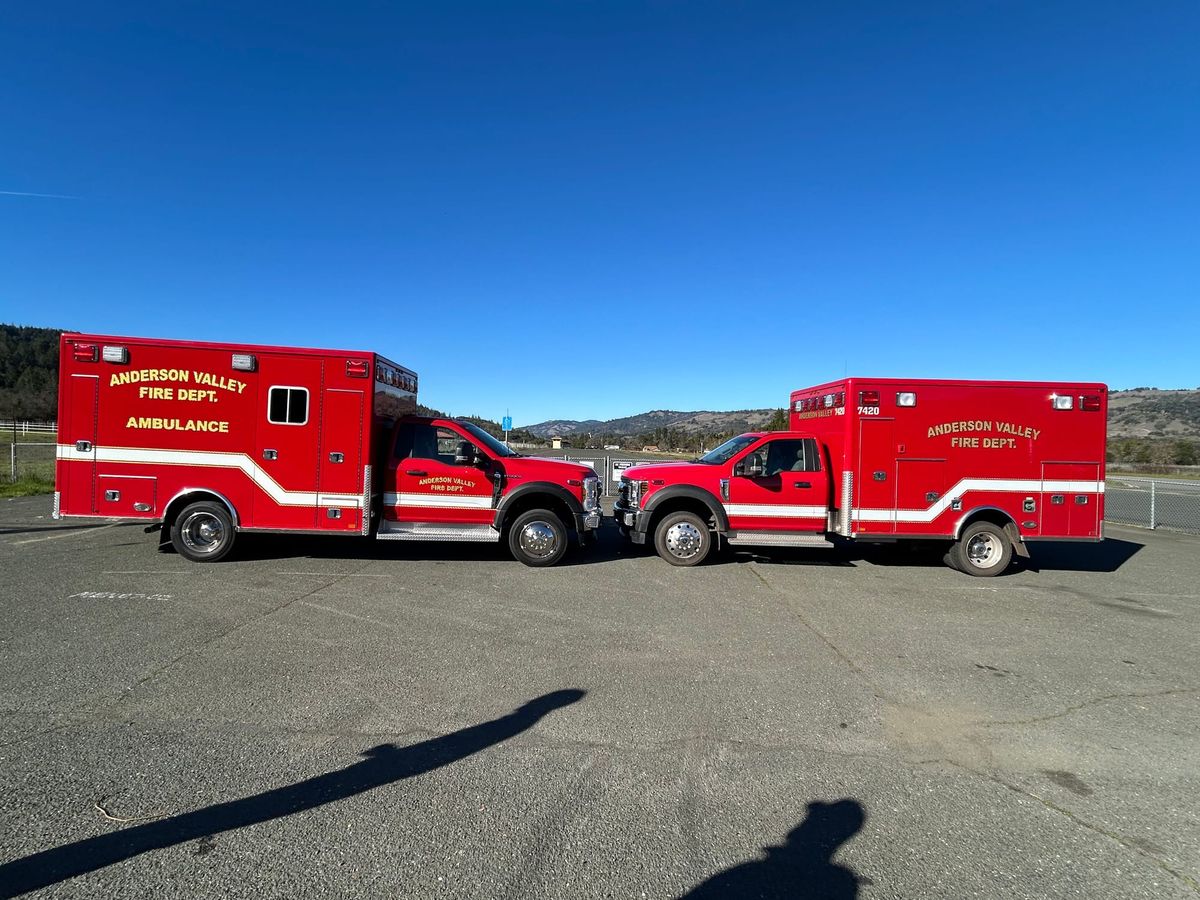
UKIAH, Calif. — Six rural fire and ambulance agencies are forming a joint powers agreement to keep 911 ambulances running in some of Mendocino County's most remote communities, where the cost of staffing and equipping an ambulance is far higher than what billing brings in.
The Mendocino County Board of Supervisors accepted a status update on the effort Tuesday on a unanimous vote and voiced support, though supervisors said the county has little money to offer beyond about $990,000 left from an old PG&E settlement.
The six agencies — Anderson Valley Community Services District, Coast Life Support District, Covelo Fire Protection District, Elk Community Services District, Long Valley Fire Protection District, and Ukiah Valley Fire Authority — together handle about 30% of the county's 911 emergency ambulance calls, often over long distances in areas with few residents.
The agencies told the board that an ambulance costs about the same to keep ready whether it runs one call a day or 10, and that rural agencies spread those fixed costs over fewer transports. A federal study puts the average rural public ambulance transport at about $2,800 to provide and about $1,300 in revenue — a shortfall of roughly $1,500 a trip.
Most patients are on Medicare or Medi-Cal, which pay at the low end, so the agencies have little control over what they collect. For the Coast Life Support District, billing covers only about a third of operating costs; the rest comes from the community.
The agencies have met regularly since December, secured letters of support from their boards, and written a draft agreement that is now under review, the presenters said. The agreement would not take over any agency's staff, budget, equipment, or daily operations — those stay with each local board — and it would follow the accountability rules in state Government Code section 6505. Early priorities include a shared medical director, joint purchasing, training and EMT recruitment, and joint grant applications. The next step is for each agency's board to approve the agreement and formally establish the partnership.
The presenters said they would ask county Public Health to take part and hoped money the county had set aside for joint-powers work would stay available. They said they were not asking the county for funding, only for support.
Supervisor Ted Williams (D5) said he did not see how the county could avoid supporting the effort, but pointed to the funding gap the presenters had described. "In a post-Prop 13 world, I think we get the services we pay for," he said, and urged the agencies to poll residents on what they would pay for ambulance service. Williams said the effort was more likely to win voter support because it had been kept separate from county government. "The county being in tight collaboration is probably the kiss of death for any funding ask," he said. He moved to
accept the presentation.
Supervisor John Haschak (D3), who seconded the motion, said working together was "a key to solvency" for the agencies but would not fix a revenue problem driven by low Medicare reimbursement and federal cuts under HR 1. He said he supported using the leftover PG&E money,
and that the county's legislative platform would call for more state and federal funding.
Supervisor Mo Mulheren (D2) called the effort "a great example of the county getting out of the way," and Supervisor Madeline Cline (D1) asked whether another rural county had tried the same approach.
Asked how much of the PG&E money remained, Chief Executive Officer Sara Pierce said about $990,000 of the amount set aside for the joint-powers work was still available.
In public comment, Dee Pallesen, of the 5th District, said every rural parcel should pay into the EMS system, noting that an ambulance responds to a 911 call even from a parcel, like Pallesen's, that pays into no fire district. "We should all be paying our fair share," Pallesen said. Bronwyn Golly, the EMS chief of the Coast Life Support District, said that with federal and state help unlikely, "working together is going to be the best answer that we have."
Clay Eubank, a battalion chief with Anderson Valley Fire, said the Anderson Valley Community Services District is "100% behind this partnership."