
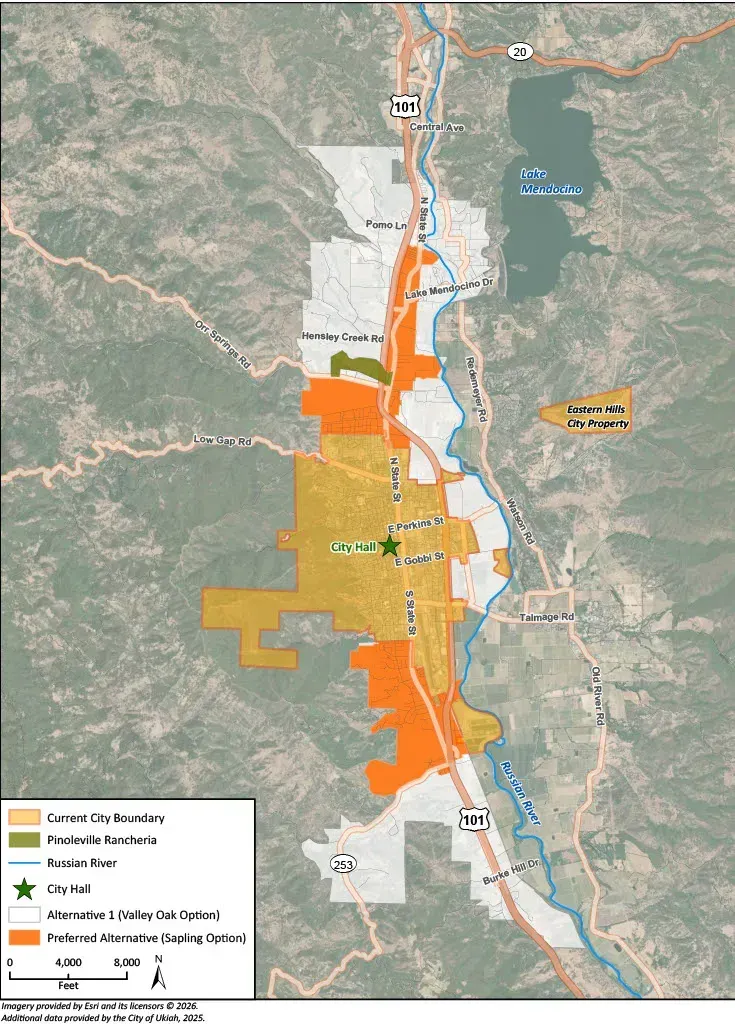
Several years ago, Mendocino County supervisors, elected officials and staff from the county and its four cities got together to figure out how the different jurisdictions could grow together. The biggest and most difficult issue was money: How would the county divvy up tax dollars with expanding cities?
Money was tight throughout Mendocino County. The conversations were difficult. Still, people talked through their differences and came up with a dryly named bureaucratic document: the Master Tax Sharing Agreement, which the board of supervisors signed in 2024.
Today, that agreement is in jeopardy. On Tuesday, supervisors discussed withdrawing from the agreement for the second time in two years. Ultimately, they voted 4-1 to give the city of Ukiah another chance — but it’s not clear the decision represented the will of their constituents.
Supervisor Bernie Norvell, who represents District 4 and the northern coast, cast the sole dissenting vote. In his comments, he described how his position had changed. When the issue of terminating the agreement was raised in 2025, he had opposed it.
“Supervisor Cline and I asked for an opportunity to meet and confer with the city of Ukiah, go through the process for one year,” he recalled.
He said he was voting no because the discussions around the proposed Ukiah annexation made it clear that the county has no leverage — not just vis-à-vis Ukiah but in any proposed annexation. Withdrawing from the agreement would create a level playing field, he said. The county would be able to represent the interests of county residents if the terms of a proposed annexation were devastating to county finances.
The built-in gotcha
Norvell acknowledged the agreement requires five years’ notice to terminate. He said acting immediately allows the city of Ukiah to come up with a final map.
“Then we can actually have something to study and analyze,” he said. Ukiah’s current position — that the map proposed in April is interim — renders further discussions meaningless.
“The city of Ukiah has been very clear on this,” Norvell said. “Everything is a draft.”
At the same time, he said Ukiah officials have been “adamant” that the current map is the smallest one they can accept.
Norvell, who is a member of an ad hoc committee that has been meeting with the city, said he is not opposed to productive discussions once there is a final proposal.
“We can sit in a joint meeting with the city of Ukiah and speculate until we all run out of breath, but we’re not going to accomplish anything until we know exactly what they are going to propose.”
But other supervisors expressed concern that terminating the agreement would ensure that the proposed map — with its harmful impacts — would precipitate annexation.
“I think it would force the city to complete the process within five years,” said Supervisor Ted Williams, who represents the southern coast and Anderson Valley. “Because they want these terms. I don’t know if we’re going to get as good an annexation if we try to rush it rather than if we try to work together.”
Williams advocated for the solution ultimately accepted by the board — finding a consultant to help guide the city and county through negotiations.
“Maybe it doesn’t go anywhere good, but at least there’s a chance and we’re doing it from the start,” he said.
The lack of trust
Williams’ proposal directly addresses a lack of trust and transparency widely noted by elected officials and by residents who would become city of Ukiah residents if the annexation proceeds as proposed.
Supervisor Madeline Cline, who joined Norvell last year in asking for a chance to meet with Ukiah officials and discuss annexation, said those conversations had not been productive.
“We have tried really hard,” she said. “I’m not confident that this tax-sharing agreement lays out a process that will ever be productive.”
Auditor-Controller Chamise Cubbison noted the lack of information from the city regarding special districts.
“We have asked the city to tell us what the plans are for the remaining districts that are in that annexation area, and no information has been forthcoming in terms of whether they will exist, whether they will be dissolved, whether they will be absorbed, whether they will become city-area districts.”
That lack of information has made it harder for county staff to evaluate the full impact of the proposed annexation.
Theresa McNerlin, a member of the board of the Ukiah Valley Sanitation District, stated flatly: “Nobody here really trusts the city, especially myself, because of those answers, because they don’t give you full answers.”
She highlighted two specific examples:
- The SAFER grant and sheriff’s deputies. She said the city manager stood before the board and failed to give transparent answers to direct questions about those topics.
- The Ukiah Valley Sanitation District lawsuit. She recalled working with the sanitation district five to 10 years ago when officials discovered financial discrepancies and asked the city to reconcile them. According to McNerlin, the city replied, “Yeah, there are some discrepancies, but you’re never going to get that money from us,” forcing the district into a difficult five-year lawsuit to recover the funds. She noted that “the same players [are] sitting here today.”
Dan Edwards, a District 1 resident, said, “I don’t trust the city of Ukiah.”
He cited the historical example of when Masonite closed and a company wanted to build a Costco on the property. He said the city launched what he described as an “evil” campaign claiming Costco would ruin mom-and-pop businesses, successfully killed the county project, and then immediately purchased adjacent land to bring Costco into the city limits so the city could collect the tax revenue instead of the county.
A supervisor who supports annexation
Supervisor Mo Mulheren, who represents Ukiah, described her own frustration with the county’s analysis of annexation.
“I already stated, I don’t think that it was transparent,” she said. “I don’t think it was honest about what it actually is going to look like and I don’t think that the county’s going to do anything different in that regard.”
In a memo to her colleagues, Mulheren argued the analysis focuses heavily on projected revenue transfers while giving insufficient weight to future economic growth, housing development, increased assessed property values and other tax revenues that could result from annexation. She contended that a complete analysis should consider both costs and potential long-term revenue gains, as well as opportunities for housing and economic development that could be facilitated by city infrastructure and services.
Mulheren also argued that the Local Agency Formation Commission process should be allowed to continue. She said the Master Tax Sharing Agreement was negotiated over several years by the county and its incorporated cities to provide a predictable framework for future annexations. Terminating the agreement before the current proposal receives a full public review, she said, would undermine the process established to evaluate questions about governance, infrastructure, public safety, housing and service delivery.
Supervisor John Haschak said he agreed with Mulheren and many of the points she raised in her memo.
“We do need to be thinking about how we are going to move this county forward,” he said. “Just saying no to this plan from the city of Ukiah is not going to help us.”
Haschak moved the motion to table the question of terminating the tax-sharing agreement and to hold a joint meeting with the City of Ukiah, with an independent consultant reviewing the proposed annexation’s fiscal impacts to the county. The vote was taken and the motion carried with Norvell dissenting.