
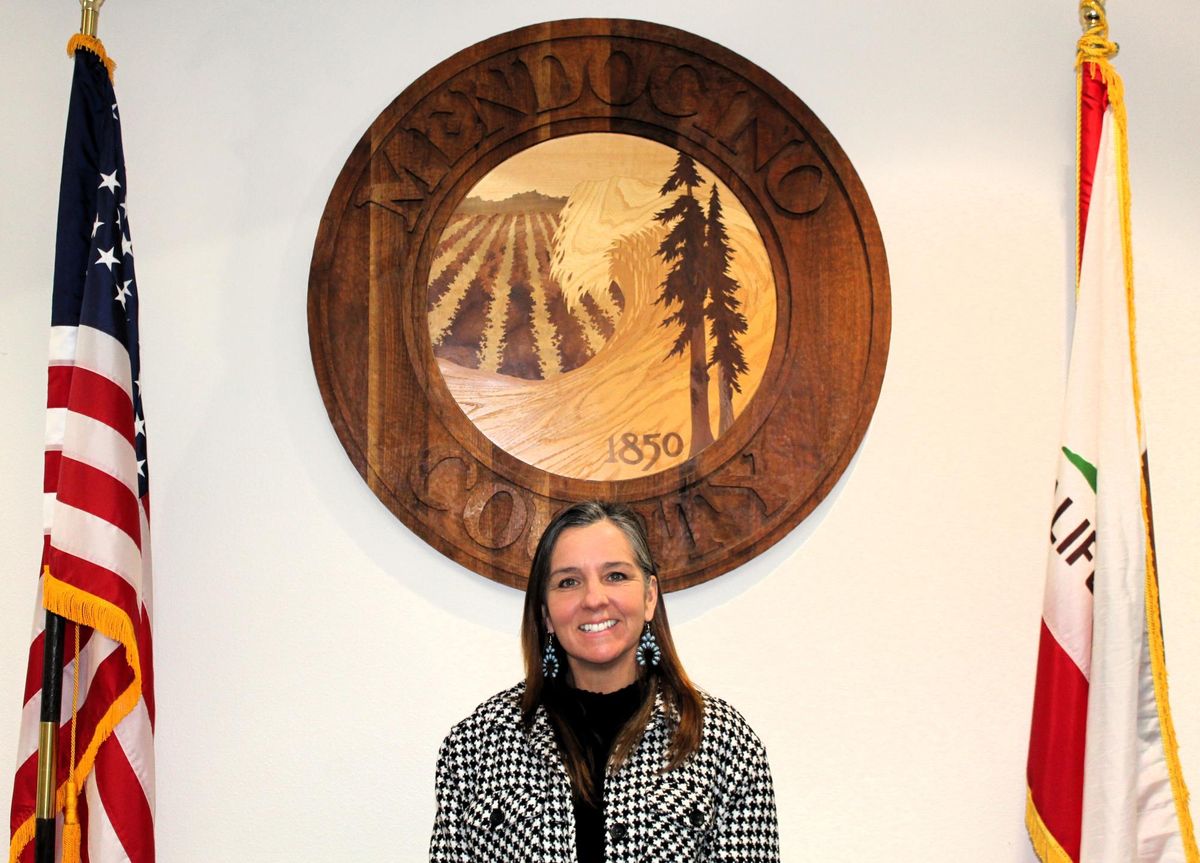
Supervisor Mo Mulheren sent this letter to the board of supervisors early on June 23, 2026 to express her thoughts on annexation. We’re printing the letter in full.
Over the last several months, we have heard a lot about what the County may lose if the proposed Ukiah annexation moves forward. What I have not heard nearly enough about is what the County stands to gain. The Master Tax Sharing Agreement was not created overnight. It was negotiated over several years by representatives of the County and all four incorporated cities and approved by their elected officials. The purpose was simple: create a predictable framework for future annexations rather than starting from scratch every time a proposal comes forward. Now that we have the first major annexation proposal under that agreement, some are suggesting we terminate the entire framework before the public process has even been completed. I do not believe that is the right approach.
The annexation proposal remains under review through the LAFCO process. Questions about roads, public safety, water, finances, governance, housing, and service delivery are exactly the issues LAFCO is designed to evaluate. Ending the MTSA now prevents those questions from being fully answered and short-circuits the process that was specifically designed to address them. The question before us is not whether every concern has been answered today. The question is whether we should allow the public process to continue and let the proposal be fully evaluated. I believe we should.
The County’s presentation focuses heavily on projected revenue transfers over a sixteen-year period. That is an important part of the conversation, but it is not the whole conversation. The County’s own budget documents project continued revenue growth based on historical trends. The CEO Budget Team, under the guidance of Ben Rosenfield, recently updated its forecasting methodology to better reflect historical growth patterns and improve accuracy. Yet the annexation analysis largely evaluates revenue transfers without giving similar consideration to future revenue growth, housing development, economic expansion, increased assessed values, or additional taxable sales activity. If we are going to project costs and transfers sixteen years into the future, we should also project revenue growth sixteen years into the future.
Using the County’s own non-departmental revenue projections as a starting point, even modest annual growth rates of 2.5%, 3%, and 4% generate substantial increases in County revenues over the same period being used to evaluate annexation impacts. The County’s analysis projects approximately $34.2 million in cumulative impact over sixteen years. At the same time, the County’s own forecasts show tens of millions of dollars in revenue growth over that same period. A balanced discussion should acknowledge both. I have attached three scenarios: one using the $92 million recently used in budget discussions, one using a $100 million starting point as a modest next-year estimate, and one using $247 million, which reflects the total County General Fund. I have not seen documentation from the Ad Hoc showing how revenue growth was incorporated into the annexation discussion.
There is also a bigger question about how expenses are being compared. If we are using non-departmental revenue as the baseline, are we comparing only the expenses tied to that revenue? Or are we also counting broader County expenses, including roads and the Sheriff’s Office? Right now, the analysis appears to use a narrow revenue base while discussing broader County obligations.
One thing that stood out to me is the focus on Bradley-Burns sales tax. There has been significant discussion about the loss of this revenue, but much less discussion about the other taxes that continue to come to the County through economic activity in the cities. Current allocations show that the City of Ukiah generates almost as much Bradley-Burns sales tax revenue as the entire unincorporated County. That should not surprise anyone. Cities are where people shop, stay in hotels, eat in restaurants, start businesses, and go to work. That is exactly how cities are supposed to function.
The MTSA recognizes that reality while still protecting County revenues through a fifteen-year phase-down period. The agreement does not immediately eliminate County revenue. It provides a gradual transition over a decade and a half. That was intentionally built into the agreement. The MTSA also does not reduce the sales taxes that go directly to the County for Measure O, Measure B, and the 1991 and 2011 realignment dollars that support public safety, mental health, social services, and other County responsibilities.
The County’s presentation also focuses on future property tax allocations but does not fully account for the possibility that annexation itself may increase the overall tax base. The annexation area contains significant opportunities for future housing and economic development. Projects that may be difficult to complete under current conditions could become more feasible with city infrastructure, city utilities, and city planning capacity. The question should not simply be who receives future property tax revenue. The question should also be whether annexation creates new property tax revenue that otherwise may never exist.
Our communities must grow near the urban core if we want to be sustainable. I have raised many times the difficulty of completing the large-scale housing projects our community needs. Our residents need places to live, and we need to attract working professionals such as doctors, college professors, teachers, and public safety employees.
One of the most significant omissions in the County’s analysis is the treatment of roads. The presentation assumes essentially no reduction in road-related obligations. However, County transportation documents identify approximately $15.2 million in programmed road work within the annexation area between fiscal years 2029–30 and 2033–34. In addition, approximately 14.64 miles of roads currently included in the County’s twenty-year road plan would ultimately become the responsibility of the City. There are also approximately 22.3 additional miles of public roads within the annexation area that do not appear in the presentation. Those roads represent real future maintenance obligations that would no longer be the burden of the County.
The County’s own transportation documents indicate that road maintenance remains one of its largest long-term challenges. If annexation transfers these responsibilities to the City, that is a real benefit to County taxpayers because resources can then be redirected to roads elsewhere in unincorporated Mendocino County. The question should not be whether the County loses roads. The question should be whether transferring road obligations creates opportunities to better maintain roads in the remainder of the County.
The County presentation also assumes no reduction in public safety costs. However, calls for service within annexed urban areas would largely shift to the Ukiah Police Department. Areas such as Motel 6 North and Laws Avenue make up a meaningful share of dedicated Central District resources. As those calls shift to UPD, Sheriff’s resources can be redirected toward communities throughout the rest of Mendocino County. This does not eliminate the Sheriff’s responsibilities. It allows resources to be focused where they are needed most.
For years we have discussed staffing challenges and limited law enforcement resources. We should at least acknowledge that reducing urban service demands on the Sheriff’s Office has value.
The County would also continue receiving revenues associated with 1991 Realignment, 2011 Realignment, Public Safety Realignment, and Behavioral Health Realignment. Many of the services cited as concerns in the annexation discussion continue to be supported through these funding streams. A complete fiscal analysis should acknowledge those ongoing revenues.
County residents have repeatedly raised concerns regarding water. However, the County of Mendocino does not operate municipal water systems. The City of Ukiah has significantly greater experience operating water infrastructure and pursuing utility-related grants and improvements. The annexation discussion should recognize that infrastructure investments are often easier to accomplish through entities that already have the necessary systems, staffing, and expertise.
The annexation area presents opportunities for housing, infrastructure investment, and economic growth. Cities generally have greater access to infrastructure funding, utility financing, transportation grants, and housing programs. The current analysis evaluates annexation primarily through the lens of revenue transfers rather than long-term economic opportunity. That approach understates the potential benefits to the entire community. The question is not simply who gets a piece of today’s pie. The question is whether annexation helps create a larger pie in the future.
This discussion is also about governance. Today, large portions of the First and Fifth Supervisorial Districts wrap around the City of Ukiah. Many residents living immediately outside city limits rely on the same businesses, schools, transportation systems, utilities, and services as residents who live inside the city. As urban development continues, it is reasonable to discuss whether governance boundaries should better reflect the realities of how people live and receive services.
The MTSA was negotiated to create certainty. Developers, businesses, residents, cities, and the County all benefit when there is a predictable process for evaluating annexation proposals. Terminating the agreement before the first major proposal completes review sends the opposite message.
For years this Board has discussed the importance of policy consistency and avoiding sudden changes in direction. The MTSA represents years of work by County and City representatives. Ending it now before the public process has run its course raises serious questions about predictability and long-term planning.
LAFCO exists to evaluate proposals like this. Questions regarding service delivery, finances, governance, infrastructure, environmental review, protest proceedings, and public input are exactly what the LAFCO process is designed to address.
The existence of unanswered questions is not evidence that the process should stop. It is evidence that the process should continue.
The County’s presentation raises legitimate issues that deserve thoughtful review. However, it does not tell the entire story. A complete analysis should also consider revenue growth projections, property tax growth, housing opportunities, economic development, road maintenance savings, public safety efficiencies, continued realignment revenues, water and infrastructure benefits, representation and governance, and the phased protections built directly into the MTSA.
The Master Tax Sharing Agreement was developed through years of collaboration between the County and all four incorporated cities and their elected officials and administrations. It was designed specifically to provide a framework for annexation discussions while protecting County interests during the transition. Rather than terminate the agreement now, we should allow the public review process to continue, allow LAFCO to complete its work, hear from the community, and make decisions based on the complete picture.