
Fort Bragg City Council Expresses Support and Skepticism About State Forest Modernization Bill
Councilwoman describes bill as "naive, ill-conceived, redundant, [and] damaging.”
Clarification: We’ve added a paragraph detailing the work Tess Albin-Smith did for CAL FIRE, and we’ve included the fact that supporters of AB 2494 made up the majority of public comment. (April 15, 2026, 9:13 a.m.)
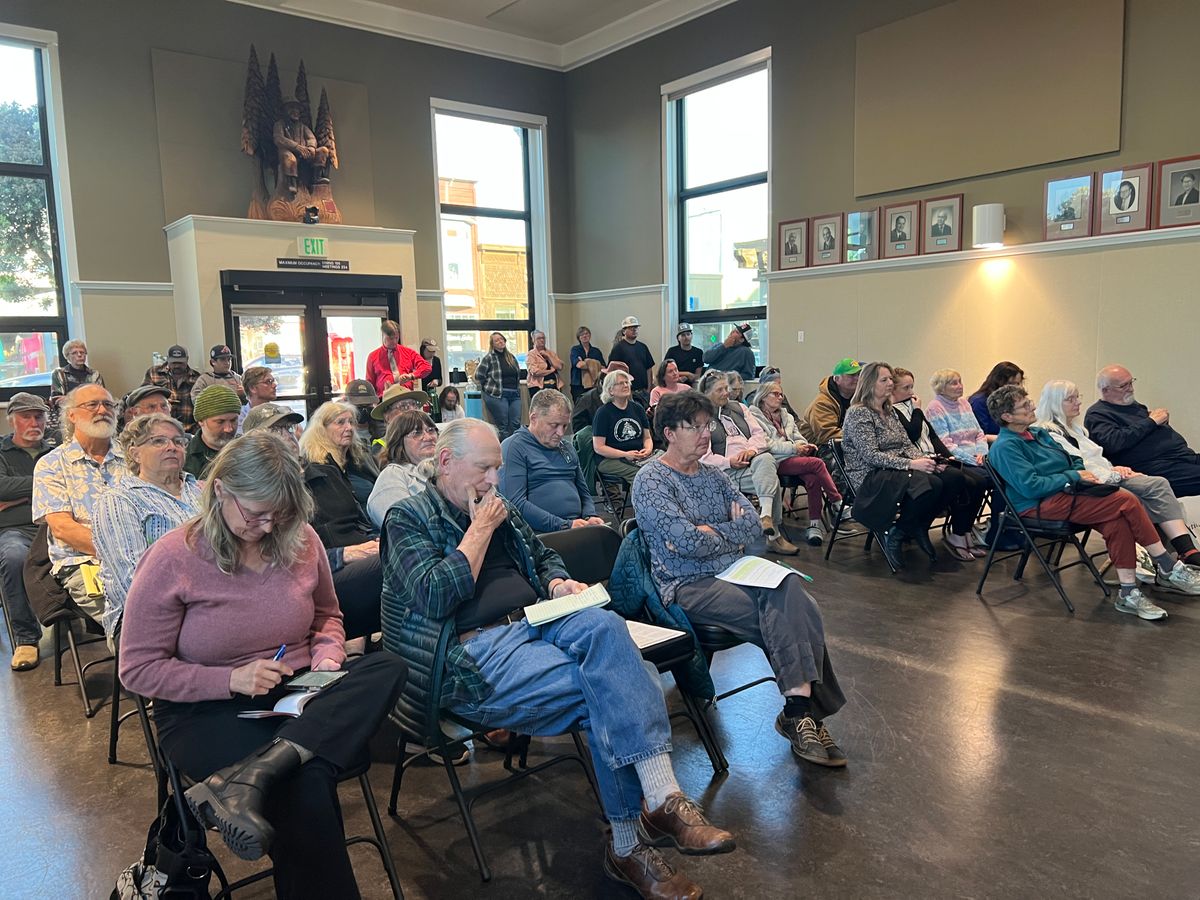
The Fort Bragg City Council narrowly rejected a proposal Monday night to formally support Assembly Bill 2494, a measure designed to modernize management practices within the state’s demonstration forest system.
In a 3–2 vote, the council declined to send a letter of support to the legislature for the bill, which has sparked intense local debate over the future of the 49,000-acre Jackson Demonstration State Forest. Councilmembers Tess Albin-Smith, Scott Hockett, and Vice Mayor Marcia Rafanan voted against the motion, while Mayor Jason Godeke and Councilmember Lindy Peters were in favor.
The Case for Modernization
Councilmember Lindy Peters, who brought the item forward at the request of supporters of the bill, argued that the legislation is necessary to shift the forest’s focus toward what he called the “three Rs”: restoration, research, and recreation. Peters emphasized that the current management framework was established decades ago and fails to address modern challenges such as carbon sequestration and the inclusion of Native American tribes, who were historically left out of forest planning.
“Let’s bring us into the modern age of managing and sustaining our forests,” Peters said, noting the bill would prioritize ecological health over maximum timber yield.
The Case Against NIMBYism
Councilmember Tess Albin-Smith led the opposition, characterizing the bill as “naive, ill-conceived, redundant, [and] damaging.” Contrasting her position on the bill with what she described as her history of staunch support for environmental issues, Albin-Smith argued that the bill’s primary objectives—including tribal co-management and increased environmental sensitivity—are already being addressed in the recently revised Jackson Demonstration State Forest Management Plan.
Albin-Smith, who once worked for CAL FIRE, noted that timber is a renewable resource that, when used for construction, is more environmentally friendly than other building materials. She also pointed out that wood continues to sequester carbon when used in construction, and she criticized people who advocate for the use of wood but oppose timber harvesting in California’s 14 demonstration state forests.
Albin-Smith provided details about her role at CAL FIRE in her comments. She highlighted that she was the first person hired for the California Forest Improvement Program (CFIP), which was funded by timber sale revenues from Jackson State Forest. “We restored something like tens of thousands of uh, land in forest, reforesting, putting fish habitat in, fixing roads so that they weren't damaging fish habitat, doing fire uh mitigation um with private small private land owners.”
“This is a case, in my opinion, of ‘not in my backyard,’” Albin-Smith said. “I want wood. I want to build a house, but I don’t want those trees to come from my backyard.”
She expressed concern that the bill could lead to a loss of timber tax revenue for the county and feared that, if the state determines the forest is no longer intended for timber production, it might eventually be sold. “Don’t mess with a good thing,” she warned.
A Moving Target
A significant point of contention during public comment was the fact that the bill is undergoing constant revision. Opponents, such as resident Jenny Shattuck, pointed out that the bill has been heavily redlined and is no longer what many supporters believe it to be.
“Why would you support something that you don’t know what you’re supporting yet?” Shattuck asked, suggesting the council wait until the final language is settled.
Shattuck also noted that consultation with local interests is not required by the bill. “Does this mean we are going to lose the Jackson Demonstration State Forest Advisory Group?” she asked, referring to a 13-member citizens advisory body that currently works directly with the Department of Forestry and Fire Protection (CAL FIRE) and the Board of Forestry and Fire Protection on forest management policy and implementation.
The current version of the bill states that state policy will seek integration of local Indigenous traditional ecological knowledge in forest management but does not recognize any other sources of local input.
Economic and Safety Concerns
The council heard from several residents who feared the bill would devastate multigenerational logging families. Opponents argued that the timber industry remains a “backbone” of the community and that current management has successfully prevented catastrophic wildfires for decades through byproduct fire reduction.
Conversely, supporters of the bill who made up the majority of people providing public comment, cited an alliance with the Intertribal Sinkyone Wilderness Council, and argued that a “restorative economy” would create more jobs in forestry and tourism while protecting the oldest standing redwoods.
Response from Sacramento
Assemblymember Chris Rogers, the bill’s sponsor, joined the meeting via Zoom to address the council. He clarified that AB 2494 does not ban timber harvesting but instead creates a “new lens” through which to view forest management.
Rogers noted that the state has not updated its forest management laws in 50 years and argued that the bill is a necessary response to community concerns and the Mendocino County Board of Supervisors’ request for updated legislative platforms. He also said the bill opens up opportunities for additional funding for restorative work.
Despite Rogers’ plea and the support of Mayor Godeke, the majority of the council remained unconvinced that a formal city endorsement was appropriate at this time.
Read our coverage of AB 2494:
A Different Kind of Harvest: Can California’s Forests Grow Jobs Too? (March 24, 2026)