
A Different Kind of Harvest: Can California’s Forests Grow Jobs, Too?
State and local support grows for the "restoration economy"
Correction: An early version of the story reported that Supervisors John Haschak and Mo Mulheren were the dissenting votes. The dissenting votes were Supervisors Bernie Norvell and Madeline Cline. March 24, 2025 11:26 p.m.
California Assembly member Chris Rogers introduced AB 2494 in the Standing Committee on Natural Resources on Monday, March 23. The committee voted 10-4 along party lines to advance the legislation. The bill redefines management of state forests to promote biodiversity conservation and fire resilience, while maximizing the promotion of durable onsite carbon storage and sequestration, climate resiliency goals, equitable forest access, wildlife and recreation opportunities, and compatible research efforts.
According to CalMatters’ Digital Democracy Database, there is unusually high organizational interest in the bill, with farming and timber interests opposing it, along with the Rural Counties Representatives of California.
On Tuesday, March 24, the Mendocino County Board of Supervisors voted 3-2 to support the bill with Supervisors Bernie Norvell and Madeline Cline dissenting.
At dawn, the forest sounds the same as it always has: the low churn of truck engines, the whine of saws, the crack of timber under pressure. But on a narrow ridge above the Pacific, a different kind of work is underway.
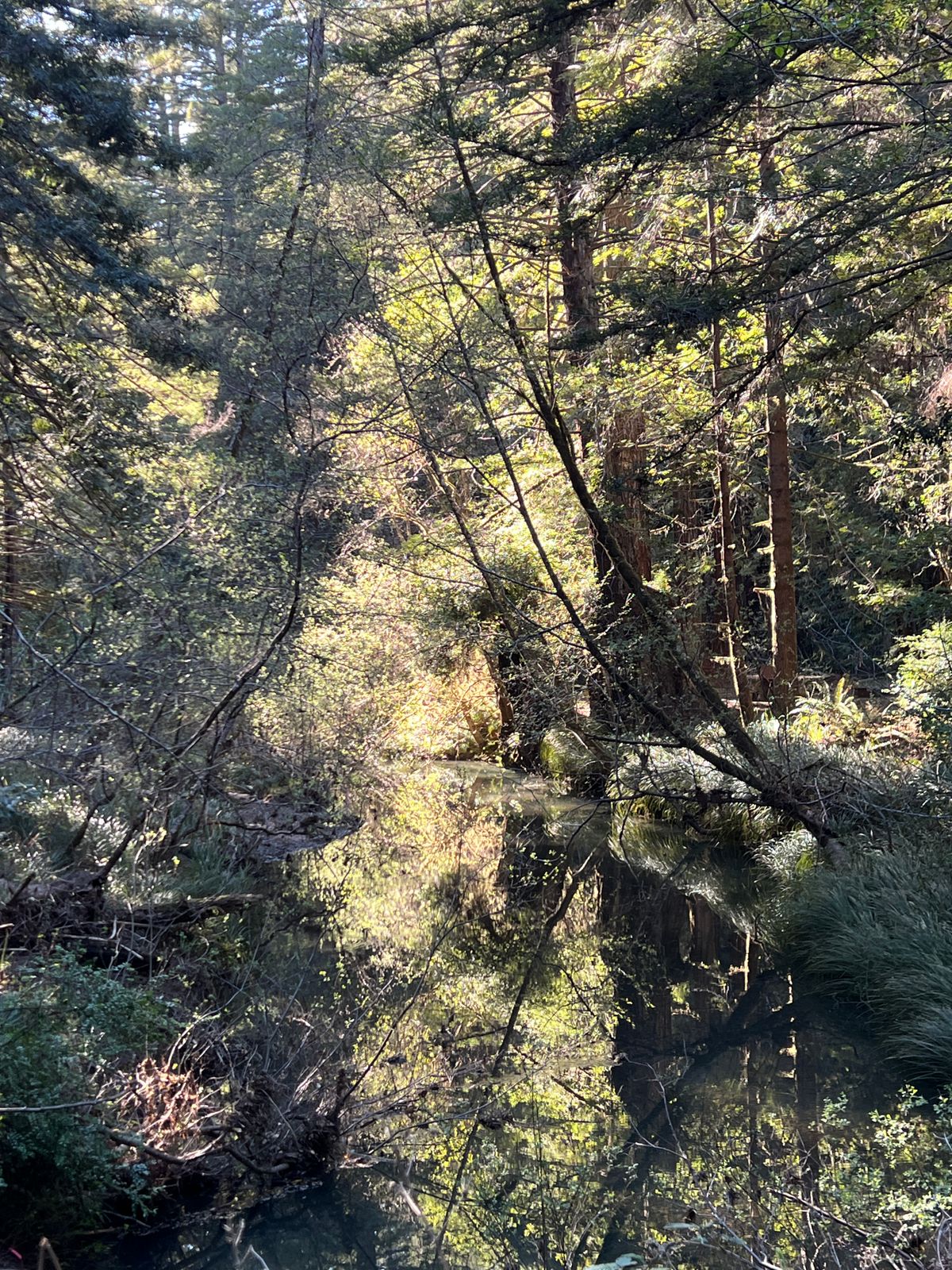
A crew in hard hats moves slowly through a stand of second-growth redwoods, cutting only the smaller trees. Behind them, other workers scatter branches, stabilize a dirt road that is no longer used, and check a stream where salmonids are hatching.
This is not logging as Mendocino County has long known it. It is something closer to what foresters and economists are beginning to call “a restoration economy”— and its promise is not just ecological revival, but jobs.
For decades, timber has been treated as a pillar of the North Coast economy. Yet in reality, its footprint has shrunk to a fraction of what many imagine. In the region’s four major timber-producing counties, logging accounts for about 0.3 percent of all jobs, according to an analysis presented by the Pacific Coast Science Symposium in 2016.
Even in the heavily forested lands of Jackson Demonstration State Forest, where residents have been debating logging practices for decades, timber work represents a sliver of the broader economy. Tourism alone supports roughly 20 times as many jobs in Mendocino County as logging, according to environmental analyst Evan Mills.
What has changed is not just the number of trees, but the idea of what forests are for.
From Extraction to Restoration
Traditional industrial logging is designed for efficiency: fewer workers, larger trees, faster output. Restoration forestry, by contrast, is labor-intensive by design.
Instead of removing the biggest trees, crews thin dense stands of smaller ones to reduce wildfire risk. They stabilize former logging roads, restore fish habitat, clear invasive species, and conduct controlled burns. The work extends beyond the forest floor into mills and workshops that turn small-diameter wood into furniture, poles, composite materials, and biochar.
All of this requires more hands — and more human workers.
A restoration-based approach can generate more than five times as many direct jobs as conventional logging, according to Mill’s analysis, while producing more than three times as many jobs overall when indirect and induced employment are included.
In one case study of a 533-acre timber plan, a conventional harvest would have created about 12 jobs. A restoration-focused alternative — cutting smaller trees and leaving larger ones standing — would have created about 20.
“Restoration logging of this kind ~3% of forest acreage each year would net enough money to cover the 14 Demonstration State Forests’ entire budget,” Mills writes.
A More Stable Economy?
Timber jobs have long been volatile, rising and falling with global markets, litigation, and fire. In the early 2000s, logging in state forests slowed significantly due to intense environmental litigation, public protest over habitat loss, and shifting management priorities away from maximum timber production towards conservation and restoration.
Restoration work, proponents argue, is less tied to boom-and-bust cycles. It is driven instead by long-term ecological goals: reducing fire risk, improving watershed health, and adapting forests to climate change.
A large-scale restoration effort known as “Redwoods Rising” has offered a glimpse of what that could look like. Over its first three years, the project created roughly 300 direct jobs and 475 total jobs — far more employment per dollar than traditional forest management.
The work is also different in character. Logging remains one of the most dangerous professions in the United States, with fatality rates far above the national average. Restoration projects, which involve a broader mix of tasks and smaller trees, may reduce some of that risk while offering more diverse roles.
Beyond Timber
There is another shift underway, one harder to quantify but increasingly visible on the ground.
One weekends, mountain bikers thread through forest trails. Families congregate in picnic areas. Foragers search for mushrooms in the damp understory. Campgrounds — when they are open — fill with visitors drawn by the smell of the trees, the gurgle of a stream, and the expansiveness of the night sky.
Recreation, long secondary to timber production, is emerging as a parallel engine of job creation. In places like Wyoming and British Columbia, mountain biking alone has generated millions of dollars in local economic activity, according to researchers.
In Mendocino County, where tourism already outpaces timber by a wide margin, some see restoration as a way to align the forest with the economy that surrounds it.
But that transition is far from complete. In parts of the state forest, signage is sparse, trails are degraded, access is limited, and vandals have free reign — a legacy, critics say, of managing public lands primarily for timber.
A Debate Rooted in Identity
For old-time residents, the question is not just economic. It’s also cultural.
Logging built towns along the North Coast, shaping identities that persist even as the industry has faded. Any shift away from traditional practices can feel threatening, particularly to families that continue to rely on the logging economy.
“I think it’s short-sighted. I think it’s a terrible mistake,” Bruce Burton, owner of the Willits Redwood Company, told the Board of Supervisors on Tuesday. Willits Redwood Company processes about 10 million board feet of timber from Jackson Demonstration State Forest every year, Burton said.
“I’m not going to belabor it, but I’m happy to answer questions — especially about the economic impact. We employ about to 30 families in Willits, along with the truckers and loggers who work with us during the season,” Burton said.
Yet others argue that restoration is not an abandonment of forestry, but its evolution — one that could sustain both forests and communities in a warming, fire-prone future.
“We’re not pushing loggers out of the forest,” said Melody Myer, conservation attorney at the Environmental Protection and Information Center, EPIC, which is one of the bill’s sponsors. “We need them to do this management, this important management to keep our community safe and to make sure our forests are healthy.”
Advocates for the billl, like Myer, are painting a picture of an alternative future, where one day soon, on a hillside above Caspar Creek, a worker will pause as a small tree falls, its branches catching briefly in the canopy before settling to the ground. Around her, the larger redwoods stand tall.
In the quiet that follows, the difference is almost imperceptible. The forest is still being used. It is still being logged. But the goal, increasingly, is not just what can be taken from from the forest —but what can be reclaimed, and who might find work to support themselves and their families in the process.
This story is available for distribution under CC BY 4.0