
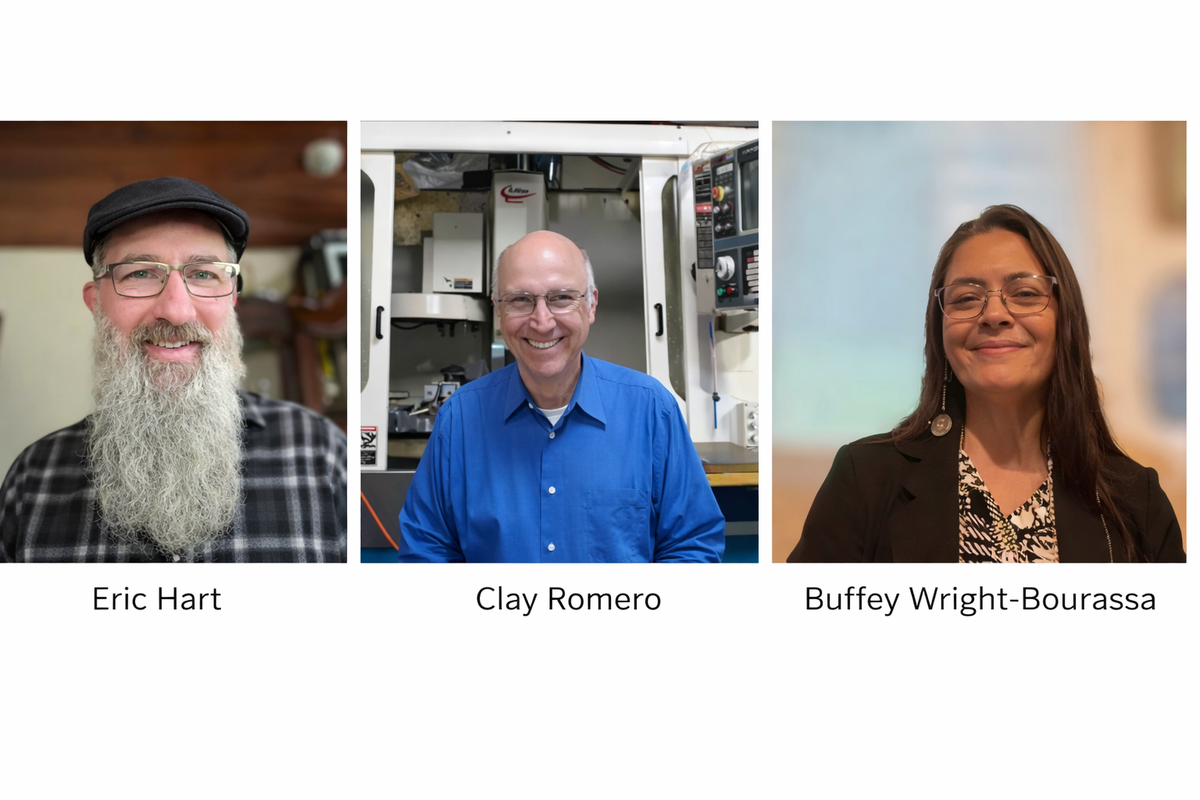
Candidates for the Mendocino County Board of Supervisors squared April 29 in Laytonville. Eric Hart, Clay Romero, and Buffey Wright-Bourassa discussed Mendocino County’s post-cannabis economic slump, permits and code enforcement, and escape assessments. The three pointed to their varied backgrounds — working within county government, engineering and the private sector—as they pitched solutions. Key themes included fixing slow permitting systems, stabilizing funding for emergency medical services, and exploring new tools, including AI, to improve county operations. Russell Green did not participate.
Question 1: The Laytonville area as defined by the Laytonville Unified School District, the Long Valley Fire Protection District as well as the Laytonville Area MAC boundaries is split between the third and the fourth districts. As county supervisor, how do you plan to represent Lakeville’s needs across two districts?
- Eric Hart proposes both a long-term and a short-term strategy. Long-term, he advocates for redistricting in 2030 to unify communities based on where residents actually live, work, and socialize, rather than splitting them down the middle. Short-term, he believes the solution lies in collaboration with the other four supervisors. He notes that while he may not agree with the District 4 supervisor on everything, they share a common responsibility to the county as a whole and must work together to take care of residents regardless of district boundaries.
- Clay Romero emphasizes that he views the residents as people rather than statistics divided by district lines. He believes that when essential services like emergency medical services and ambulances are at stake, jurisdictional boundaries should be secondary to ensuring the public’s safety. His approach is to treat the entire county as one unit, stating that “this is all the same county” and that representation should not be difficult if the focus remains on the needs of the people.
- Buffey Wright Bourassa cites her experience serving three terms on the Tribal Council as evidence of her ability to work across different governmental systems. She highlights the fact that current District Three Supervisor John Haschak encouraged her to run and her relationships with other members of the board of supervisors.
Question 2: What are the top three issues you have seen or heard about in the Laytonville area?
- Eric Hart identifies the struggling economy following the cannabis “crash” and COVID-19, the lack of housing caused by sewer infrastructure limits and county planning barriers, and the need for better basic daily services, such as reliable cell service.
- Buffey Wright Bourassa focuses on the lack of sewer and water infrastructure hindering growth, the difficult permitting process (specifically mentioning high costs for water testing), and the inadequacy of transportation, noting that Mendocino Transit Authority does not serve Laytonville.
- Clay Romero points to the failing economy, what he calls the “very bad policy” of the current cannabis ordinance, and the critical need for a wastewater system to handle drainage and runoff in the town area.
Question 3: What is your track record in working for the public’s best interest and what qualifies you for this office?
- Eric Hart points to 25 years of experience in operations optimization for large corporations like AT&T, including as a technical director supporting thousands of AT&T employees. Locally, he served on the Civil Grand Jury investigating county accountability and has led both local and county-wide fire safe councils.
- Clay Romero emphasizes his perspective as a self-employed machinist who has not worked in government. He also cites 15 years spent studying healthcare funding systems, claiming he has designed a system that could significantly reduce county costs.
- Buffey Wright Bourassa highlights nearly 12 years of experience within county government, including as a human resources technician and substance Use disorder prevention specialist, and three terms on a tribal council. As the Restorative Justice Program Manager for the Mendocino County Sheriff’s Office, she currently manages the inmate welfare fund budget and coordinates over 60 volunteers.
Question 4: What do you see as the biggest weakness and the biggest strength in Mendocino County?
- Eric Hart sees the strength in the creative and unique character of the residents. He identifies the weakness as a historical dependence on “boom-bust” economies (timber and cannabis) rather than building a stable baseline of small businesses.
- Clay Romero believes in the strength is the county’s brilliant and hard-working people, while the weakness is the geographic isolation that makes it expensive and difficult for outlying areas to obtain specialty materials for business.
- Buffey Wright Bourassa finds strength in how the community unites during crises like fires or the opioid epidemic. The weakness is the internal “silos” within county government and organizations that prevent effective collaboration.
Question 5: What is the biggest reason people are disillusioned with the Board of Supervisors, and what is your vision for working with them?
- Eric Hart argues that the Board has failed to implement its vision and has essentially allowed the CEO to run the county. His vision is for the Board to reclaim its leadership role and fix internal departmental inefficiencies.
- Clay Romero criticizes the Board for ignoring public input at meetings. He views county residents as “customers” who deserve better service and wants the Board to focus more on how property tax money is actually spent.
- Buffey Wright Bourassa believes disillusionment comes from the public only seeing the “show” of board meetings. She advocates for more accountability and town halls to facilitate face-to-face conversations with residents.
Question 6: What is the primary role of the Planning and Building Services department, and what is your view on complaint-driven inspections?
- Eric Hart believes the department should be a partner in building safety, but is currently hindered by outdated systems, a lack of IT support, and a negative culture. He wants to track complaints to prevent “weaponization” and shift the department toward a “find a way to yes” mentality.
- Clay Romero views the current system as “maddening” and advocates for simplification and common sense.
- Buffey Wright Bourassa finds the neighbor-on-neighbor complaint system difficult, she notes that professional code enforcement would require additional funding. She noted that she lived on tribal land and they also were required to tell on each other.
Question 7: How are escape assessments being handled, and what is the impact on residents?
- Eric Hart attributes the problem to disorganization and poor structure within the assessment department. He emphasizes the need for predictable billing and a “humane” approach when the county has “dropped the ball”.
- Clay Romero calls massive, unexpected tax bills “completely unreasonable.” He argues that if the county missed assessments for seven years, the resident should be given seven years to pay it back without penalties.
- Buffey Wright Bourassa notes that these assessments are tied to cleaning up records following a state audit. She advocates for better communication and processing rather than simply sending residents a bill for tens of thousands of dollars.
Question 8: How would you go about balancing the budget after the state audit?
- Eric Hart proposes a three-step approach: 1) collect money left on the table (like unpaid TOT from Airbnbs); 2) eliminate internal waste and inefficiencies; and 3) pursue state and federal grants.
- Clay Romero believes the budget should be balanced by growing the physical economy (manufacturing and agriculture) rather than treating residents like a “cash cow” or relying on government jobs.
- Buffey Wright Bourassa opposes using reserves for structural deficits and advocates for upgrading the county’s accounting infrastructure (noting that staff currently rely on Excel spreadsheets) to ensure stronger financial discipline.
Question 9: Do you see a role for Artificial Intelligence (AI) in government?
- Eric Hart sees AI as a tool for efficiency (like summarizing text) but warns that it is not yet ready to replace human thinking or core government responsibilities.
- Clay Romero views AI as a useful tool for sorting vast amounts of information. He suggests its dangers are exaggerated and that if it creates a problem, one can simply “unplug it”.
- Buffey Wright Bourassa cites the county’s new disclosure policy and expresses concerns about cybersecurity risks and the high environmental cost (water and electricity) of AI data centers.
Question 10: What are your thoughts on improving animal care and animal control services?
- Eric Hart frames the issue as public safety, focusing on aggressive dogs and nuisance wildlife. He advocates for better-funded spay and neuter services to address the problem at its root.
- Clay Romero initially admitted he was unaware of major problems in this area but stated he is a “reasonable guy” open to learning more and supporting necessary improvements.
- Buffey Wright Bourassa attributes current issues to a lack of funding and staffing compared to the 1970s.
Question 11: What are your personal limits on free speech and conduct toward protected groups?
- Eric Hart states that while free speech is protected, it has limits regarding threats to life and safety. He notes that attacks on public figures should be focused on criticizing issues and actions rather than attacking protected characteristics like race.
- Clay Romero describes himself as a “very tolerant man” who will defend the right of others to say whatever they want, even if he dislikes it, until those words lead to harmful actions.
- Buffey Wright Bourassa highlights her background as an equity officer and emphasizes the importance of treating all people with respect, regardless of their point of view, political standing or pronouns.
Question 12: What are your thoughts on funding for public ambulances staffed by fire departments?
- Eric Hart notes that depending on the part of the county, 80-90% of fire calls are medical. He supports creating a steady funding stream and states he would personally support a tax for these essential services.
- Clay Romero views emergency medical services as a matter of life and death. He pledges to ensure these services are funded because “the equipment is just simply not there to help people” currently.
- Buffey Wright Bourassa strongly supports ensuring fire districts receive predictable, transparent funding from sources like Measure P and Prop 172.
Question 13: What are your plans to assist small cannabis growers?
- Eric Hart argues the county failed by treating growers as a “cash cow.” He wants to support existing small “mom and pop” high-quality organic cannabis growers and proposes a graduated process for new businesses to get established. He said the county needs to push for better state regulation.
- Clay Romero advocates for simplifying the ordinance and treating cannabis like any other regular agricultural product to help revitalize the local economy. He said regulation boils down to: “when you are growing cannabis, don’t irritate your neighbor.”
- Buffey Wright Bourassa supports a one-time amnesty for penalties and interest to help growers get into compliance, but does not support forgiving the base taxes already paid by others. She said people who did the right thing should be protected.
Question 14: What will be done, if anything, about mental health in our county?
- Eric Hart considers mental health a core county responsibility. He advocates for supporting non-governmental organizations (NGOs) and working with the state to secure better funding.
- Clay Romero expresses a personal passion for the issue due to the impact of mental illness on the community. He pledges to use his position on the board to make mental health funding a priority.
- Buffey Wright Bourassa identifies “huge gaps” in current crisis response programs. She calls for stronger coordination between law enforcement, EMS, and behavioral health to ensure patients and their families aren’t left without options.
Other Resources:
Mendo Local Candidate Forum — District Three
Mendocino Voice Coverage of District Three Laytonville Forum
Mendocino Voice Coverage of District Three Willits Forum