
Fort Bragg's Newest Solar Array is Billed as Finished. It Has Yet to Make a Watt.
The new solar array at the C.V. Starr Recreation Center in Fort Bragg has yet to produce an power despite being finished months ago. This story asked why.
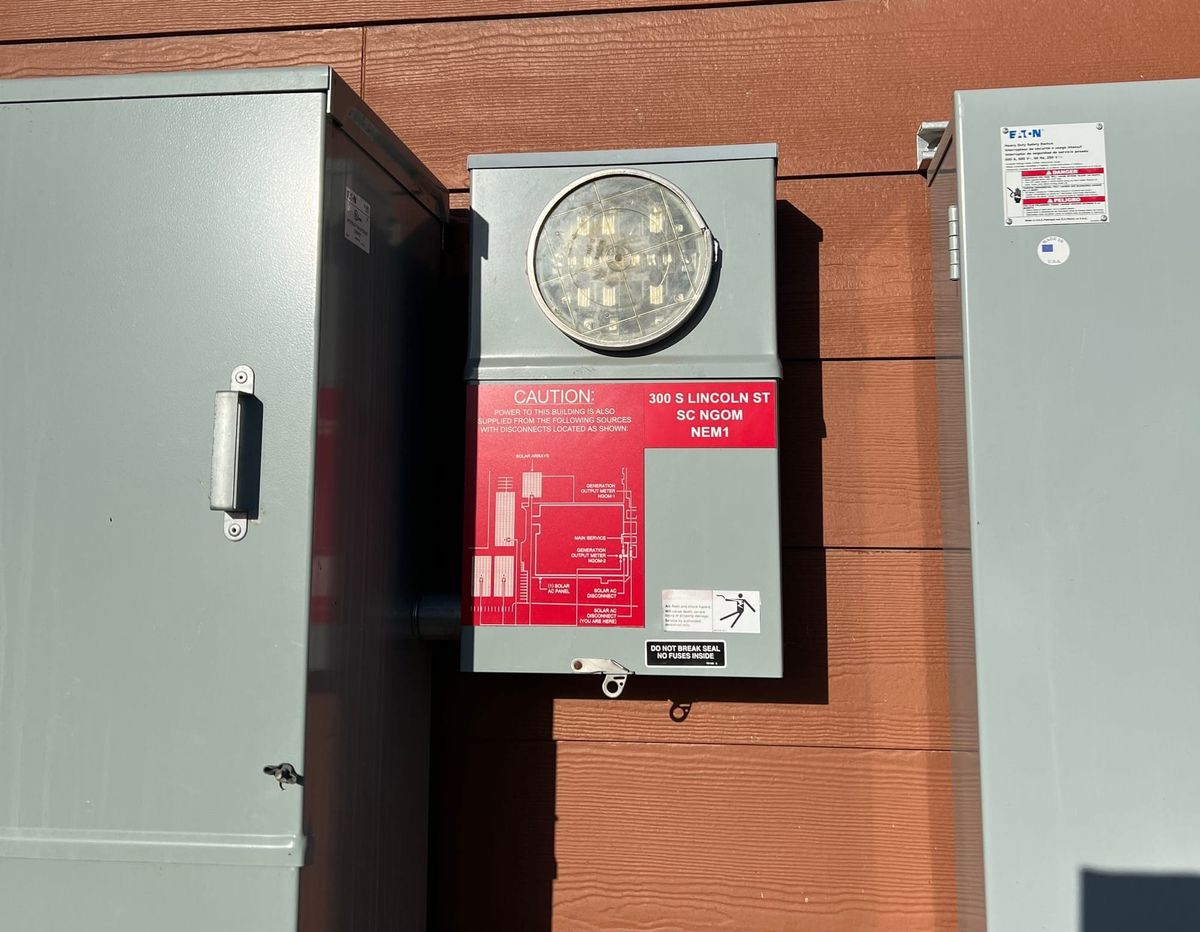
Editor's Note: This story originated with a question a reader asked us one night at the Tall Guy Brewery in Fort Bragg. She wanted to know why the array wasn't functioning. The answer illustrates the challenges the city faces in coordinating the work of a contractor and PG&E.
FORT BRAGG, Calif. — Steve Becker drove to Fort Bragg from Redding on Tuesday night so he could be at the C.V. Starr Community Center by 7:30 a.m. Wednesday. He was meeting PG&E, and the utility had told him its representative could arrive as early as 8 a.m. — or as late as 4:50 p.m. Becker, a project engineer with Syserco, didn't care. He just wanted to get the project, which has been stalled over differing interpretations of code and equipment specifications, back on track.
"When it comes to this sort of thing, there's always that window," Becker told MendoLocal.News.
That window, and an inspection that raised questions about the equipment connecting the array to the grid, are part of why the carport panels, which the city's contract projected would save it as much as $133,871 a year — about $11,160 a month — in electricity, have yet to produce any power. The array was installed by Syserco Energy Solutions as part of a six-site, $7.5 million city solar project. The city's records show it was billed as 100% complete on June 26.
But a solar system can't be switched on until the utility gives written permission, known as "permission to operate." Before it does, PG&E has to install special meters that track the power the array produces, inspect the equipment, and approve the electrical plans. PG&E has not yet given that permission, and the city says C.V. Starr is "not currently generating" the savings it was built to produce.
The city, PG&E, and the installer each explain the delay differently.
Public Works Director John Smith, in a written response to MendoLocal.News, described a slow but routine exchange between PG&E and Syserco over "interpretations of the code and current specs" — not physical defects. "Syserco has not had to physically change, replace, or alter anything at the facility," Smith wrote. He said the array could come online "as soon as late October."
PG&E says the delay is the installer's doing. In a September email relayed to MendoLocal.News by Mayor Jason Godeke, a PG&E field-metering manager wrote that "all of the issues with this project are in the installer's court." The manager said the project failed an inspection on July 17 and that Syserco's responses raised "additional questions … rather than directly addressing the outstanding issues."
Syserco General Manager Scott Meinzen, answering MendoLocal.News' questions in detail and in writing, said the July inspection turned on a design PG&E had already approved. A PG&E technician who visited July 15, he said, questioned whether the equipment connecting the array to the grid was big enough, including the array's main shutoff switch and the building's existing electrical service. PG&E canceled a meter installation set for July 22. Syserco's engineer replied that the new meter only measures the power the array produces, and that the array's peak output is well within what the switch and meter are built to handle.
By Meinzen's account, PG&E agreed on Sept. 4 that the equipment was acceptable and asked only for a wording change on the electrical diagram, which shows how the system is wired: it should list the meter's rating as 600 amps, not "600A (Min.)." PG&E also wanted a new diagram. On Sept. 15, he said, PG&E confirmed its engineers had approved the corrected diagram. "Presently, the issues raised during the July field inspection have been addressed and are no longer preventing the project from moving forward," he wrote.
What remains, Meinzen said, is PG&E's to do, in order: inspect the cabinet housing the meter — the inspection that prompted Becker to drive to Fort Bragg — and set it up to credit the city for power it sends to the grid. PG&E estimates this last task could take one to two weeks. PG&E will then conduct a final inspection and install a second meter. PG&E has not given a date for final inspection or permission to operate, he said, so Syserco can't say when the array will come online.
Records obtained through the California Public Records Act show a city payment was also a step in the process. In a May 5 request that became part of a June 3 change order — a signed amendment to the contract — Syserco wrote that "before they can install the [meters] at the Community Center, the City must first remit payment for the invoice issued by PG&E on May 4, 2026." Once the city paid, PG&E scheduling "may take an additional 4–6 weeks."
Meinzen said the invoice, for the meter installation, arrived with a PG&E agreement Syserco forwarded to the city May 5. The city signed the agreement that day and issued a check to PG&E on May 19, 15 days after the invoice, he said, and PG&E confirmed on June 11 that the payment had been processed. The invoice, he said, "is not what is currently holding up the array."
Godeke, forwarding PG&E's answers to MendoLocal.News, said the city was "very much looking forward to seeing the C.V. Starr array come online," adding, "It will provide significant energy and savings for the City."
Smith, the public works director, in an interview with MendoLocal.News, said he expected there to be a few months' delay following the June 26 certification of "Final Completion." The city still owes Syserco $290,945 — the amount that will be released when all the work is complete.
But when that will be no one knows. Becker waited all day on Wednesday. PG&E never showed.
In an email on Thursday, Megan McFarland, PG&E spokesperson, said, "I spoke to the team and we are looking into why there was a no-show. We are disappointed about it too because we know this is an important project for the Customer."