
Fort Bragg Sets Decibel Limits in Noise Ordinance Overhaul
The Fort Bragg City Council voted 5-0 to introduce a noise ordinance with decibel limits by zone and time of day, with the Skunk Train horn at the center of the debate.

FORT BRAGG, Calif. — The Fort Bragg City Council voted 5-0 Monday to introduce a rewritten noise ordinance with specific decibel limits that vary by zoning district and time of day.
The rewrite of Chapter 9.44 of the municipal code drops the existing test — noise "uncomfortable to the average person" — in favor of measurable ceilings for daytime hours, 7 a.m. to 10 p.m., and nighttime hours after 10 p.m. Commercial and industrial zones get higher thresholds than residential ones.
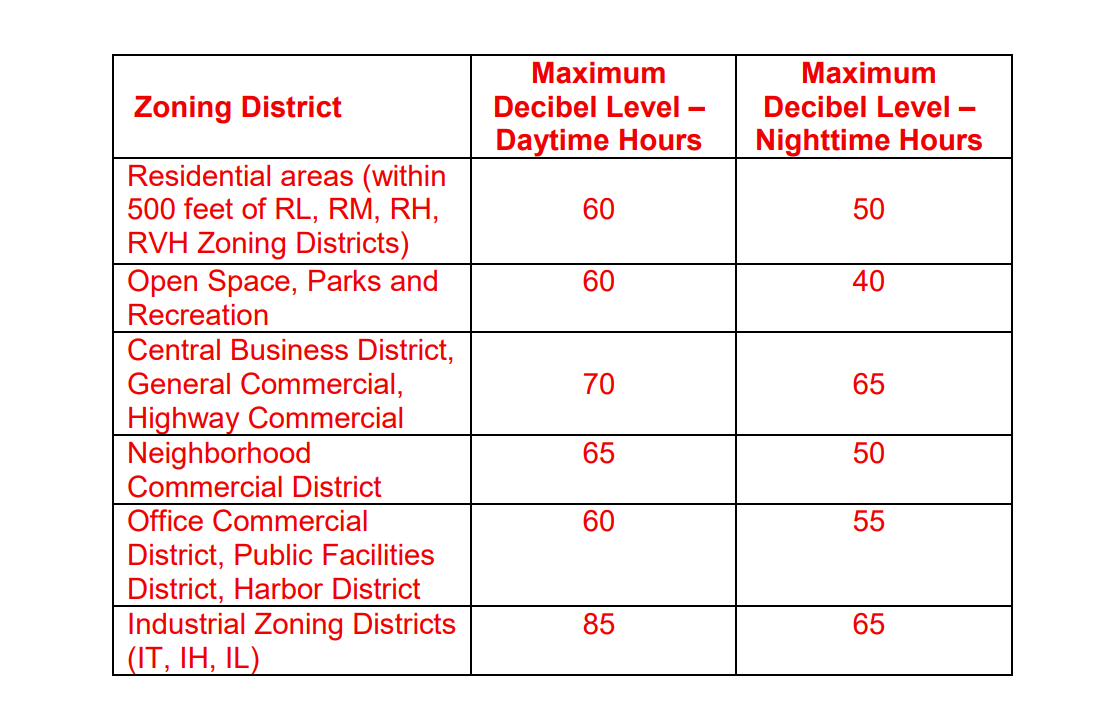
Planning consultant Marie Jones, who presented the ordinance, said the city attorney had flagged the old language as difficult to defend in court. Code enforcement staff, she said, had reported recurring complaints about food truck generators, construction hours, public assembly buildings in residential zones, and the Skunk Train horn.
Under the new rules, noise disturbances are misdemeanors, though officers may issue a warning for a first violation. Officers must use a calibrated decibel meter rather than their own judgment. Phone apps are not suitable for enforcement, she said, but can help residents decide whether a complaint is worth filing.
The ordinance also sets a 30-minute threshold for continuous animal noise, extends construction noise limits from projects requiring use permits to those requiring building permits, and establishes limits for occasional social gatherings. Emergency generators running during power outages are exempt.
The ordinance was introduced by title only.
You Read Our Stories. Please Help Fund Our Newsroom.
MendoLocal.News was created by locals for locals. We pay attention and dig deeper and we distribute for free. With your support, we can keep going.
Monica Lynne, owner of Interior, said she has spent nearly two years filing noise complaints about a food truck parked on the same block as her business. "After nearly two years of filing complaints, I have zero confidence in the City's ability to enforce new ordinances when it has failed to adequately investigate and enforce the ones already in place," she said.
The skunk train horn was also discussed. Jones said the Skunk Train is not complying with existing train horn rules. She said the rule requires trains to sound their horns 15 seconds before reaching a crossing, and that the railroad appears to start from "way up the canyon."
Robert Pinoli, president and CEO of Mendocino Railway, which operates the Skunk Train, said in an email to MendoLocal.News on Tuesday that the suggestion that federal horn rules are not being followed is "unsupported." (Read Pinoli's entire statement.)
"Train horns are sounded where and when federal safety regulations require," Pinoli said. "In addition to public crossings, railroad operating rules require horn signals in other circumstances, including circumstances involving safety, visibility, and railroad signaling operations."
The ordinance addresses the railroad through a preemption clause: Skunk Train operations are subject to the city's decibel limits to the extent federal law does not preempt them.
Pinoli said the railroad asked the city earlier this month to add "two straightforward clarifications recognizing federal railroad preemption and the City's jurisdictional boundaries."
"The City did not respond to this request and oddly they weren't even mentioned in the staff report to the Council," he said. "Mendocino Railway will continue complying with applicable law, as we always have. We would like to see the City show the same respect for the legal limits of its authority."
A quiet zone for train noise would require new crossing gates at Highway 1, Jones said. The gates there now come down on either side of the road, she said, but a quiet zone requires a set of four that keeps drivers from going around them. Jones said her understanding of federal law is that only the Highway 1 crossing would need them, not every crossing in town.
She put the cost at about $350,000, a figure she said she averaged from what two or three other communities budgeted for the gates about two years ago. Council Member Tess Albin-Smith said she remembered a former police chief citing something like $1 million. Jones said she was not involved in that estimate and did not know how he reached it.
The city has applied for a Caltrans grant to pay for design and engineering of the crossing, which Jones said would produce a proper cost estimate.
Residents who live near the tracks urged the council to act. A 32-year resident of Stewart Street said the horn was never a problem until the past year. A resident who has lived near the train corridor for 26 years said the trouble began when the company installed a new, louder horn, and urged the council to pursue a quiet zone.
Pinoli said the claim that the railroad installed a louder horn is false. "We are so confident in that fact that we would welcome the City's participation in an objective review and testing of our locomotive horns to verify compliance with applicable federal requirements," he said.
For five years, Pinoli said, the railroad has "suggested our willingness to participate in discussions regarding a potential quiet zone and related planning efforts."
Mary Rose Kaczorowski argued that the Skunk Train operates as a tourist and event railroad, not a federal public carrier, and that federal horn rules may not fully apply.
Paul Clark, speaking online, suggested the city invite Skunk Train management to present its view of the federal requirements.
Council Member Lindy Peters called the ordinance "sound" and said he was ready to support it. The horn is pleasant at 11 a.m., he said, but residents have made clear that late-night and early-morning honking is a different matter. He recalled that the city once replaced the Bainbridge Park fire siren with radios, evidence, he said, that Fort Bragg has dealt with disruptive noise before.
Inland Housing Zoning Advances on Third Try
The council voted 5-0 to adopt a resolution amending the inland general plan and 5-0 to introduce an ordinance amending the inland zoning code, an item before it for the third time. The council waived further readings of the ordinance, which allows it to be placed on the consent calendar at the next meeting.
The resolution says Fort Bragg "would not be able to achieve" its 668-unit state housing allocation under current limits on multifamily housing in commercial zones.
The changes are intended to meet the state's Regional Housing Needs Assessment requirements for 2027. The ordinance would allow multifamily housing without a use permit on existing vacant parcels in commercial and residential zones. It would also set minimum and maximum densities for multifamily housing in four commercial zones and allow buildings up to 35 feet in neighborhood commercial zones with a use permit.
The council approved coastal zone amendments Sept. 14 but deadlocked 2-2 on the inland resolution with one member absent. At a continued hearing Sept. 28, it directed Jones to reconcile a conflict between the inland general plan and the inland zoning code. In the general commercial, highway visitor commercial and office commercial designations, the plan allowed housing only above the ground floor or at the rear of the ground floor.
Deleting that language aligns the plan with housing types the council has already approved in commercial zones: multifamily, group homes, supportive housing, tiny home communities, and live-work units.
Peters, Vice Mayor Marcia Rafanan and Mayor Jason Godeke each said they had moved from earlier skepticism to support. Godeke said the assessment's 668-unit figure does not mean 668 units will be built, only that enough zoned capacity must exist on paper. Rafanan said her main interest is making it easier to build market-rate housing.
Clark, speaking online, questioned whether the city had pushed back enough on what he called an unrealistic state allocation. He warned against the kind of unsightly overbuilding he said he has seen in Ukiah and Santa Rosa.
Fees Set for Bainbridge Park, Veterans Hall
The council voted 5-0 to adopt updated fees for Bainbridge Park and Veterans Hall, the two facilities left out when the city last revised its fee schedule in February.
Nonprofits, schools and other historically sponsored groups receive fee waivers.
Albin-Smith raised concern about a $300-a-day tournament rate, noting that the park's soccer courts are smaller than regulation size. Staff said nonprofits can request waivers and that the fee is meant to offset the heavier wear from large events. The council also asked staff to address neighbors' ongoing complaints about metal banging at the soccer field.
Veterans Hall fees were carried over from the county's existing schedule, as the city's operating agreement requires. Staff said negotiations with the county over that agreement, including its restrictions on renovations and upgrades, are still to come, and the fees will return to the council.
Three veterans spoke. The adjutant of American Legion Post 96 said the hall's tile roof has leaked for years and no repair money is available. He urged the city to at least install a heavy-duty tarp before rain forecast for the weekend.
The district commander for American Legion posts in Del Norte, Humboldt, and Mendocino counties asked the city to press the county to make repairs before the city formally takes over, and asked that the $500-a-day rental rate not fall on Fort Bragg residents. The chief of the Westport Fire Department said veterans using the veterans service office under GI Bill programs need a private study space at the hall.
Godeke suggested making the hall free for nonprofit veterans groups. Staff said the American Legion and related groups are already on the historically sponsored list and pay nothing.
Business Concierge Program Approved
The council voted 5-0 to adopt a resolution establishing a business concierge program and authorizing a $10,000 partnership with the West Business Development Center.
City Manager Isaac Whippy described the program as a "one front door" approach for businesses and property owners dealing with City Hall. A business community survey will go out with license renewals in December.
Whippy said the city has 881 active business licenses and has received 89 new applications this year. The most recent sales tax data showed a 0.5% increase in the first quarter but a decline in local business activity. Several businesses have closed, including Rite Aid, though Whippy attributed that closure to a national chain decision rather than local conditions.
Sarah Bodnar, CEO of West Center, said the Small Business Development Center network is restructuring regionally, which will reduce services in some rural areas. The Mendocino Coast will not be affected, she said, because West Center's Women's Business Center will keep operating. She said the $10,000 would let the organization direct more time and customized training to Fort Bragg businesses rather than spread limited resources evenly across the region.
Albin-Smith asked how the money would be allocated. Bodnar said survey results would decide, with possible uses including training on artificial intelligence, help moving retail online, Spanish-language permitting workshops, and roundtables.
Clark, speaking online, asked how the chamber of commerce fits into the model and urged the council to keep City Hall receptive to new businesses. Jacob Patterson, also online, supported the program and called the investment small compared with what the city spends on marketing.
East Oak Street Tops Street and Storm Drain Priorities
The council directed staff by consensus to make the east end of East Oak Street, where a storm drain has failed, the city's project in a competitive Local Partnership Program grant application due Nov. 18. No vote was taken.
Public works staff and consultants from Lumos & Associates recommended full reconstruction, not overlay, for all six streets the city is considering for the grant: East Oak Street, East Chestnut Street, South Harrison Street, West Street, and two unnamed alleys. They based the recommendation on pavement core samples and camera inspections of storm drains.
The most urgent problem is at the east end of East Oak Street, where footage showed sections of storm drain that have entirely degraded. One barricaded inlet covers a failed section beneath the road.
The storm drain work alone is estimated at roughly $1.06 million. Full reconstruction from Highway 1 to Denison Lane would add about $1.1 million in paving costs.
The competitive grant would be paired with formula Local Partnership Program funds and a 25% match from the city's street sales tax, for a working budget of roughly $5 million.
Staff said that is not enough to rebuild East Oak Street from Highway 1 to its east end. What can be funded, staff said, is the stretch where the storm drain is being replaced.
A resident supported the priority list and asked the council to consider permeable paving and traffic calming measures beyond stop signs and speed bumps, such as chicanes.
Patterson, speaking online, suggested moving the alley between Alder and Oak streets to second priority because of its lower cost. He also recommended splitting East Oak Street into two phases, starting east of Sanderson Lane, where conditions are worst. He said disability access requirements on those blocks may require undergrounding Pacific Gas and Electric Co. poles, which he said would be cheaper while the road is already open.
Albin-Smith echoed the call for traffic calming and asked whether a "dig once" approach could bundle broadband, utilities, and road work.