
Fort Bragg Proposition Workshop Reveals Facts Hidden in the Fine Print
A Fort Bragg workshop with CalMatters and MendoLocal.News unpacked the fine print of California’s 2026 ballot — from the billionaire tax to the secretive FAIR Plan.
FORT BRAGG, Calif. — Did you know that Proposition 38 was written in such a way as to steer $4.2 billion to a research institution co-founded by the same philanthropist who spent more than $43 million supporting the initiative?
Or that deciding not to vote on Proposition 40, known as the billionaire tax — for fear of the lawsuits it might inspire, or for other reasons — could perversely limit the state's ability to collect new taxes if Propositions 41 and 42, the measures designed to counter it, pass alongside it?
Or that the California FAIR Plan Association is a private entity created by statute, and that its records and meetings aren't covered by California's open-government laws?
These were a few of the insights shared by CalMatters Partnership Director Dan Hu at last night's VotingMatters workshop, sponsored by MendoLocal.News and CalMatters.
Both outlets practice collaborative journalism: they share their reporting with other newsrooms and each other and actively seek out ways to partner, rather than to compete.
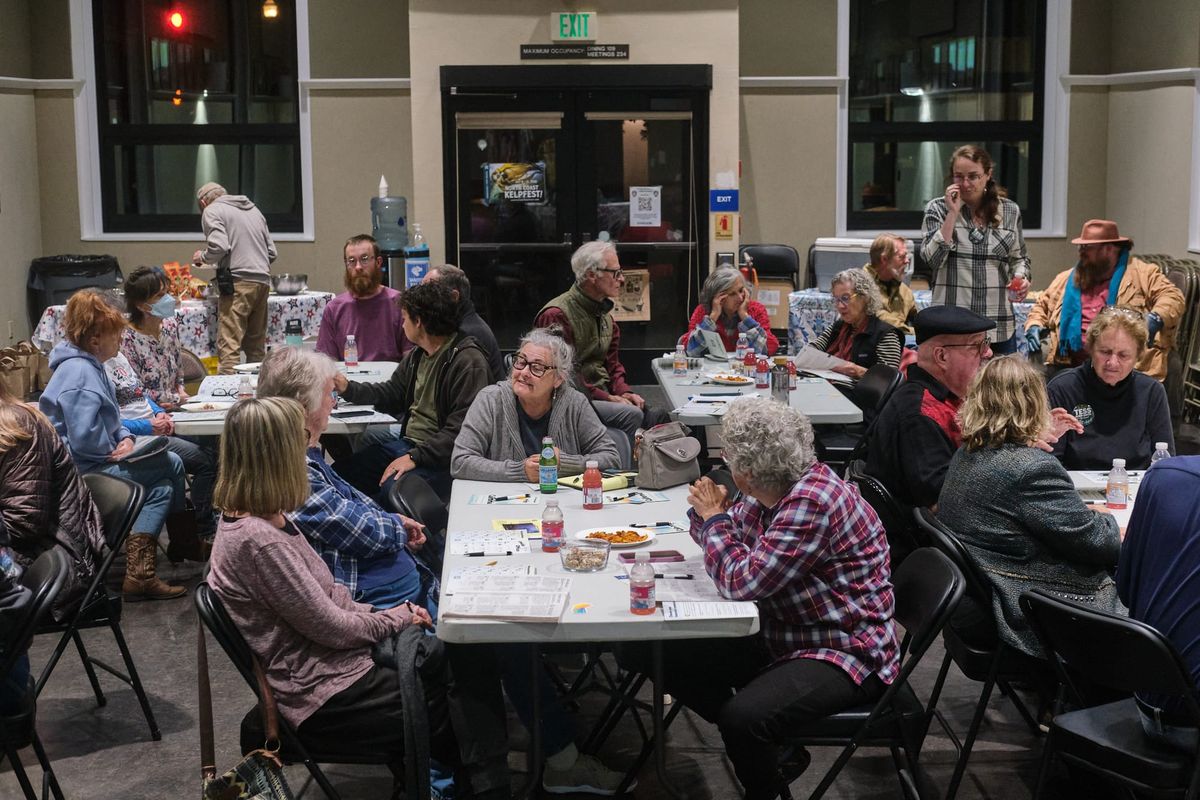
About 30 people attended the interactive workshop at Fort Bragg Town Hall. After walking people through CalMatters' Voter Guide — so they would know where to continue their research — Hu turned to the propositions.
Proposition 38 (Medical Research)
Hu noted Proposition 38 sounds like it's for a good cause. It authorizes $8.4 billion in bonds to support research into technologies that use the body's own immune system to treat disease. It explicitly dedicates half the money raised to cancer, heart disease, and Alzheimer's.
At the same time, as participants noted, it falls into a category that many voters find objectionable: extremely wealthy individuals funding ballot measures that benefit the same industries that produced their own extravagant wealth.
The official voter information guide doesn't state that the money will benefit the California Institute for Immunology and Immunotherapy, which was co-founded by Dr. Gary Michelson in January 2024. But a university spokesperson confirmed to CalMatters reporter Mikhail Zinshteyn that the institute would meet the criteria set forth in the measure:
- It's a nonprofit founded before 2025;
- It focuses on immunology and immunotherapy research rather than research broadly;
- It's affiliated with a University of California campus with a medical center that serves a minimum number of patients. Currently only UCLA meets that threshold;
- It must meet a minimum square-footage requirement for the size of the research institute;
- It must have received a minimum amount in donations, including for specific research.
Hu pointed out that voters passed a similarly structured measure in 2024. Proposition 34 placed limits on how health care providers spend money and appeared to apply to only one organization: the AIDS Healthcare Foundation.
Proposition 45 (CEQA)
CalMatters' Voter Guide says Proposition 45 would speed up environmental reviews for eligible housing and infrastructure. But as at least one workshop participant pointed out, eligibility is defined very broadly — potentially creating a loophole that can be abused.
During discussion, which took place around five tables, participants recognized that California's environmental review law, known as CEQA, has both benefited and hobbled Mendocino County. It has allowed residents to challenge projects that risk polluting the groundwater, but it has also made building much more expensive.
Is Prop. 45 the right way to reform CEQA? That's a question many asked, but few could answer.
One downside of Prop. 45 highlighted in the Official Voter Information Guide is that it will likely "increase costs for the state and local government, including state courts." The guide warns: "These costs likely would be in the high tens of millions of dollars annually, potentially exceeding $100 million annually."
Proposition 40 (Billionaire Tax)
Hu said participants in VotingMatters workshops around the state have been eager to discuss Prop 40. It was one of the most mentioned propositions by participants who RSVPed to MendoLocal.News.
As explained in CalMatters' Voter Guide, it's a one-time tax on 200 Californians whose net worth exceeded $1 billion at the start of 2026. Those individuals would be required to pay 5% of covered assets such as businesses, securities, art, collectibles, and intellectual property. The money is earmarked primarily for healthcare — and some opponents, including health groups who weren't consulted, say it doesn't address long-term fiscal challenges of funding healthcare
Opponents also include Google co-founder Sergey Brin, who has spent more than $138 million campaigning against the measure — and supporting two countermeasures, Propositions 41 and 42.
During the discussion, people described wanting to see billionaires pay more tax — and also questioned whether Prop. 40 was the right vehicle. Some concerns were expensive lawsuits, a billionaire exodus from California, and how the windfall will be spent.
Making the choice even more difficult is the conflict between Propositions 40, 41, and 42. The Official Voter Information Guide states that if all three propositions pass and either Proposition 41 or 42 receives more votes, Proposition 40 can be stopped. But the reverse is not true: if Proposition 40 receives the most votes, nonconflicting elements of Propositions 41 and 42 can still take hold.
The Insurance Commissioner Race
"We don't usually cover the insurance commissioner race in these workshops," Hu said. "But I heard you might be interested in it."
What followed was a discussion that, for many participants, surfaced little-known facts about the California FAIR Plan, which is increasingly providing insurance in Mendocino County. Hu shared three short interviews featuring the two candidates, Jane Kim and Ben Allen.
As CalMatters reporter Levi Sumagaysay wrote on Oct. 9, the candidates differ in their approach to solving California's broken insurance market. Kim is proposing public, nonprofit disaster insurance. Allen says he'd get everyone on board to reduce wildfire risk — community members, the industry, state officials, and experts.
Both candidates addressed the FAIR Plan. Allen, a Democratic state senator representing Santa Monica and the west side of Los Angeles (Senate District 24), called the plan one of the worst actors in his district on claims, especially in contesting basic smoke-damage claims.
Kim called the plan "one of the most secretive in the country," describing a nine-person board with no consumers or public officials and meetings held in secret. Once public disaster insurance is established, she would depopulate the plan, which she said is now insuring over 600,000 homes, and return it to its original mission as an insurer of last resort.
It was Kim's video that produced the most surprise at the Fort Bragg workshop. It was news even to some FAIR Plan customers that the plan is a private entity created by statute — not a government agency — and that its records and meetings aren't covered by California's open-government laws.