
Fort Bragg Eyes $8.5 Million Grant to Rebuild Aging Timberwolf Stadium
The Fort Bragg City Council voted unanimously Monday to pursue a state grant of up to $8.5 million to replace the community-built dirt track with an all-weather surface, install synthetic turf, upgrade restrooms, and other upgrades.
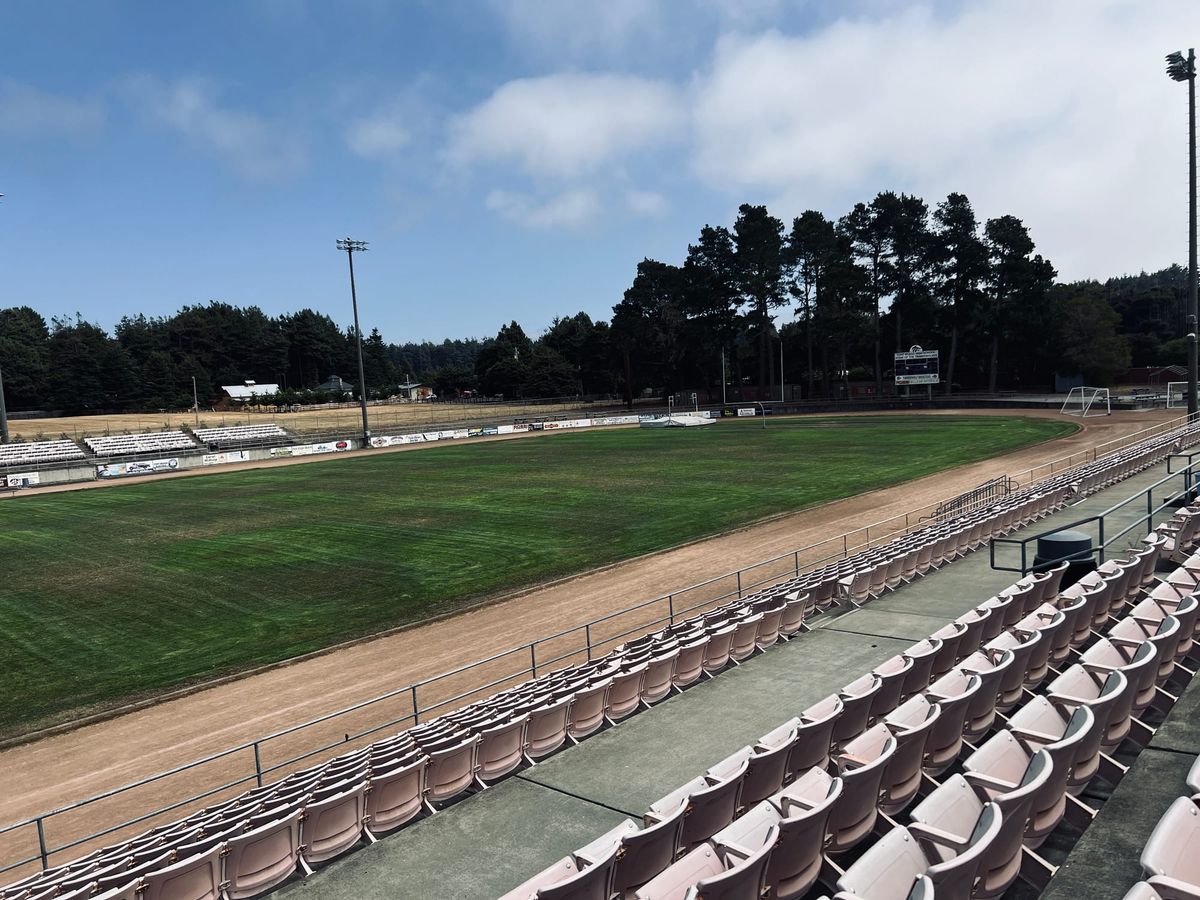
The Fort Bragg City Council voted unanimously Monday to pursue a state grant of up to $8.5 million to modernize Timberwolf Stadium, agreeing to serve as lead applicant on a project that would replace the community-built field's dirt track with an all-weather surface, install synthetic turf, upgrade restrooms and expand the aging complex's role as an emergency evacuation site.
The council's approval does not encompass construction. Instead, the 5-0 vote authorizes City Manager Isaac Whippy to begin a new round of community engagement and to negotiate a partnership and site-control framework with the Fort Bragg Unified School District and the Mendocino Coast Sports Foundation, which owns the maintenance agreement for the fields. Staff expect to return to the council in September, ahead of a state grant portal that is scheduled to open by the end of August.
At issue is the condition of a stadium that residents built largely themselves. The sports foundation was established in 1991, and after a local businessman donated the property and roughly eight years of volunteer labor — including refurbishing salvaged light poles and installing stadium seats from Anaheim Stadium — the stadium opened in 1999. Whippy said the facility is now valued at more than $15 million but was built with about $1.3 million in donations.
Nearly three decades later, officials and coaches say the original vision was never finished. The stadium still has a dirt track and a natural grass field that floods in the rain, limiting use through the wet winter months and requiring heavy maintenance.
"It rains so much that most of the time we are unable to practice on our dirt track and flooded field," said Tara Larson, a 1989 Fort Bragg High graduate who now coaches the school's track team. She said the program has grown to more than 125 athletes and, because it lacks an all-weather track certified for automatic timing, must travel to every league meet.
"This puts us at a disadvantage and makes it so parents and the community are unable to support their kids at home meets," Larson said. She added that all-weather surfaces reduce injury risk by eliminating "hidden tripping hazards like potholes, rocks or uneven terrain."
Larson said football, cheer and soccer squads that use the field, together with track, account for well over half of the high school's student body, and that the stadium also serves physical education classes, elementary schools and the wider community.
Whippy told the council the sports foundation applied for the same state grant in 2020 but fell short. That earlier application estimated the project at about $6.2 million, including $3.2 million to replace the track, $1.5 million for field upgrades, $650,000 for LED lighting and $400,000 in construction management. The lighting has since been completed by the foundation and the school district, Whippy said. With inflation, he said, the remaining work would likely consume most of the $8.5 million maximum available under Round 5 of the state's Parks and Community Spaces, or PACS, program, which has about $188 million available statewide. (min of $200k and max $8.5 million)
Whippy said having the city as lead applicant could strengthen the bid in the areas where the foundation's earlier attempt lost points. He also noted the same grant fund could cover two proposed downtown urban parks, and that the projects might be packaged into a single application.
Joe Chacon, president of the Mendocino Coast Sports Foundation, urged the council to move forward. "This project means a lot to me personally. I grew up here in town, playing on that field," he said, adding that he now watches his own children play there. He described the stadium as built by "community volunteers, local donations and people coming together."
Council Member Lindy Peters raised the stadium's potential as a disaster shelter, asking whether that use had been built into the application. Whippy confirmed it is part of the grant plan and that the county emergency services office is expected to provide a letter of support. Larson noted that the city and fire department have formally designated the stadium as a community evacuation center for serious emergencies, "yet it's muddy and wet for many months out of the year."
Council Member Tess Albin-Smith, reminisced about coaching the high school girls' soccer team for 14 years — until the field became unusable. "We had to stop doing tournaments," she said, because "no one would come." She said she ran soccer tournaments from 1997 until 2016, some bringing as many as 5,000 people to town — "bigger than the salmon barbecue," she said — with nonprofits staging barbecues and fundraisers alongside the games. Restoring the field, she said, could bring those events — and their economic lift — back.
Kathy Westfall, a parent of four student athletes, asked the city to publicize its surveys more broadly, warning that low participation skews results, potentially jeopardizing support for the project. "Let's get more people on these surveys," she said, "rather than four people, and then you say 90% say no."
Whippy said the coming engagement effort would include at least five public outreach meetings — at the school gym, the stadium, the farmers market and City Hall — along with a survey included in the council's agenda packet asking residents what additional uses the upgraded facility should serve.
The school district would retain ownership of the property, while the city would take on the role of lead applicant, grant compliance, and project coordination. Whippy said the proposal would also go before the school board in September.