
Five Targeted Local Measures — What's at Stake and Where in Mendocino County
Voters in Fort Bragg, Point Arena, and northern and southern areas of the county will vote on measures ranging from an additional 2% hotel tax to a $830 million college bond that will pay investors more than $1 billion.
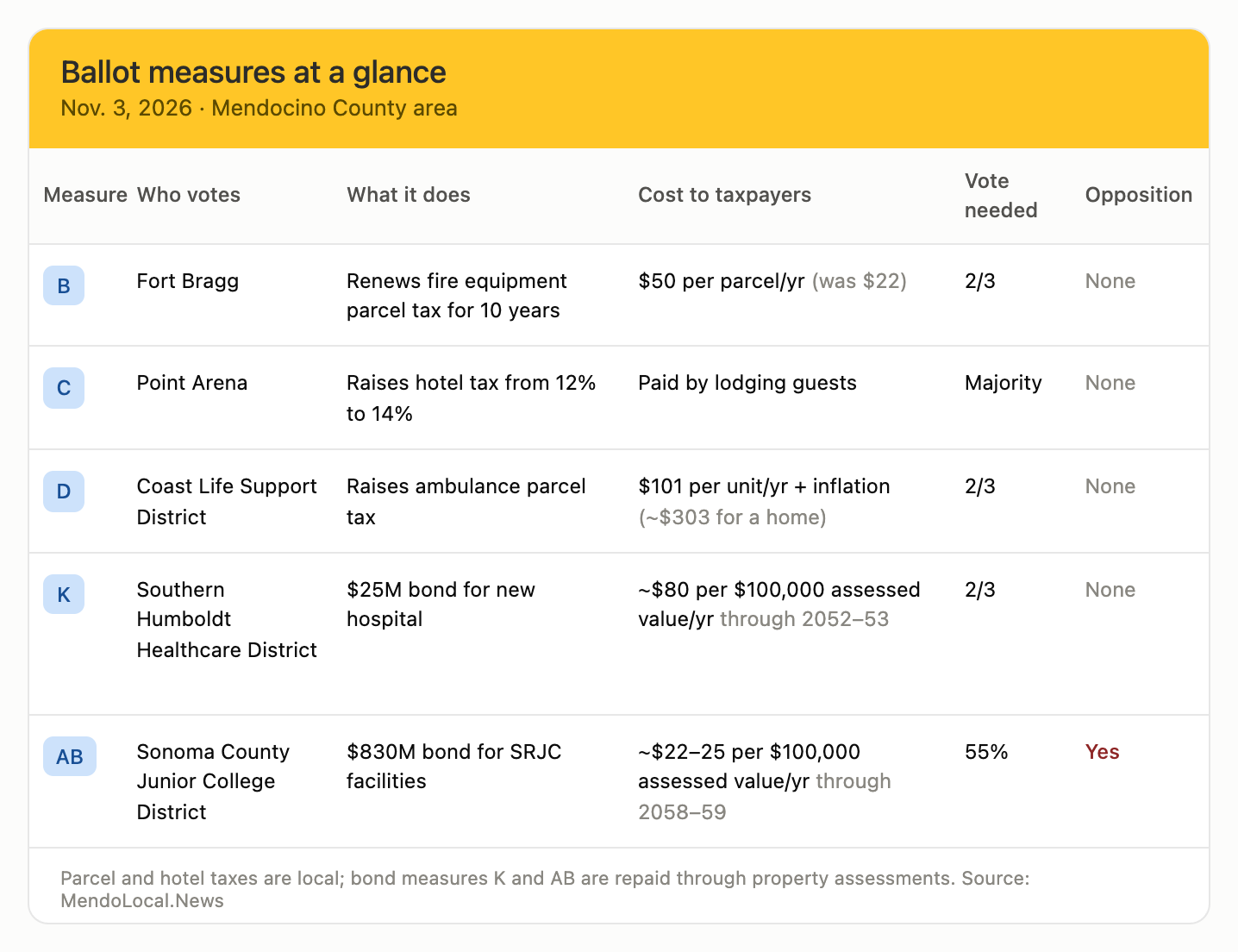
Mendocino County voters will decide five local measures on the Nov. 3, 2026 ballot, but no single voter will see all five and some may see no local measure at all. Each measure is decided only by residents of a particular city or special district: a fire equipment tax in Fort Bragg, a hotel tax in Point Arena, an ambulance tax on the south coast, a hospital bond on the county's northern edge, and a community college bond that reaches into the county's southern corner.
Four of the five drew no formal opposition. No one filed a ballot argument against Measures B, C, D, or K. Only Measure AB, the $830 million Santa Rosa Junior College bond, has a written argument against it.
Four of the measures need a two-thirds supermajority to pass. Point Arena's hotel tax needs a simple majority, and the college bond needs 55%.
Measure B: Fort Bragg asks to renew its fire engine tax, at more than double the old rate
Who votes: City of Fort Bragg residents. Needs: two-thirds.
Fort Bragg has paid for fire engines and other firefighting equipment with a dedicated parcel tax since 1983. Voters renewed it in 1994, 2004, and 2014, each time by the required two-thirds. The 2014 version, which charged $22 per parcel per year, has expired, according to the city attorney's impartial analysis.
Measure B would bring the tax back at $50 per parcel per year for 10 years, from fiscal year 2027-28 through 2036-37. The city estimates it would raise about $123,900 a year. The money could be spent only on fire equipment for the Fort Bragg Fire Department, would sit in a separate account, and the city treasurer would report on it to the council at least once a year. Raising the rate, extending the tax past 2036-37 or changing what the money can buy would require another two-thirds vote.
The case for: Supporters, including Fire Board member Bob Rossi and former Mayor Dave Turner, say the department's volunteer firefighters deserve safe, modern equipment. They describe the measure as a renewal of a 40-year local commitment, stress that the money cannot go to salaries, pensions, or other city programs, and note the 10-year sunset.
The case against: No argument against Measure B was submitted. The proposed $50 rate is more than twice the previous $22, and neither the measure nor the supporting argument explains how the $50 figure was set.
Measure C: Point Arena would raise its hotel tax from 12% to 14%
Who votes: City of Point Arena residents. Needs: simple majority.
Measure C would raise Point Arena's transient occupancy tax, often called the hotel tax, from 12% to 14% of room rent starting April 1, 2027. The tax applies to stays of 30 days or less at hotels, motels, inns, bed and breakfasts, vacation rentals, and similar lodging. It would remain in effect until voters repeal it.
The city attorney estimates the extra 2% would bring in about $35,833 a year. Mayor Barbara Burkey said the current tax brought in roughly $200,000 in fiscal 2024-25. Because the money goes to the general fund rather than a single dedicated purpose, it needs only a majority vote. The city council says the general fund pays for services such as keeping parks, beaches, restrooms, and public spaces clean and safe and supporting local businesses.
The case for: Mayor Barbara Burkey and Vice Mayor Dan Doyle argue the tax falls on visitors, not residents, while visitors rely on the city's roads, parks, parking, restrooms, and pier. They say every dollar stays in Point Arena and cannot be taken by the state.
The case against: No argument against Measure C was submitted. Because the revenue is general-fund money, the measure does not legally require it to be spent on tourism-related services; the council's description of uses is a statement of intent.
Measure D: South coast ambulance district seeks a bigger parcel tax
Who votes: Residents of the Coast Life Support District, which spans the Mendocino-Sonoma coast from Irish Beach south to Timber Cove. Needs: two-thirds.
The Coast Life Support District runs the ambulance service for a roughly 500-square-mile stretch of coast. Measure D would replace its 2020 parcel tax with a new rate of $101 per "unit of benefit" per year, adjusted upward each July by Bay Area inflation (CPI-U). It would take effect Nov. 3, 2026.
What a property owner pays depends on how the land is used:
| Land use | Units | Annual tax at $101/unit |
|---|---|---|
| Undeveloped agricultural, timber, pasture land | 0 | $0 |
| Vacant buildable lot | 1 | $101 |
| Single-family home | 3 | $303 |
| Farm with residence, or rural property with multiple buildings | 4 | $404 |
| Duplex | 6 | $606 |
| Other multi-family, including trailer parks | 8 | $808 |
| Institutions, utilities, schools, churches, hospitals | 8 | $808 |
| Stores, service stations, commercial and office buildings | 10 | $1,010 |
| Hotels, motels, restaurants, golf courses, theaters | 20 | $2,020 |
The money must go into a separate account for ambulance, life support, and related operating costs, with an annual report and public hearing. The ordinance sets no end date for the tax itself. It separately raises the district's state spending limit through fiscal 2030-31; going past that would take another vote.
The case for: EMS Chief Bronwyn Golly, board member Naomi Schwartz and community members say emergency calls have doubled and cost per call has risen more than 25% with no increase in tax funding. They describe the longest ambulance ride in California, with hospital round trips over 100 miles that often take more than six hours. The district staffs two ambulances, plus a third in Manchester when Garcia River flooding closes Highway 1.
The case against: No argument against Measure D was submitted. The tax carries automatic annual inflation increases and no sunset date.
Measure K: A $25 million bond to replace Southern Humboldt's 77-year-old hospital
Who votes: Residents of the Southern Humboldt Community Healthcare District, which extends into northern Mendocino County. Needs: two-thirds.
The district runs Jerold Phelps Community Hospital in Garberville, along with a clinic, pharmacy, and other services. It says the hospital building, now 77 years old, does not meet upcoming state earthquake-safety rules under Senate Bill 1953, which require hospitals to withstand a quake and keep running when cut off from power and water.
Measure K would let the district borrow $25 million through general obligation bonds to build a new hospital. Planned features include a larger emergency room, upgraded building systems and equipment, accessibility improvements, and a helicopter pad for life-flight transfers. The district says the bonds would also serve as matching money to unlock other construction funding. Bond money could not pay salaries or operating costs.
The cost: The district's tax rate statement estimates 8 cents per $100 of assessed value, or $80 per $100,000, every year from 2027-28 through 2052-53. Total repayment with interest is estimated at $50.4 million. The impartial analysis notes that according to the California Constitution such an ad valorem tax on real property may not exceed 1% of the full cash value of the property, however, the constitution provides for an exception when the tax is used to pay the bonded indebtedness for the acquisition and improvement of real property that has been approved by a two-thirds vote. The analysis also flags that medical equipment, one intended use, likely does not qualify under the constitutional exception that allows bond-backed property taxes for real property.
The case for: Supporters, including Redway Fire Chief Seth Ayers and Southern Humboldt Chamber of Commerce Director Yvonne Hendrix, call Jerold Phelps the only hospital for a vast rural area. They say it began as a converted home, its roof, floors, and plumbing are failing, and state law requires it be replaced within three years or closed. They warn closure would be catastrophic for communities that can be cut off by fires, storms, and earthquakes. They also promise new services such as MRI and bone density scans, and local jobs.
The case against: No argument against Measure K was submitted. The supporters' argument says a citizens' oversight committee will hold bond money until matching funds arrive, but that committee and condition do not appear in the measure's legal text, which requires an annual report to the board instead.
Measure AB: Santa Rosa Junior College's $830 million bond, the only contested measure
Who votes: Residents of the Sonoma County Junior College District, which covers Sonoma County and parts of Marin and Mendocino counties. Needs: 55%.
Measure AB would authorize $830 million in bonds for Santa Rosa Junior College's Santa Rosa and Petaluma campuses, its Public Safety Training Center, and its Roseland and Shone Farm centers. The project list is broad: nursing and health labs, firefighter and EMT training facilities, trades and agriculture programs, leaky roofs, earthquake and fire safety, technology and cybersecurity, energy upgrades, and possible student and workforce housing. Inclusion on the list does not guarantee a project gets built.
The cost: The district estimates an average tax of $22 per $100,000 of assessed value and a peak of $25 per $100,000 in 2041-42, collected through 2058-59. Total repayment is estimated at $1.76 billion. The measure requires annual audits, a citizens' oversight committee, and a ban on using bond money for salaries.
The case for: Supporters, including Assemblymember Chris Rogers, the student body president, a fire academy instructor, and a registered nurse, say SRJC trains much of the region's nurses, firefighters, EMTs, and tradespeople. Their central claim is that the measure will not raise tax rates because it replaces expiring bonds. They also cite endorsements from Reps. Mike Thompson and Jared Huffman, State Sen. Mike McGuire, and the Sonoma County Democratic Party, and argue hands-on trades training matters more as AI reshapes the job market.
The case against: Sonoma County resident Andrew J. Smith argues the college has not shown how it arrived at $830 million, double a previous $410 million bond, and offers no building-by-building cost list. He says the tax rate is only a projection that could rise, that total repayment roughly doubles the borrowed amount, that underwriting costs will shrink the money available for projects, and that higher property taxes could be passed on to renters.
The fact check: Both sides have a point on taxes. The ballot question itself says "without increasing tax rates," but the tax rate statement and county counsel both describe the rates as estimates that are not binding on the district and could change with interest rates, bond timing, and property values.
Sources: full measure texts, impartial analyses, tax rate statements, and ballot arguments for Measures AB, B, C, D, and K, Nov. 3, 2026 election.