
Contributions to the District Three Supervisor's Race Draw Scrutiny
In the District 3 supervisorial race, Buffey Bourassa has out-raised Eric Hart — and three of her contributors raise questions.
If recent years are any indication, running for election to the Mendocino County Board of Supervisors does not take much money. Candidates for the five-member board routinely mount their campaigns on a few thousand dollars: Bernie Norvell raised $5,000 in his 2024 District 4 race, Adam Gaska about $6,500 in a District 1 bid the same year, and Mo Mulheren just $2,100 when she ran as an incumbent representing District 2 in 2024. Even the costliest recent contests — hard-fought fights for open seats — have topped out around $56,000 to $60,000, the sums Madeline Cline and, four years before her, Mulheren raised to win District 1 and District 2.
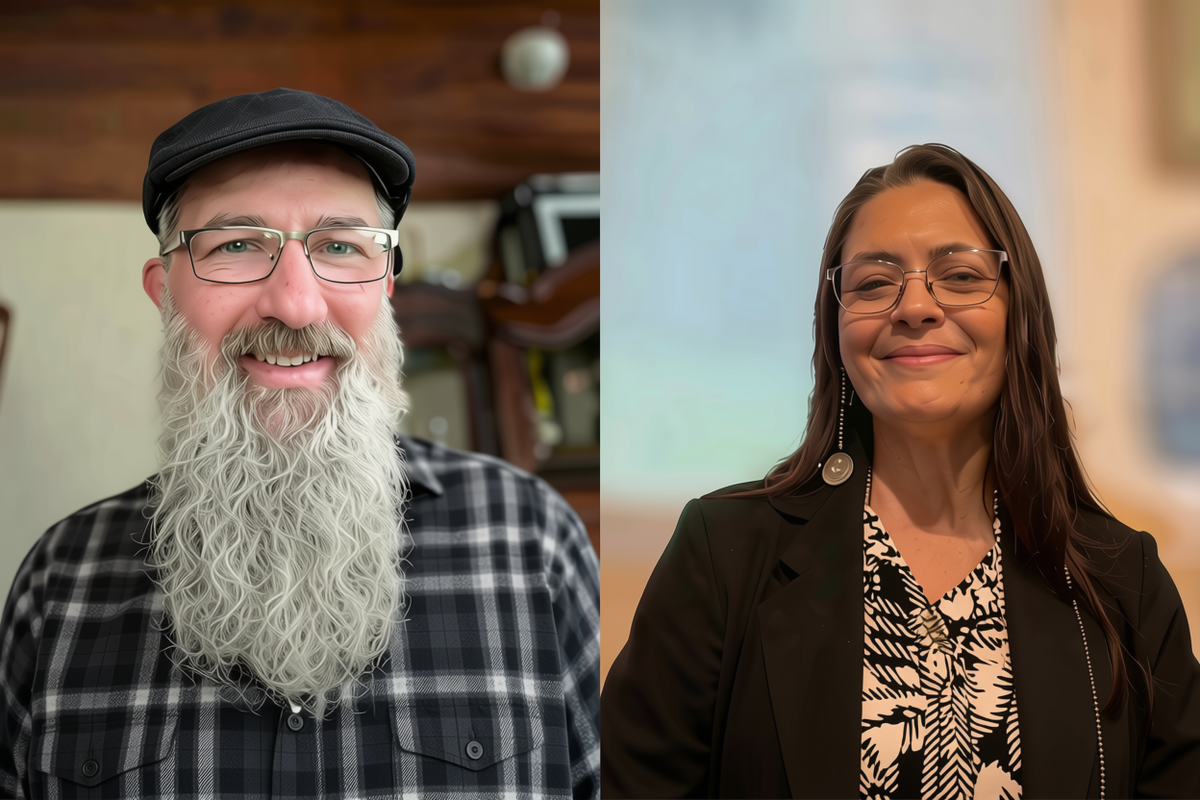
The District 3 runoff between Buffey Wright Bourassa and Eric Hart is also a contest for an open seat, but neither candidate has come close to those totals. Bourassa has out-raised her opponent, taking in $30,663 so far this year; Hart has largely paid his own way.
When campaigns are this modest, a few contributions can really stand out. In Bourassa's filings, the ones that do come from a gas-station developer with permits pending before the county, an organizer of a group that has sued the county, and her own boss, the sheriff.
When Mendocino County Sheriff Matt Kendall decided to back Bourassa, he did more than write a check. He told her he intended to contribute — she said that would be great, he recalled — and figured his two brothers would give as well. "If the twins and I want to donate to her campaign, that's my business," Kendall said in an interview with MendoLocal.News. He gave $500; his brothers Luke and Mark Kendall each gave $100 the same day.
Bourassa is not only the candidate the sheriff is funding. She is, for now, one of his employees — a restorative justice program manager in his office since 2023. "If you win, you'll have to quit," Kendall said he told her. Replacing her would be "the hardest part for me," he said.
A review of six years of Mendocino County supervisor campaign filings turned up no other contributions from the sheriff to any board candidate. Kendall said he had offered to contribute to the campaigns of Supervisors Ted Williams and John Haschak, and that both politely turned him down, telling him they did not need the money.
Two of Bourassa's donors are tied to matters that have come, or could come, before the board she is seeking to join. A $1,000 contribution came from Concord Terminal Shopping Center LLC, a company managed by Farah Alam. State business records show Farah Alam and Mahmood Alam jointly manage a network of property-holding companies. Faizan Corporation and 898 Main Street LLC won a contested county use permit this year to build a gas station in Redwood Valley over neighbors' objections, and a company Farah Alam manages is seeking a separate permit for a gas station in Laytonville. Farah Alam was named in 2019 as a discharger in a state cleanup and abatement order over gasoline in the groundwater at a Ukiah property she and Mahmood Alam co-owned; in 2023, Faizan Corporation and Mahmood Alam agreed to pay $500,000 to settle environmental and consumer violations brought by seven district attorneys. The permit co-applicant, 898 Main Street LLC, has been suspended by the state Franchise Tax Board since May 2025.
Mahmood Alam has disputed both enforcement matters. Responding earlier this year to questions about the Redwood Valley permit, he said he and Farah Alam were named in the 2019 order on information "later determined to be inaccurate," that later testing found no contamination attributable to the property, and that the case closed without penalties. He described the 2023 settlement as covering reporting and compliance deadlines rather than any fuel release, and said Faizan Corporation had retained the environmental consultant the judgment required.
A second $1,000 donation came from Dan Potash, an organizer of the Mendocino Preservation Fund, the group whose challenge to the board's decision allowing the demolition of the Mendocino water tower was dismissed by a Superior Court judge this year and is now on appeal.
Asked whether she would step aside from votes involving those donors, Bourassa said her contributions carry no strings. "A contribution does not buy access, influence, or a vote," she wrote. On the Alam money, she said she had "made no commitment to Farah Alam, Mahmood Alam, or any related business concerning either gas station project," and that if such a matter came before the board she would disclose the contribution, seek guidance from County Counsel and, if necessary, the state Fair Political Practices Commission, "and recuse myself if required." She gave the same answer for the Potash contribution and the water-tower litigation.
She drew a line, though, at the sheriff. Bourassa said she would not recuse herself from decisions on public safety or the sheriff's office budget "solely because these individuals contributed to my campaign," calling those decisions "a central responsibility of a County Supervisor" that affect every resident. She said she would review the sheriff's budget "as I would any other department's" and step aside only if a specific matter created a legal conflict. Kendall, she said, is "best positioned to explain his reasons for supporting me," which she attributed to her work in his office; neither he nor his brothers, she said, had asked for anything in return.
State law sets one clear boundary. Under the Levine Act, a local official may not take part in a decision on a permit, license, other entitlement for use, or a contract if the official accepted more than $500 from a party to that proceeding within the previous 12 months — a threshold the Legislature raised from $250 at the start of 2025. That rule would apply to the Alam gas-station permits if one reached the board within a year of the Concord Terminal contribution. The county has no local limit of its own on how much a single donor may give; the ceiling is the state default of $5,900 per donor per election. Bourassa has one donor at that ceiling: Mary Guibert of Willits, listed on the filing as the estate manager of the late musician Jeff Buckley, gave $11,800 across the primary and the runoff — the most allowed in each.
Hart has taken a different approach — scrutinizing the donations that come in. He said he personally reviews every donation over $100, both to learn "who cares enough to donate" and to "verify whether they have any business before the county, or may be pushing a certain agenda," and that he meets personally with anyone giving a significant amount. He said it’s a matter of courtesy as well as vetting. A donor with business before the county, he wrote, is "an automatic no," refused "immediately and politely" with his thanks.
Hart has funded his campaign largely from his own pocket, lending it about $11,800, and said he front-loaded the race with money he had set aside to buy a new car so that he would not have to fundraise before the primary. His outside contributions are smaller and mostly local, but they include $2,000 from his wife, Jillian Tatum, and $4,580.10 from the Mendocino County Democratic Party — his largest single donor. He said he has returned no contributions, having accepted only two from donors tied to nonprofits that work with the county, for $250 and $200. He stated that he would recuse himself from a vote involving a significant recent donor and, at a minimum, would disclose the relationship publicly.
Haschak, who has held the District 3 seat and once proposed that the county adopt its own lower limit on campaign contributions, said accepting money from people or entities with matters before the board "does raise questions." State law, he noted, calls for a supervisor to "recuse yourself for one year after accepting such contributions." His own proposed contribution-limit ordinance, floated in 2024, never became law. Haschak said it stalled amid turnover in the County Counsel's office, and he is unsure the current board would support it. Haschak estimated he raised about $20,000 in his last campaign, in 2022, though the county's online filing system has no record of the disclosure statements he says he filed.
Kendall kept money out of his own campaigns for sheriff, he said. When he ran, licensed cannabis growers offered to contribute, and he turned them down. "I didn't take any donations. I had a lot of people sending me checks that I just sent back," he said. "I didn't want to be in anyone's pocket."
Editor's note: MendoLocal has reported separately on the gas-station permits sought by Faizan Corporation, and on the Mendocino Preservation Fund's litigation over the Mendocino water tower.
This story is published under the Creative Commons 4.0 license