
Can't Afford to Stay: Fort Bragg Teachers Make Their Case as the Schools Shrink
As Fort Bragg Unified faces declining enrollment and a tightening budget, four teachers pressed the school board for a cost-of-living raise, laying out what it costs to live on their salaries.
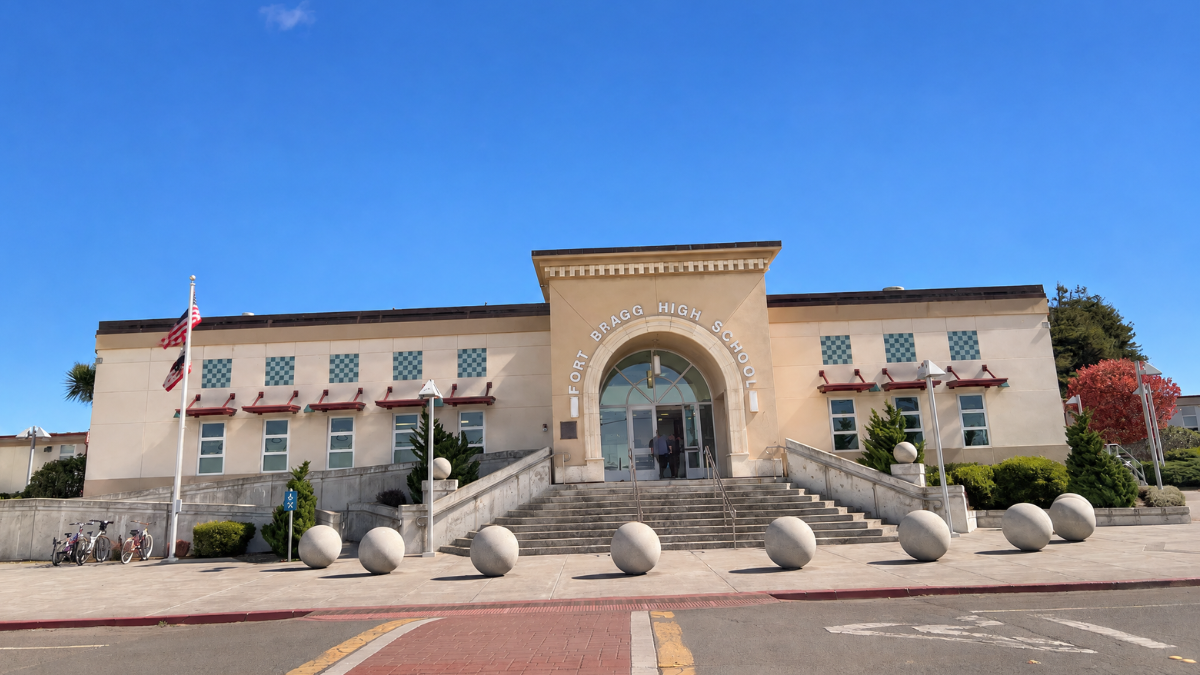
Correction: An earlier version of the article stated that Joel Zika earns $71,000 and spends roughly half of his salary on rent, electricity and student loans. In fact, Zika's salary is $61,000 and two-thirds of his salary goes to rent, electricity, and student loans. (6:32 p.m. November 23, 2026)
FORT BRAGG, Calif. — Joel Zika teaches geometry and calculus at Fort Bragg High School, tutors two afternoons a week, and after five years in the district earns about $61,000 a year. By the time he covers $1,600 in monthly rent, a $300 electric bill, and the roughly $337 in student-loan payments resuming this fall, he has spent about $2,200. This is "before I buy groceries, buy gas and all my other bills," he told the school board on November 12. A back-of-the-envelope calculation shows that's roughly two-thirds of this take-home pay — before milk, eggs, car payments or anything set aside for a rainy day, much less a down payment.
Zika was one of four Fort Bragg teachers who asked the school board for a cost-of-living adjustment to the certificated salary schedule, laying out their modest household finances for the board. Their appeals collide with a budget the superintendent says is strained by declining enrollment, which has cost the district more than 100 students since 2023-24, with at least 100 more projected by 2028-29.
The teachers belong to the Fort Bragg District Teachers Association, whose contract with the district remains unsettled. Earlier in the meeting the board ratified a separate 2% salary settlement with the California School Employees Association, the classified unit that covers support staff, retroactive to July 1. Board President Kathy Babcock noted for the record that the classified deal has no bearing on the certificated talks, which continue without an agreement.
Zika said he earned his teaching credential at Fort Bragg High School and has built a career in the district. Hower, his electric bill has doubled from $150 since he moved to the coast, he said, and the roughly $17,000 in student-loan forgiveness he received for five years of service is now giving way to monthly payments as a forbearance period ends. "What we're asking is really not that much," he told the board, adding that it would help the district keep teachers like him.
Jess Green, a fifth-grade teacher at Dana Gray Elementary speaking for the teachers association, compared Fort Bragg's salaries with districts in places that cost the same or less to live — Ukiah, Willits, Eureka, Del Norte, Konocti, and Clear Lake — using cost-of-living figures she attributed to uscostofliving.com, which draws on federal data.
A new Fort Bragg teacher earns $58,097 a year against a comparison-group midpoint of $57,887 — roughly even in raw dollars, Green said. But Fort Bragg's cost of living runs about 16% above the national average while the comparison districts sit at or below it, she said, so once local prices are counted, a new Fort Bragg teacher effectively starts about 13% behind the midpoint — "over $600 a month in lost purchasing power." In Ukiah, where costs are lower, teachers start more than $2,000 a year higher, she said.
"When a district starts teachers behind its neighbors, it becomes harder to recruit and easier to lose teachers to places that pay more and cost less to live in," Green said. She asked the board to approve a cost-of-living adjustment to the certificated salary schedule and to build a recurring, pass-through adjustment into the contract so the two sides would not have to renegotiate the comparison each year. A one-time payment, she said, "does not close a gap that is measured against what it costs to live here year after year."
Jocelyn Sugrue, a humanities teacher at Fort Bragg Middle School, delivered her comment as a poem, contrasting local pay with Sacramento, where she put the median teacher wage at $90,000. A written comment from Vicki Wellspring, a teacher at Redwood Elementary, urged the board to approve the full cost-of-living adjustment the state authorized for the year, citing a roughly $1,000 medical bill her family absorbed after an insurance change left a deductible uncovered.
Babcock told Green the board would not vote the raise up or down that night. "It goes back to the bargaining table," she said, inviting the teachers to take questions to the superintendent directly but declining to discuss the closed-session direction given to negotiators.
Superintendent Joseph Aldridge addressed the budget in his report. Fort Bragg Unified's estimated ending fund balance sits at about $8.79 million, Aldridge said, though he cautioned the figures are preliminary, drawn from early numbers before the district's first interim budget report is complete. Of that total, $4.85 million is restricted — tied up in grant limits and categories such as community-schools funding that cannot be spent on ongoing salaries. That restriction, he said, is why the district's certificated offer pairs a 2% ongoing raise with one-time money — a $1,600 one-time payment and $800 toward benefits — rather than a larger permanent increase. "That's not considered ongoing from the state," Aldridge said of the one-time funds. "It's pretty frustrating in that regard."
The district has lost 106 students since 2023-24 and expects to be down to about 1,472 or fewer by 2028-29, a decline of at least another 100 students, Aldridge said. Over the same period, the number of students with disabilities rose from 221 to 236. Aldridge said he does not expect to avoid staffing reductions in the spring. He also pointed to about $145,000 in new paid-pregnancy-disability-leave costs, which he said the state's cost-of-living funding does not cover.
Diana Paoli, a trustee stepping down after 10 years on the board, told her colleagues in her final remarks that declining enrollment and budget pressures lie ahead.
You Read Our Stories. Please Help Fund Our Newsroom.
MendoLocal.News was created by locals for locals. We pay attention and dig deeper and we distribute for free. With your support, we can keep going.