
An Oxford Historian Captured Mendocino's Weed Stories Before They Disappeared
British historian Charlie Harris on his book "Mendo": how Mendocino County went from logging and fishing to the heart of the Emerald Triangle's cannabis trade. Interview by Mendo's own Richard Miller.
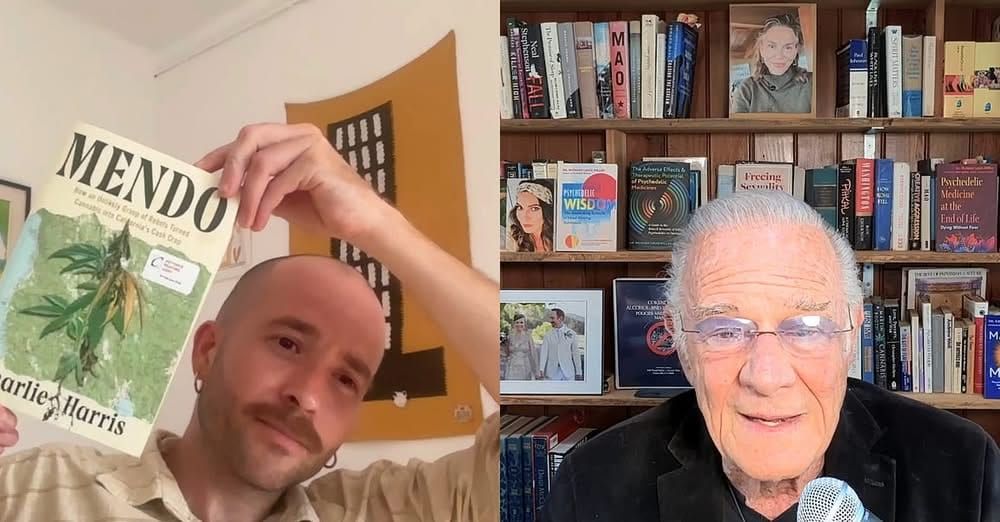
British historian Charlie Harris — a onetime North Coast cannabis trimmer who studied the war on drugs at Oxford — spoke with Dr. Richard Louis Miller, a longtime Mendocino County resident, on Miller's Mind Body Health & Politics podcast about Harris's book Mendo (Counterpoint Press, June 2026), a history of how Mendocino County became the cannabis capital of the Emerald Triangle. Miller, who says he has been coming to the county since 1975, draws on his own memory of the era throughout. Edited and condensed for clarity from an auto-transcript of the ~60-minute conversation.
Miller: How did a guy from England come to write a book about cannabis in Mendocino County? Take it from the top.
Harris: I started the way a lot of people did — I really liked cannabis. I was 21, studying abroad in Vancouver, and hitchhiking up the West Coast in 2014. A guy picked us up near Bodega Bay and, as we got into southern Mendocino County, offered to let us stay with him. It turned out he lived on a pot farm. I'm from the UK, where buying cannabis then meant parking-lot deals and hustling all day for a gram — so the abundance stunned me. I started coming back to trim. I was a lousy trimmer, honestly — too interested in smoking pot and surfing — but I kept coming back.
Miller: And then you went to graduate school?
Harris: I went to Oxford for a master's in U.S. history, and I worked for the Global History of Capitalism project there for about eight years. I got into the history of informal markets, which led me to war-on-drugs history — and back to Mendocino, this time as a researcher.
Miller: Why write the book?
Harris: When I first started going to Mendo, everything was paranoid and closed — it was still illegal. Then it became legal, even "nauseatingly mainstream." But all these people had extraordinary stories about black-market living and building a community around cannabis, and almost none of it had been written down. My pitch to growers on the North Coast became: we need to get these stories down before they disappear. People who'd spent their lives keeping this secret trusted me to record it. That was the great privilege of my life.
Miller: How did a fishing and logging area for over a century become the epicenter of American marijuana production?
Harris: Mendocino's whole story is new people moving in. It didn't have gold, but it had old-growth redwoods — the tallest trees in the world, fed by the Pacific fog. The loggers saw a bounty and pulled them out. But when you cut a redwood, several identical trees spring from the stump and grow too close together to get big — so you're left with an unproductive forest. The logging boom ended suddenly in the 1960s, and it took fishing down with it: logging debris wrecked the salmon streams. By the late '60s the land had been stripped, nobody wanted it, and North Coast property prices collapsed.
Meanwhile, down in San Francisco, the joyful hippie thing was turning sour — hepatitis outbreaks, a housing crackdown, violence in 1968. Out of that came the Back-to-the-Land movement: the idea that hippies should reconnect with the earth and live off the land on communes and farms. It was, believe it or not, the largest urban-to-rural migration in human history — human history normally runs the other way.
Miller: And they used marijuana as currency.
Harris: They tried to live off the land and discovered, as one ex-commune member put it beautifully, "we couldn't grow gasoline." Traditional farming was hard. But back then almost every bag of weed had seeds in it, so everyone planted some — and it was the one crop they could trade and sell. People paid rent with it, got their cars fixed with it. That was the beginning.
Miller: You were here for the homesteading wars.
Harris: The county tried to drive the hippies out by red-tagging their hand-built houses as "unfit for human habitation" — inspectors would literally fly into the woods in single-engine planes and tag people's doors. But it backfired. Locals hated the hippies, but they hated the government more. To those old libertarian loggers, nothing is more American than building your house with your own two hands — and the idea the government could order you to tear down your family home was unacceptable. So a coalition formed. The way it's told in Mendocino is: you had the hippies and the rednecks, and they didn't get along — until they did, and formed a new generation, the "hipnecks." The rednecks saw the hippies were making real money growing pot, and the county had been brutally poor. Pot became the way to make a living.
Miller: Then the mills closed.
Harris: They'd over-logged, so the mills went out of business and hundreds of logging families were suddenly out of work. Many went into marijuana — and nobody knew the timberlands like them. You didn't grow on your own property; you'd hike or dirt-bike out to a clear-cut, run a trickle of irrigation from a summer-running stream, and tend it every few weeks. Laid-off loggers knew every inch of that forest. And community knits together generation by generation — one man told me nothing did more for relations between old-timers and newcomers than the high-school quarterback being a hippie. But he was fast.
Miller: Was there a political change in the 1980s?
Harris: You get Ronald Reagan and an intensification of the war on drugs. Local sheriffs didn't much care — their buddy from the mill growing a little weed didn't hurt anyone. But Reagan sent in the National Guard and formed CAMP, the Campaign Against Marijuana Planting, in 1982; its first real year was 1983. It was the largest domestic law-enforcement operation in the country and the first to use military equipment — Huey helicopters straight home from Vietnam, guardsmen hanging out the side. They'd play "Ride of the Valkyries." They loved playing soldier in the woods.
Miller: And this is where asset forfeiture comes in.
Harris: CAMP was a testing ground for new ways of fighting your own citizens — and one of them, civil asset forfeiture, was first used in Mendocino County. The very first application was a young couple making an honest go of ranching who had a corner of pot plants; the federal government offered to drop charges if they signed the ranch over. Eventually they did. What's crazy is CAMP arrested very few people but claimed a lot of property. I spent weeks in the records asking what the point was — until I found the budget reports. Every single year those choppers flew, it turned a profit. Growers had a nickname for it: the Campaign to Aid Marijuana Prices. Every plant they cut made the rest worth more, and every night they were on the news calling California weed dangerously potent — which just made everyone want it.
Miller: Is that when California weed started beating Mexican weed?
Harris: It knocked it out of the park. At the same time, growers switched genetics — going from equatorial sativa to indica seeds from places like Nepal and Pakistan, which grew far more happily in the Northern California photoperiod. That's when you get the kushes. By the mid-to-late '80s, California weed got really, really good.
Miller: What changed after Reagan?
Harris: The politics fragmented — a firmly anti-pot federal government, a famously relaxed Mendocino County, and a state of California slowly softening. The county practically functioned as a narco-state: a local radio station ran a "traffic report" where people phoned in the location of CAMP helicopters and police convoys, and juries would never convict a grower they liked. In 1996 California legalized medical marijuana, and things really changed. DA Norm Vroman made it publicly known he had no interest in prosecuting growers — he was almost certainly a grower himself; the feds were preparing a warrant on his home when he died — and he built the first medical-marijuana permit system in North America, which was, of course, entirely illegal under federal law.
Miller: And prices started to fall.
Harris: People planted much more. Ballot measures let you grow, say, 25 plants without the sheriff coming after you — and 25 plants outdoors could net you $100,000. Word spread, more people came, and homes got scooped up as grow sites, which priced out teachers and bus drivers. The middle class held up through the subprime crisis, but the working class suffered. Then legalization crashed prices for good. Part of it was hedge funds — believe it or not, they helped ruin American cannabis, propping up operations like Flow Kana that sold below cost and undercut traditional farmers, the way Uber undercut taxis. Part of it was simple overproduction as other states legalized. Everything that made Mendocino a great place to grow outlaw weed — remote, rugged, permissive — made it a terrible place to run a legal farm. A pound that brought $5,000 in the '80s recently sold for under $500. When you think about it, the grower is paid a fifth of what they used to be, while the consumer pays about the same — the dispensaries, transporters and the state's brutal taxes take the middle.
Miller: What's your concern about the product today?
Harris: Potency. Nobody actually wants stronger weed — but it keeps getting stronger because of the economics. Weed today is comfortably more than ten times as strong as in the '70s and '80s: back then it was 1 to 3% THC; now 22% is a baseline in a California dispensary, and vape concentrates advertise 90% THC. A huge amount of our legalization case was built on studies of something completely different — it's like repealing alcohol prohibition on the promise that all you'd drink is Bud Light, and then all you drink is absinthe. Those 90% vapes, often made with butane-extracted hash and glycerol, have a very different effect on the lungs and brain than 2% organically grown pot — and the research isn't keeping up. I've smoked cannabis daily for 16 years; I'm not a square. But I suspect people with kids, are saying "I'm not so sure about this".
Miller: Give us a quick word on marijuana in England.
Harris: Our culture's shaped by Amsterdam's proximity — mostly sativas: amnesia haze, super silver haze, a lot of "cheese." We used to get great Moroccan hash, but less now. More and more is grown indoors in the UK. It's still very much illegal — you still buy it from a guy in a hatchback playing loud music with an annoyed-looking girlfriend in the passenger seat — but medical permits are starting to appear, mirroring what happened in America: legalization comes bottom-up, once enough people are just doing it. And as in the States, the racial disparities in policing and arrests are huge.
Miller: The name of the book again?
Harris: It's called Mendo, published by Counterpoint Press. You can get it from Counterpoint, Penguin Random House, or Barnes & Noble — but please support your local indie bookstore first; if they don't have it, ask them to order it. And honestly, even more than the book, I recommend visiting Mendocino County. Tourism is about all it's got left.
Miller: Any last thing?
Harris: I'm just so grateful to Mendocino County — for the people, the community, the years of inspiration and friendship, and yes, the great waves and sunburns. In an age of reactionary politics, a lot of us have a difficult relationship with America. But I have real hope for it, and it endures in Mendocino County. It's one of the most special places on earth.
Editor's note: The transcript was edited to reflect that concern that parents with children may have about the increased potency of cannabis. The Q&A incorrectly stated that Miller has children. He does not. (12:27 p.m. August 19, 2026)