
Seeds of Change: Mendocino Coast Farmers Cultivate Crops That Adapt to Their Environment
With adaptation gardening, melons, squash and other crops flourish on coastal bluffs
The next seed exchange in Mendocino County will be held Saturday, March 14, at the Anderson Valley Grange. See the Mendocino County Seed Libraries Facebook page for more details.
There will also be a community seed swap in Fort Bragg on Saturday March 28, at the Fort Bragg Library, from 2 p.m. to 4 p.m.
Imagine a garden where plants thrive not because of careful breeding or advanced fertilizers, but because they’ve learned to adapt to their environment.
Now imagine these plants growing from seeds that are entirely natural. They aren’t carefully bred hybrids controlled by corporate patents. They are strong, wild, and free — and packed with nutrients, far more than the vegetables sold at the supermarket.
This isn’t a futuristic fantasy. It’s the result of applying the principles of adaptation gardening, a movement spreading around the world thanks to pioneers like Julia Dakin, a farmer in Caspar, CA, and Joseph Lofthouse, a farmer from Utah.
Their approach — also known as landrace gardening — focuses on cultivating crops that are genetically diverse and freely pollinating, allowing them to evolve and adapt to local conditions.
A WORKING MEADOW
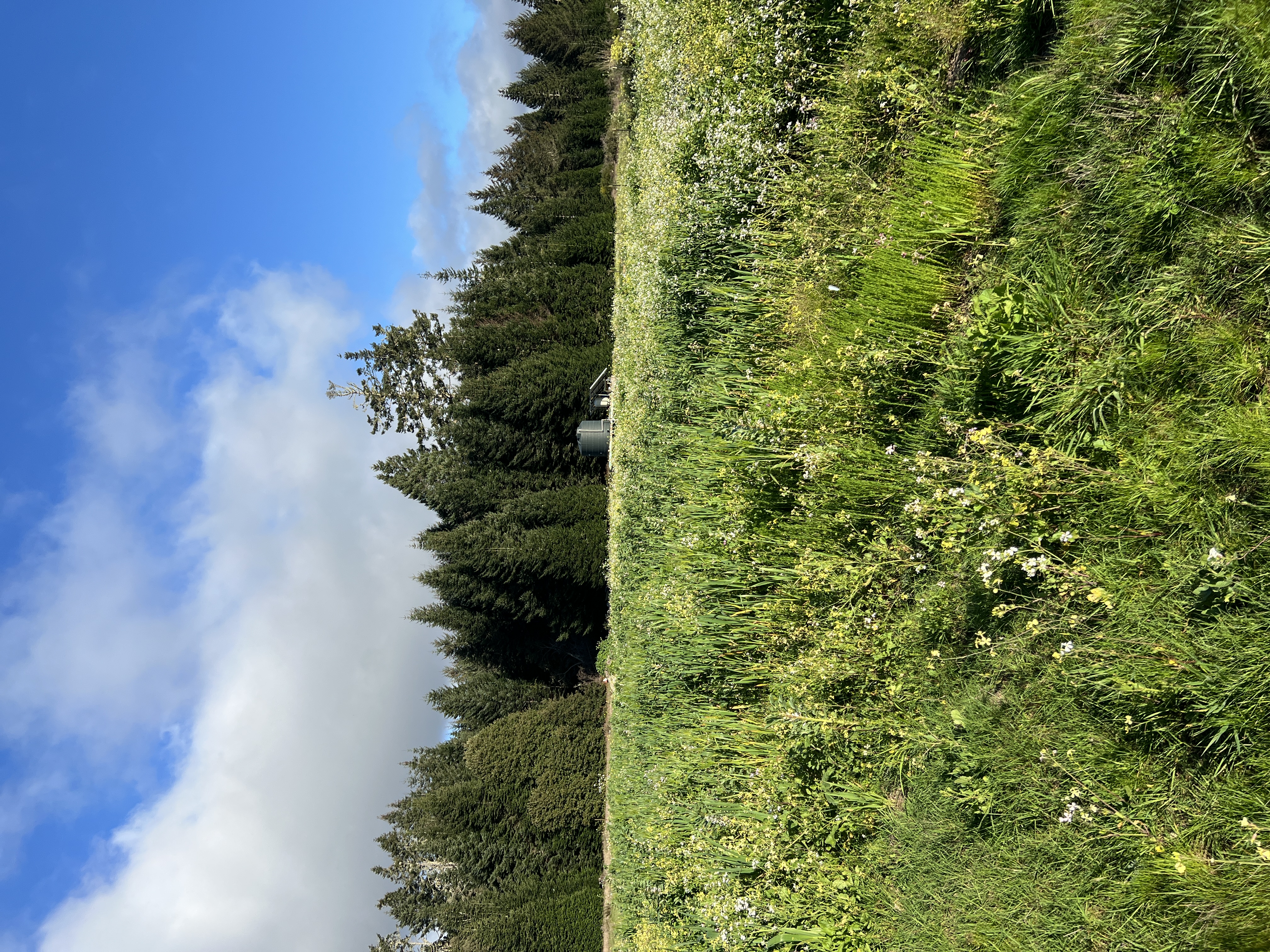
Julia Dakin moves slowly through a field of fava beans, her hands brushing through white and purple flowers and tender green leaves.
It’s early March on the Mendocino Coast, in farm in Caspar known as the Field of Dreams, and the plants are months away from harvest.
Dakin planted fava to give the earth and herself a rest. Favas are a winter crop — rich in protein for humans, nitrogen-fixing for the soil. As they grow, their long taproots will break up the ground and improve water filtration, readying the field for spring planing.
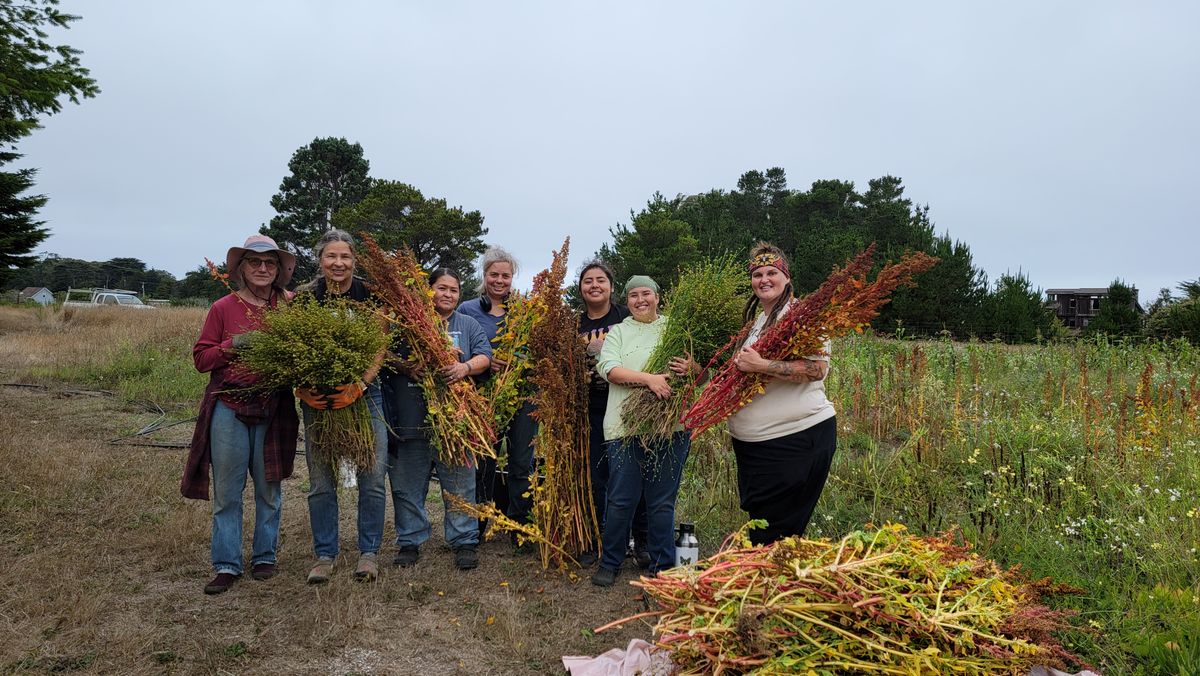
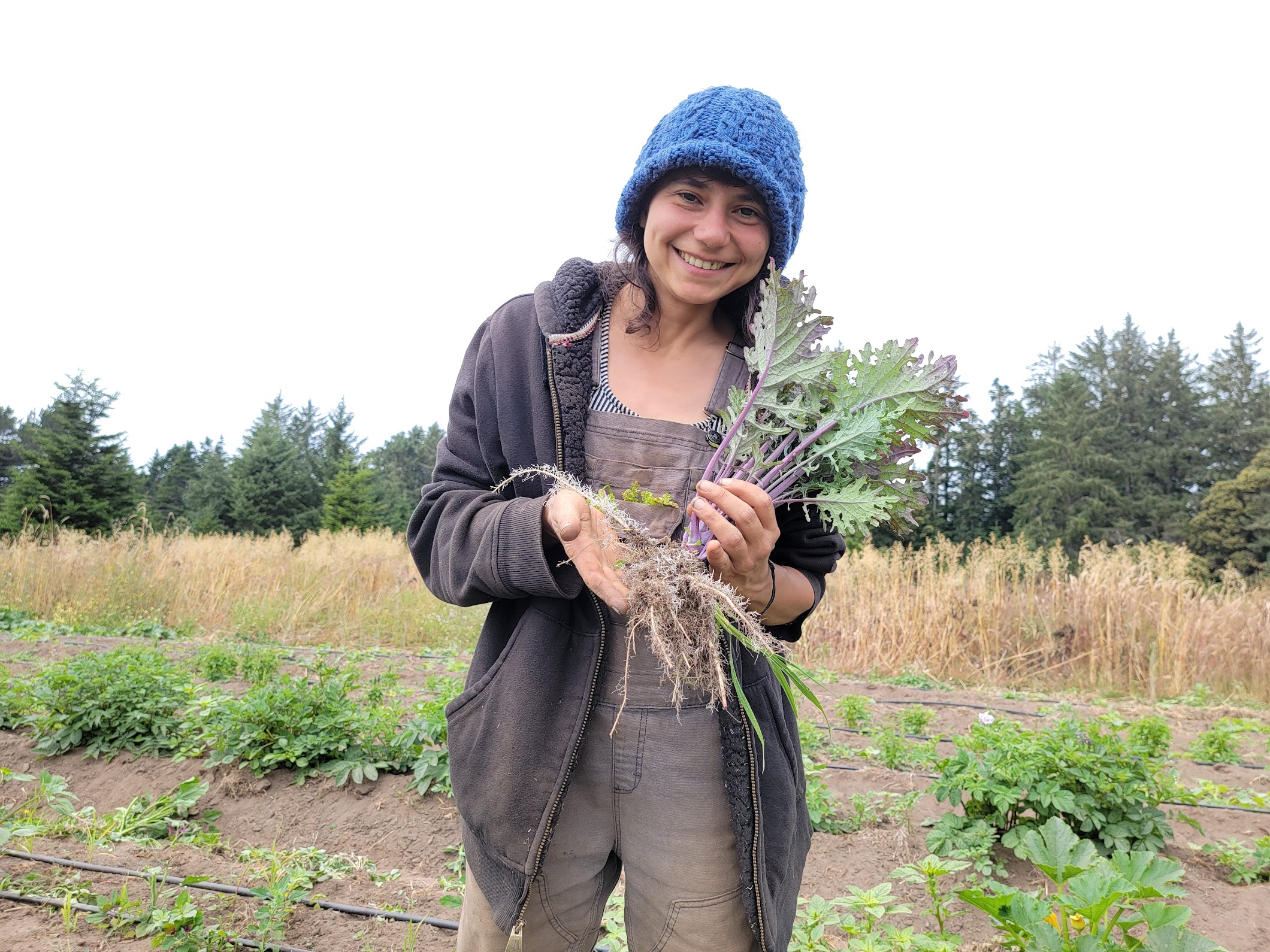
Later in the summer, Dakin — and a team of volunteers led by Matilda Hernandez-Miyares — will grow food crops here. The seeds from successful plants will be harvested and shared at seed exchanges, where gardeners across the county, country, and the world will continue the process of adapting them to their own fields and gardens.
PLANT BY PLANT
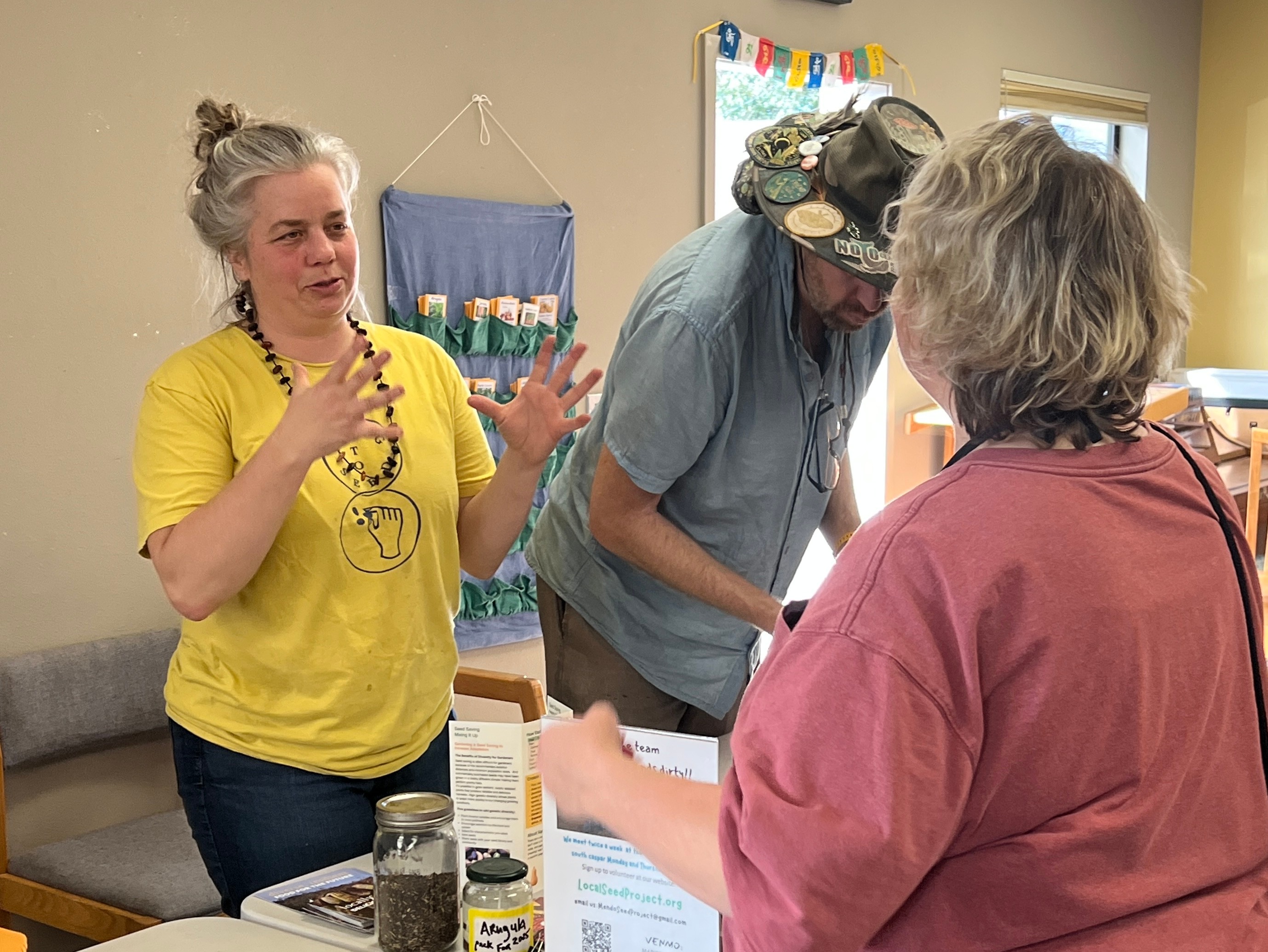
Two rows of tables line a narrow room in Fort Bragg. Gardeners move slowly from table to table, browsing neat stacks of manila packets of seed — celery, beets, carrots, radishes, corn, melons, herbs and more.
From time to time, someone stops to talk to Dakin or another volunteer about their garden. They describe how much sun it receives, whether it sits in the fog belt, or if the soil is rocky or acidic. They want to know what plants are most likely to flourish.
There isn’t time today to explain the full principles of adaptation gardening — or how, with patience, gardeners can dramatically expand the diversity of their crops.
For now, it is enough to encourage people to plant something — to take that first step toward helping reverse the worldwide decline in the nutritional quality of food crops.
HIGHER YIELDS, LOWER LEVELS OF NUTRIENTS
Scientists around the world have documented an alarming decrease in essential minerals and nutraceutical compounds in fruits, vegetables, and other crops, with troubling consequences for global health.
Leslie Amoroso, a nutritionist at the Food and Agriculture Organization of the United Nations counted more than 2 billion people suffering from micronutrient deficiencies. Since Amoroso’s article was published in 2014, the decline in nutritional value has continued.
A review of scientific literature published ten years later attributed the decline to the so-called green revolution in agriculture. “Since the 1940s, crop yield and the per-capita availability of foods have been continuously increasing due to intensive farming techniques, artificial fertilization, pesticides, irrigation, growing high-yielding varieties … whereas malnutrition tends to increase incessantly due to disrupting the fine balance of soil life and decreasing the nutritional density and quality of the food crops,” the authors wrote in “An Alarming Decline in the Nutritional Quality of Foods: The Biggest Challenge for Future Generations’ Health,” published by MDPI.
The crisis hit home for Dakin in 2020. She was working in regenerative agriculture focused on soil health. It was — and still is — widely accepted that fertile soil will produce crops with higher levels of essential vitamins, minerals, antioxidants, and phytochemicals. But the relationship is far from straightforward. Indeed, a 2018 report from the Bionutrient Institute found “no obvious relationship between the relatively simple measurement of soil biological activity and any of the food quality measures.”
SOWING SEEDS OF POOR HEALTH
More important than the soil were the seeds that are planted in it. And there was a problem with the seeds. For decades, food crops had been bred to optimize for specific traits — like size or yield. During that time, nutrient density had fallen by the wayside.
Meanwhile, the market for seeds had consolidated. According to ETC group, a research collective, four companies — Bayer, Corteva, Syngenta, and BASF control 56% of the global commercial seeds market.
“We don’t see it,” Dakin said. “We see a lot of smaller seed companies in this country, but the thing is that those smaller seed companies are often buying from the big ones.”
By focusing on soil, Dakin had thought she had found a way to have an impact, despite global seed oligopolies. It was painful to learn that she was wrong. “It blew my world apart,” she said.
PLANTS THAT BREED THEMSELVES
Meanwhile, in the high desert in Utah, a farmer named Joseph Lofthouse was having a different sort of epiphany.
Lofthouse had struggled to grow food crops. He had tried heirlooms — varieties preserved from “far away and long ago,” as he puts it — but they weren’t suited to his conditions. He tried modern hybrids, but they required fertilizers and chemicals he didn’t want to use or pay for.
Nothing seemed to fit. Then he made a decision to plant sweet corn that was primarily determined by aesthetics. He could have made a choice between red, yellow, white, and purple cultivars. Instead, Lofthouse decided to plant them all. “It just thrived for me better than any corn I’d ever grown before because it was genetically diverse and could adapt to my garden.”
Lofthouse decided to convert his entire farm to crops that “basically breed themselves.” The next crop he tried were muskmelons. He planted 30 varieties. “The first year I didn’t harvest a single ripe fruit,” he said. But then the second year he identified two plants that produced more fruit than a couple hundred others plants. “And then the third year I was harvesting bushels and bushels and bushels of melons because they were finally locally adapted.”
MELONS ON THE MENDOCINO COAST
Lofthouse began blogging about what was happening on his farm. He shared his experience with other farmers in online forums. He gave away seeds. And then, during the pandemic, he wrote a book: Landrace Gardening. The title refers to an academic term that differentiates “farmer varieties” of plants, or “local varieties” of plants, from genetically uniform, commercially bred cultivars. Lofthouse said the second edition, due out later this year, will be called Adaptation Gardening.
Dakin came across the book shortly afterwards. Lofthouse’s philosophy resonated with her deeply. She decided to put the principles of adaptation gardening to the test on the Mendocino coast by planting melons, which don’t typically thrive there, on her farm in Caspar. She got some seeds from Lofthouse and from a bunch of other sources to ensure diversity.
The first year, she harvested 13 melons from three 350-foot long rows. “It was total crop failure as far as an organic farmer would be concerned,” Dakin said. “But I was excited because I knew that some could survive.”
She saved the seeds and planted them the following year. This time, nearly half the crop produced fruit. She saved the seeds and planted them, as well, the following year. It was a cold summer, but that didn’t matter to the melons. “I grew a lot of melons and they were good,” Dakin said.
GOING TO SEED
Dakin and Lofthouse put together an online course, Going to Seed, a companion to his book. Since then, thousands of people have taken the class and begun adaptation gardening on their own.
“It’s a really easy way to learn the basics about what landrace seeds are,” said Sakina Bush, a gardener and educator in Fort Bragg.
Bush and Dakin together launched the Mendocino Coastal Seed Exchange, which is dedicated to developing varieties that normally need more summer warmth like corn, melons, and squash.
The energy around adaptation gardening has spread to local seed libraries in Mendocino County and the seed exchanges they host, including an upcoming March 14th event at the Anderson Valley Grange that is put on by the Mendocino County Seed Libraries and sponsored by the Anderson Valley Foodshed and Cloud Forest Institute.
Dakin is also helping launch a broader Local Seeds Coalition, connecting regional seed groups across the country and internationally. After attending conferences in the U.S. and Europe, she realized many organizations working in parallel were under-resourced and largely unaware of one another. “How do we work together more,” she asks, “to actually change agriculture?”
A CROP THAT REJUVENATES
In the field, the fava beans sway in the coastal wind. As a cover crop, their main purpose is to rejuvenate and protect the soil. Dakin grows them cyclically, in between more intensive farming efforts. It is a rhythm that dates back millennia.
“It’s what our great-grandparents did,” she says. “What indigenous farmers around the world still do.”
Dakin’s work is patient. It unfolds over seasons, not headlines. But for Dakin and the growing number of farmers and gardeners inspired by adaptation gardening, each saved seed is a step toward recovering what has been lost. Every round of planting is a small act of sovereignty. And every harvest is an opportunity to absorb knowledge and nutrients, so the cycle can begin again.