

One in Three Residential Parcels in Mendocino County Has No Home on It
County records show more than 10,000 residential parcels without homes, but water shortages, infrastructure gaps, and development costs complicate the picture.

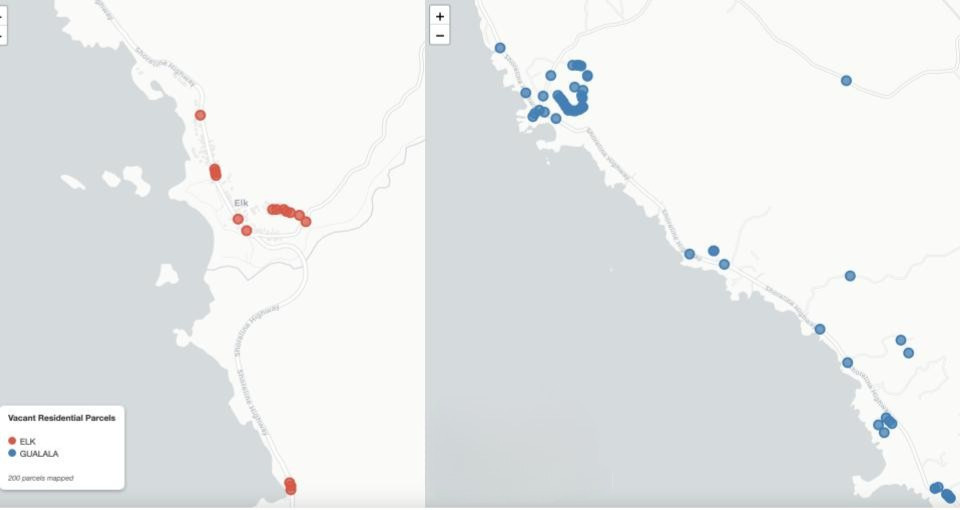
In a county where teachers sometimes sleep in cars, nurses sometimes have to choose between a campsite and a hotel room, and families spill over into aging RVs and converted sheds, an analysis of parcel data reveals an uncomfortable reality: nearly 30 percent of parcels classified as residential have no homes on them.
The analysis, conducted by MendoLocal.News, examined county assessor data and identified more than 10,000 parcels classified as vacant residential — land designated for housing but lacking a residential structure. The finding is striking in a county that continues to struggle with housing affordability and availability.
For context, the California Department of Housing and Community Development last year determined that Mendocino County must plan for 6,456 housing units between June 30, 2027, and August 15, 2035. The figure reflects projected household growth, vacancy rates, overcrowding, affordability challenges, homelessness, and housing lost in emergencies.
The analysis
The gap between land designated for housing and actual housing production raises a fundamental question: what is really driving Mendocino County’s housing shortage?
During election forums, several Board of Supervisors candidates pointed to permitting and regulatory processes as significant obstacles. District 3 candidate Russ Green said the core problem is permitting. District 5 candidate Kevin Evans suggested streamlining approvals for workforce housing and long-term rentals. District 3 candidate Eric Hart emphasized government efficiency and the need to work with homeowners whose residences are not compliant with building codes.
Yet the large number of vacant residential parcels suggests the issue may be more complex. The MendoLocal.News analysis found that 72 percent of vacant residential parcels are owned by individuals, trusts, or other entities with mailing addresses outside Mendocino County.
The finding raises questions about the extent to which vacant land is being held as a long-term investment rather than being developed for housing. However, county officials, real estate agents, and contractors caution that ownership patterns alone do not explain why so many residential parcels remain undeveloped.
Buildable lots that are impossible to build on
Supervisor Ted Williams, who represents the central and southern coast as well as portions of inland Mendocino County, warned that a parcel’s mailing address may have little to do with whether housing is ultimately built there.
Williams cited a long list of factors that can make a residential parcel difficult or impossible to develop, including lack of road access, insufficient water supplies, steep or unstable terrain, high fire hazard severity zones, wetlands, environmental restrictions, septic limitations, and unresolved title or estate issues. Parcels located in the Coastal Zone face additional regulatory requirements.
As a coastal supervisor, Williams is familiar with those challenges. Communities such as Little River, Manchester, Gualala, and Elk have some of the county’s highest rates of absentee ownership among vacant residential parcels, and they also face some of the most significant barriers to development.
No water, no house
The challenges are not confined to the coast. Brooktrails, outside Willits in District Three, illustrates how infrastructure limitations can prevent housing from being built even when land is designated for residential use.
Brooktrails alone accounts for roughly 40 percent of all vacant residential parcels in Mendocino County. Water availability remains a major constraint. As of January 2025, the Brooktrails Township Community Services District reported that only 19 new water connections were available for prospective homebuilders. Existing customers are limited to 9,000 gallons of water per month.
Brooktrails highlights a broader issue: in many parts of Mendocino County, infrastructure has not kept pace with the land designated for residential development.
“Some parcels may lack water, sewer, septic suitability, road access, fire-safe access, utilities, or may face environmental, topographic, coastal, subdivision, or General Plan constraints,” said District 3 candidate Buffey Bourassa. “That distinction matters. A parcel may be classified for residential use, but still not be realistically buildable without major infrastructure or policy work.”
Worthless lots that seem like bargains
Brooktrails originated as a massive subdivision project in the 1960s and 1970s. Thousands of lots were sold, but many were never developed. Today, many remain low-value parcels with limited development potential. The average assessed land value of a vacant Brooktrails parcel is approximately $5,645, compared with about $29,000 countywide.
“Unfortunately, some parcels cycle repeatedly through tax auction,” Williams said. “Buyers unfamiliar with local conditions purchase lots believing they can build, later discover the water limitations or infrastructure costs, stop paying taxes, and the parcels eventually return to auction again.”
Outside Mendocino County’s cities and community services districts like Brooktrails many vacant residential parcels lack access to public water and sewer systems. Property owners must install wells and septic systems at their own expense while navigating increasingly stringent state and local regulations. In some locations, site conditions make either a well or septic system impractical or impossible.
Even where infrastructure is available, economics can present another barrier.
“Today, residential construction commonly costs roughly $400 to $500 per square foot once materials, labor, utilities, road improvements, engineering, and compliance costs are included,” Williams said. “In many parts of Mendocino County, the cost to build exceeds likely resale value or rental return.”
A call for better data
Both Williams and Bourassa said the findings highlight the need for a more detailed inventory of vacant residential land.
Williams said he believes the long-term solution lies in updating the General Plan and defining where future development makes sense. “Housing is most feasible where infrastructure already exists or can realistically be supported, particularly water, sewer, roads, and emergency services,” he said.
Bourassa suggested a detailed inventory could become the foundation of a countywide housing strategy.
“I would support a coordinated review between the Assessor’s Office, Planning and Building, MCOG, special districts, and community partners so we can separate data issues from real housing opportunities and focus on solutions that actually move housing forward,” she said. “Are we making the best use of land that is already designated for housing? Before asking communities to absorb new development pressures, we need a clearer understanding of where the real opportunities are and what barriers are standing in the way.”
"72 percent of vacant residential parcels are owned by individuals, trusts, or other entities with mailing addresses outside Mendocino County." I am sure close to that number of **homes** on the coast are also owned by individuals, trusts, or other entities with mailing addresses outside Mendocino County. And many inland. I looked for an affordable home for many years before I found my current home. I looked up many of the vacant homes in the county and looked up the owners and wrote some of them letters. Real estate in many areas of the US, Canada, Australia, Hong Kong, Spain etc is used as a parking place for money by the very rich. Many of these sfh and condos in cities are not lived in or rented out. It's not like the traditional vacation homes owned by families- many these units are just not being used. At all. Meanwhile many of our young people and working people are having to move away. Or live in their cars. The coast especially has a severe shortage of workers.
The main problem is that real estate is a major investment class, larger than the global stock and bond markets combined. Affordable housing, which many claim to be a basic human right, is in direct conflict with real estate as an investment. Something which is a human right (housing, health care, education, etc.) can't be a for-profit enterprise. Also, for housing to be affordable it must be dense, within established communities, and not have value-adding amenities such as ocean views. So housing on the Noyo Headlands, for example, will never be affordable. Fort Bragg has several large lots suitable for affordable housing, but they have been kept off the market by investors. Back in 1879, economist Henry George proposed a land value tax that would encourage the development of these vacant urban parcels. He argued that private investors should not acquire the value that has been created by the public (roads, water, sewer, etc.), but only the value they created themselves by building something on the land. Another issue is water. Small community water systems would allow rural parcels to be developed without every lot having to drill their own well. Community road maintenance agreements would allow rural parcels to share the access and maintenance of private roads. There are many more issues, of course, but I think these are the main ones.