

Mendocino County Missed $3 Billion in Taxable Property Value Over Five Years, Records Show
The new assessments are worth roughly $33 million in additional property taxes

Over the past five years, the Mendocino County Assessor’s Office has gone back and added more than $3 billion in property value to the tax rolls — value that existed all along but had escaped assessment — worth roughly $33 million a year in property taxes, a MendoLocal.News review of county records shows.
MendoLocal.News requested public records of escape assessments in March. Last week, the county responded, sending us 101 files. We analyzed the files with Claude Code, an AI coding assistant.
The $33 million figure revealed by our analysis is separate from the $30.6 million the California State Auditor flagged in December, and it points to a second, comparably sized gap in the county’s fiscal management. Together the two figures describe different failures at opposite ends of the property-tax system.
The auditor’s $30.6 million is tax that was billed but never paid on defaulted properties. The $3 billion is value that was never billed on time in the first place — a recurring stream we estimate at about $33 million a year, using a 1.1% effective tax rate.
Our finding is drawn from five years of the county’s own escape-assessment records, tax years 2021 through 2025, released under the California Public Records Act. Most of the recovered value — about $2.9 billion — came from routine but late corrections: regular transfers between a buyer and seller or between a deceased owner and their heirs, as well as new construction the office enrolled years after the fact under a section of state law covering clerical roll fixes. A smaller share reflects enforcement — $78.9 million in “true escapes,” the omitted-property and business-audit cases the office is required to pursue, plus $7.4 million in penalties for concealment or late filing.
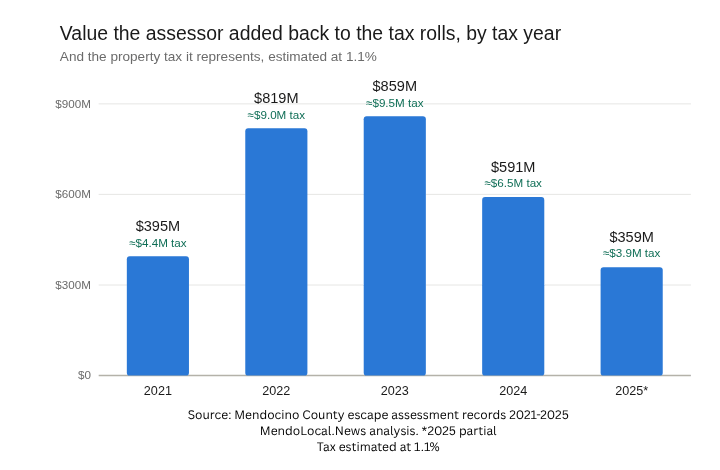
The value did not come back in a single year. The assessor added it back across the five tax years, rising and falling as the office worked through its backlog — from about $395 million in tax year 2021 to a peak near $859 million in 2023, then tapering. At a 1.1% rate, that is the difference between roughly $4.4 million and $9.5 million in tax for a given year. (The 2025 figure is partial; the office is still processing that roll.)
Our analysis puts precise numbers to a pattern described by the state auditor. Nearly 11,000 properties — about one in six on the secured roll — had at least one value-adding escape over the period. Among the cases we could date, the value sat off the rolls an average of 2.7 years, and in one Comptche case as long as nine. To guard against exactly this kind of revenue slippage, the audit directed the assessor to build “aging reports” by March 2026 to flag the properties at highest risk of going untaxed. In its 60-day response to the auditor, filed in February, the assessor-clerk-recorder’s office reported that it had built the tool for building permits but not yet for property transfers, which it called “a work in progress” because of a problem with the county’s property-tax software, Aumentum.
Most of the escaped value was recovered — billed late rather than lost. Some slipped away for good. Of the delayed cases we could date, 10 parcels — about $9.6 million in value, or roughly $106,000 in tax — fell past California’s four-year statute of limitations on back-assessments and cannot be recovered. Because we could date only part of the caseload, that figure is a floor, not a full accounting.
The $33 million found in our analysis and the auditor’s $30.6 million matters are distinct amounts. One thing they have in common is that only a fraction of the total goes to the general fund.
The auditor’s $30.6 million has been widely read as a hole in the county budget. But that money is tied to the Teeter plan, Treasurer-Tax Collector Chamise Cubbison told the board of supervisors on July 21 — a state accounting method under which the county fronts cities, school districts, fire districts and other local agencies their share of unpaid taxes and recovers it later through collection or auction. If the county collects it all, she said, the amount that would actually reach the general fund “might be a couple million dollars, but it is not $30 million.” The $33 million our analysis found is likewise not a county windfall: once the escaped value is billed and paid, that tax is distributed among the same taxing agencies — schools, cities and special districts.
Taken together, the two findings point to a county behind on both sides of the property-tax ledger — slow to put escaped value back on the rolls, and, by the auditor’s account, still owed tens of millions in uncollected bills.