
Kashia Elementary, a Feeder to Point Arena High School, Faces Possible Closure as Enrollment Falls
In the last seven years, enrollment has declined 60% while costs have increased 175%
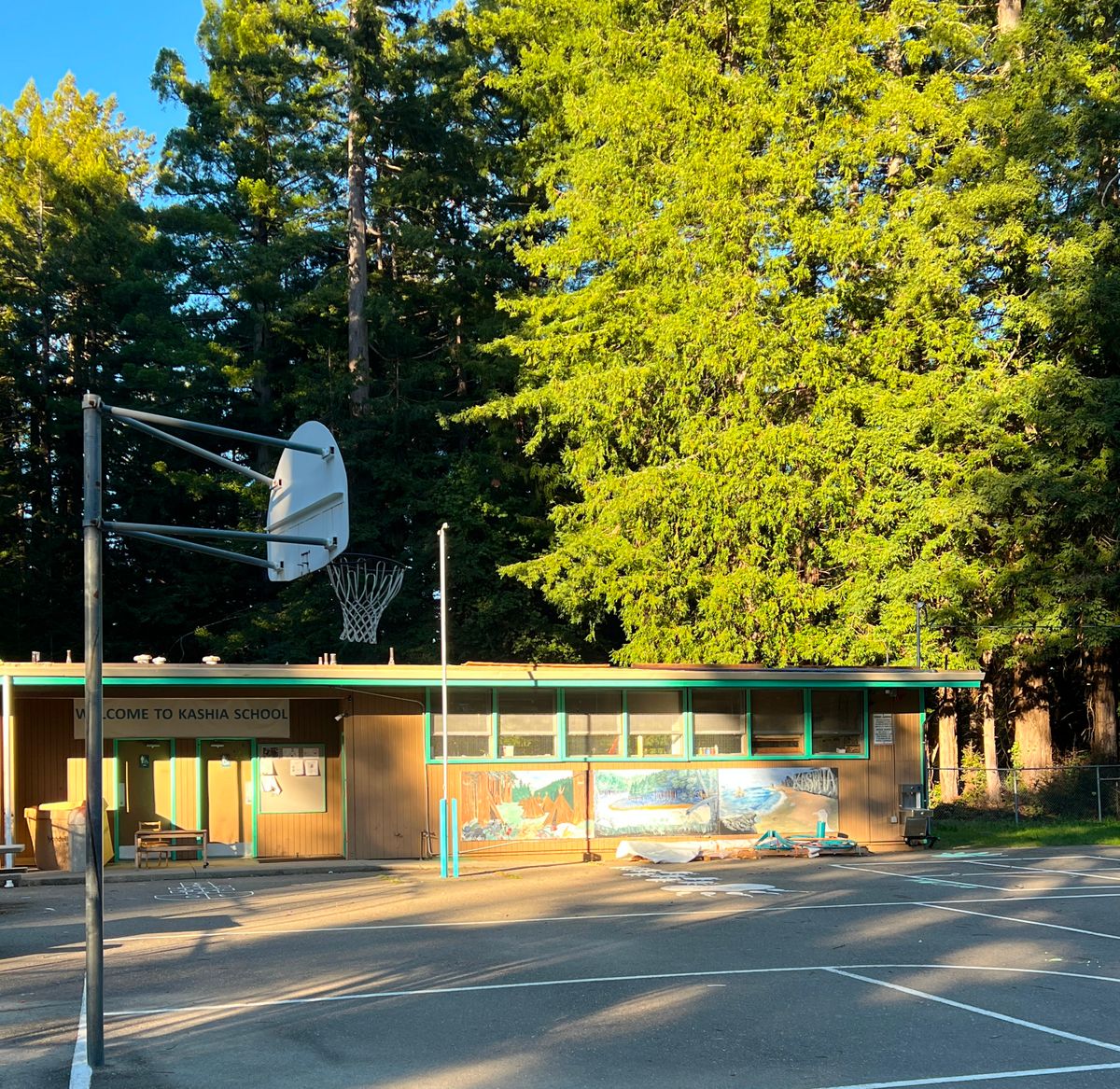
In a somber board meeting Wednesday, trustees of the Kashia Elementary School District voted two to one to eliminate three instructional positions assigned to the one-room schoolhouse on the Stewarts Point Rancheria serving the Kashia Band of Pomo Indians.
“Who will be left to educate our children?” asked trustee Coleen McCloud, who voted no.
Though heartfelt, McCloud’s protest was largely symbolic. Attendance at the tiny district — a feeder to Point Arena High School — is projected to fall below the minimum required to maintain state funding. There are currently just six students.
California education law provides for the dissolution of a school district if its average daily attendance falls below six in grades K-8. The process, known as lapsation, allows the district’s territory to be annexed to a neighboring district. Kashia’s ADA is projected to fall to 5.81. The education code also requires the district to notify staff within a certain timeframe if their positions are going to be terminated.
Greg Medici, a deputy superintendent for the Sonoma County Office of Education, said Kashia Elementary could be incorporated into the nearby Horicon Elementary School District, which serves about 75 students from Sea Ranch, Stewarts Point and Annapolis. The school is roughly 10 miles from the Kashia campus.
Community members attending the meeting urged the board to take steps to avoid lapsation, including offering Saturday academies and independent study contracts to boost attendance.
“Kashia Elementary is not just a building,” said Leah Wilder, a grandmother who attended the school herself, whose children attended Kashia, and whose grandson is now a student there. “It is where our children learn, where our families come together, and where our culture and history stay connected to the next generation.”
One parent, who asked not to be identified, said she would not send her children to Horicon because of her own experience with discrimination while attending local schools. She recounted getting into a fight after being called a “squaw” and said her grandson, who now attends high school in Point Arena, has also faced harassment.
Community member Shawn Marrufo questioned whether adequate steps had been taken to stabilize enrollment and asked about the creation of a parent advisory committee.
“Parent participation in these decisions is not optional,” Marrufo wrote in comments to the board. “It is required by law, and it is also just good practice when the future of a school is being discussed.”
Katrina Azbill noted that some community members have begun a formal effort to recall the board.
But time may be running short.
Medici said the state ultimately determines which districts receive funding through its annual budget process. State funding for school districts under California’s Local Control Funding Formula typically begins flowing in July.
Kashia Elementary has been at risk for at least a year due to declining enrollment.
There were eight students enrolled during the 2024–25 school year: three first graders, three fifth graders and two eighth graders, who have since graduated. Average daily attendance that year was 6.45 due to absences.
Without additional enrollment, the district could end up with just four students within three years.
Meanwhile, costs continue to climb.
According to an update presented to the board on Dec. 10, the school’s operating expenses totaled $935,000, with salaries and benefits accounting for about 80% of the general fund budget.
Staff included a full-time principal and lead teacher, a full-time classroom teacher, an instructional aide who also served as custodian, a part-time administrator, a part-time business manager and several contractors.
Expenses have more than doubled since the 2018–19 school year, when the school served 15 students on a $340,000 budget.
On Wednesday, business manager Christine Fears reported that expenses had risen to $999,000. Meanwhile, the district has developed a growing operating deficit within the general fund.
The general fund deficit was originally projected at $191,000 for the 2025–26 school year, increasing to $205,000 the following year and $234,000 in 2026–27.
Other districts in Sonoma County are also struggling.
Last week, the Press Democrat reported that six Sonoma County school districts have certified that their budgets are in poor standing with the state, largely due to declining enrollment.
In contrast, Fears told the board Wednesday that Kashia can reasonably expect to meet its financial obligations this year and for the next two years while maintaining the required reserves. She recommended issuing a positive budget certification.
Fears declined to answer questions about the budget when contacted by MendoLocal.news.
Acknowledging pressure for consolidation, one parent expressed fear for the future.
“I don’t want this school to close,” she said. “And I don’t know what to do.”