

Hill Case Goes to the Jury
Defense criticizes police investigators: "They didn't do their work."

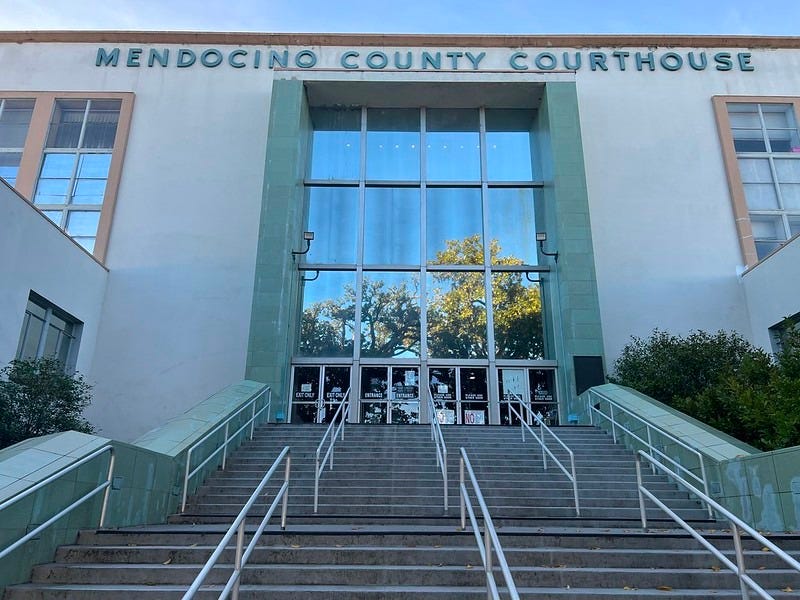
A man on trial for attempted rape and kidnapping is implicated by DNA found in multiple places on the victim’s body. To avoid conviction, the defense must persuade jurors that the man’s DNA ended up there some other way — for example, through indirect transfer, such as the woman touching an object that had the man’s DNA on it and then touching herself.
Is that a reasonable explanation? That is the question facing the jury in the case against Willy Hill, a 42-year-old Fort Bragg man.
Deputy District Attorney Eloise Kelsey and defense attorney Justin Petersen delivered closing arguments Tuesday.
In her statement, Kelsey described Hill’s account of the evening as “lies spun from whole cloth.” She noted that Hill told one story to detectives in 2023 after his DNA was matched to samples taken from the victim’s body on the night of the attack, and later offered a different version at trial.
She argued that Hill’s new story — that he had spent extended time with the woman the same evening as the attack — was crafted after he had heard testimony from the victim and other witnesses. “He knows what the evidence is,” Kelsey said. “He’s got an answer for you for everything.”
Hill has prior convictions for sexual assault. In 2021, he pleaded guilty to assaulting the wife of a close friend in Fort Bragg. He also pleaded guilty to assaulting a woman he knew through his girlfriend after meeting her at a Fort Bragg bar while out on bail for the prior offense.
Kelsey argued that Hill had a pattern of targeting women in local bars, waiting until they had been drinking and were walking home alone. “The defendant has a proven pattern of conduct,” she said. “He is that compulsive that he does this even to those who are close to him.”
According to testimony, the woman at the center of the case was walking home from the Pub Sports Bar in Ukiah on October 27, 2019, when she noticed a man following her. When she confronted him, she testified, he rushed at her, overpowered her, and dragged her from the sidewalk to the ground near some trash cans.
The woman fought back. During the struggle, she testified, her assailant put his hands inside her shirt and down her pants. He also appeared to ejaculate against her leg, she said.
She eventually broke free and called the police. Officers responded. After giving a statement, the woman agreed to undergo a forensic examination at a hospital. A sexual assault nurse examiner collected DNA samples from the woman’s lips, breasts, abdomen, and other areas.
Four years later, DNA from the woman’s lips, breasts, and abdomen was matched to Hill.
Petersen told jurors the DNA could have been transferred indirectly.
Hill testified that he and the woman were at the Pub Sports Bar together that evening. He said they played pool using the same cue, interacted with a pet parrot, and that the woman used the same toilet seat after Hill to avoid waiting in line for the women’s restroom.
The woman testified that she does not recall meeting Hill at the bar.
Petersen also pointed to what he described as investigative shortcomings. The woman initially suspected that the assailant might have been a friend of a neighbor who had reason to be angry with her. Petersen argued that police did not obtain a DNA sample from that person. He also noted that investigators did not ensure DNA was retrieved from the victim’s pant leg, which had a wet spot she believed to be semen.
“They didn’t do their work, and because they didn’t do their work, they couldn’t prove it,” Petersen told jurors.
He reminded jurors of the standard for beyond reasonable doubt: “If you can draw two or more reasonable conclusions from the circumstantial evidence, and one of those reasonable conclusions points toward innocence and the other to guilt, you must accept the one that points to innocence.” Even if the conclusion pointing toward innocence seems less probable, he said, jurors must acquit.
“That’s the law,” Kelsey acknowledged in rebuttal. But she emphasized that the prosecution is not required to eliminate all possible doubt. “Everything in life is open to some possible or imaginary doubt,” she said.
Kelsey pointed out that the DNA analysis did not turn up additional unknown third-party DNA, which would have been expected if there was another attacker.
The question for jurors, she argued, is whether they have an “abiding conviction” that the charges are true.
“Believe the victim, believe the science, use your common sense,” Kelsey told the jury.