
Across social media and digital platforms, federal surveillance is expanding, as government agencies increasingly use obscure administrative powers to strip away the anonymity of internet users who criticize or monitor official activity.
In the battle over online speech, the federal weapon of choice is an administrative subpoena. Unlike traditional warrants, these demands for information do not require a judge’s approval before they are issued. While federal law enforcement has long had the power to issue these subpoenas, civil liberties advocates warn that agencies like the Department of Homeland Security (DHS) and Immigration and Customs Enforcement (ICE) are now using them to “unmask” individuals engaged in lawful, First Amendment-protected expression.
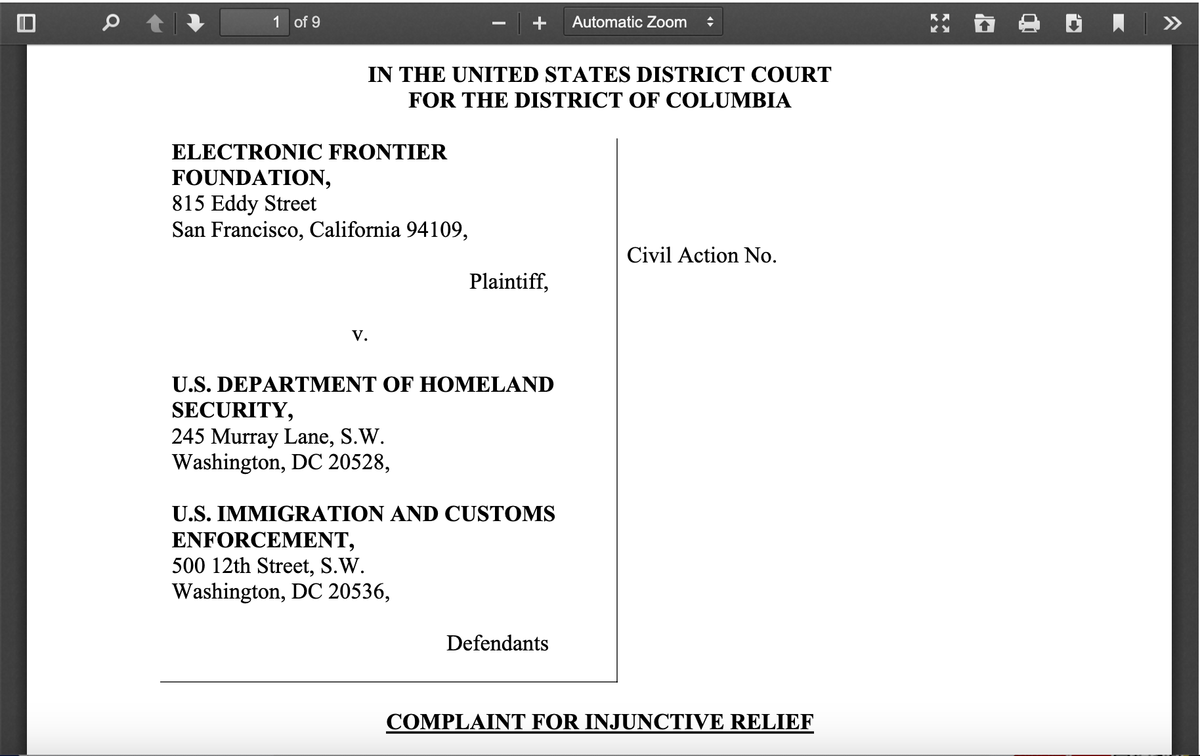
“It’s an unchecked power,” said Aaron Mackey, an attorney with the Electronic Frontier Foundation (EFF), which recently filed a Freedom of Information Act (FOIA) lawsuit to uncover the scale of this activity. “There’s no neutral magistrate that’s actually determining whether the request is lawful”.
The government is reportedly leveraging Section 1509 of the Tariff Act of 1930—a law originally intended to investigate unpaid customs duties and import fees—to compel tech giants like Google, Meta, and Reddit to hand over the names, IP addresses, and device identifiers of anonymous account holders. According to the EFF, the targets often include social media users who track ICE activity or individuals who have directly criticized government officials.
The Knock at the Door in Gualala
In the coastal town of Gualala, California, the reality of the online dragnet reached Kevin Krause, a 64-year-old retiree, on a quiet morning this past March.
A swarm of FBI agents descended on Krause’s home on Robinson Reef Road, an operation federal authorities described only as “court-authorized law enforcement activity”. The raid was the result of a months-long investigation into a private social media interaction. While visiting Michigan in September 2025, Krause had shared a criticism of Montana State Representative Lukas Schubert with his friends on Facebook. Schubert had previously posted on X that the “LGBTQ movement needs to be classified as a terrorist organization”.
Federal authorities alleged that Krause’s defense of his friends crossed into a criminal threat. He was indicted by a grand jury in February on a charge of transmitting an interstate threat, a felony that carries up to five years in prison. Krause, who has pleaded not guilty and is awaiting an August trial, is now a living example of what critics call the “chilling effect” of aggressive digital monitoring.
A “Chilling Effect” on Free Speech
The legal threshold for what constitutes a “true threat” is high. Under the Supreme Court’s ruling in Counterman v. Colorado, the government must prove a speaker acted with “reckless intent”—meaning they knew their words would be perceived as a threat and disregarded that risk. Protected speech, by contrast, can be “caustic or biting” without being criminal.
However, the EFF argues that by the time a case reaches a courtroom, the damage to free expression has often already been done. “People see this behavior by the government and they worry that they themselves would be targeted,” Mackey said, noting that such tactics deter others from speaking their minds.
Furthermore, the government has been accused of evading judicial review by withdrawing subpoenas whenever a user attempts to challenge them in court, preventing judges from ever ruling on the legality of using the Tariff Act in this way. In some instances, tech companies have provided “contemporaneous notice,” informing users their data was handed over only after the fact, leaving them with no opportunity to seek legal counsel or quash the request.
How Many Are Targeted
Currently, there is no way to tally how many Americans have been targeted by these administrative tools. Google’s transparency report shows that requests for user data increased during the first six months of the Trump administration — the most recent data available. Specifically, the number of accounts affected by requests from the U.S. government increased 9 percent compared with 2023 and 4 percent compared with 2024. Google categorizes the requests as subpoenas, preservation requests, emergency disclosure, other court orders, and search warrants, but it doesn’t breakout how many administrative subpoenas it receives.
Meta’s transparency report shows a 20 percent increase in accounts affected by requests from the U.S. government during the first six months of the Trump administration compared with 2023, but 1 percent decrease compared with 2024. Meta’s data categories are slightly broader than Google — Meta differentiates between requests for emergency disclosure and requests that were made as part of a legal process. Meta also separates out preservation requests. Like Google, Meta does not break out how many administrative subpoenas it receives.
By seeking disclosure of how many Americans have been targeted with administrative subpoenas, EFF’s suit could help quantify the extent of federal action.