
Four Candidates Claim “No Reportable Interests”
Disclosure forms filed by primary election candidates raise questions
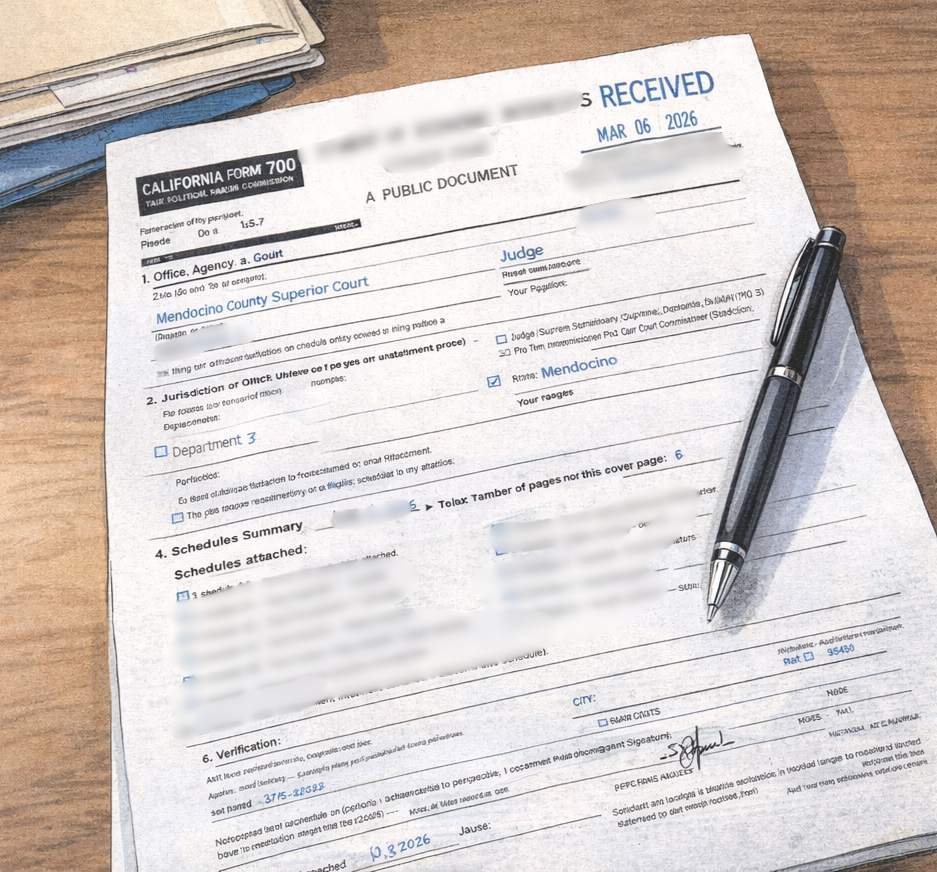
It’s Form 700 season — the time when candidates for elected office publicly disclose their economic interests, including sources of income, investments, business positions, gifts, and real property holdings.
For all our election coverage, see https://www.mendolocal.news/s/elections
The disclosures serve an important purpose. California’s Political Reform Act requires public officials to identify financial interests that could create conflicts of interest and, in some circumstances, disqualify themselves from participating in governmental decisions that may have a material financial effect on those interests or those of their immediate family members.
Failure to make required disclosures can result in administrative, civil, and, in some cases, criminal penalties. The Fair Political Practices Commission has repeatedly emphasized that omissions attributed to oversight or misunderstanding do not necessarily excuse reporting violations.
Form 700 statements are public records. Agencies are generally required to make them available promptly upon request and no later than the second business day after receiving a filed statement.
However, a coastal resident who requested copies of candidates’ Form 700 filings waited approximately six weeks for scanned copies from the Mendocino County Elections Office. When the documents were eventually provided, they did not initially include a filing for judicial candidate Colby Friend, who is running for Superior Court judge. The Registrar of Voters subsequently followed up with a cover page that stated that Colby was attaching disclosures for investments and real property, but these were not provided to the resident.
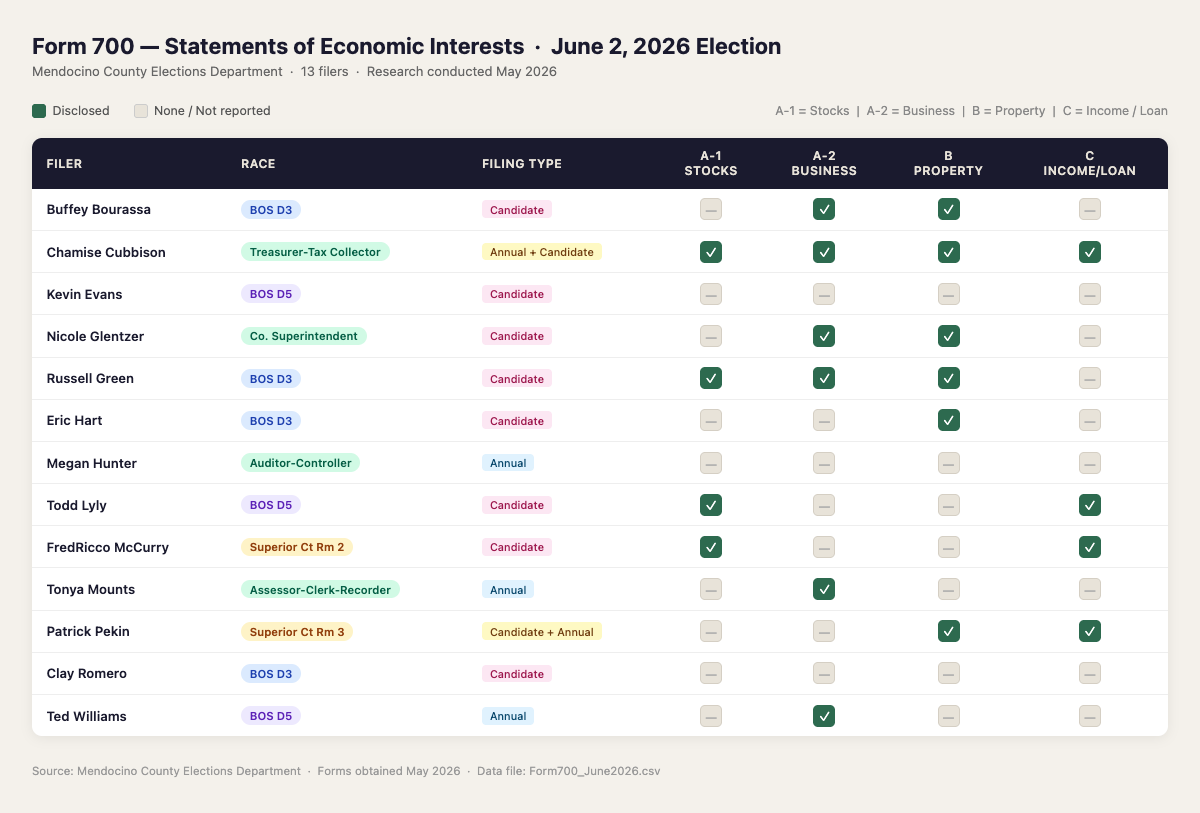
Among the candidates whose filings were provided, four reported no disclosable interests:
- Todd Lyly, candidate for Fifth District supervisor
- Kevin Evans, candidate for Fifth District supervisor
- Clay Romero, candidate for Third District supervisor
- Megan Hunter, candidate for Auditor-Controller, who is running unopposed
Neither Lyly nor Hunter checked the form’s “No Reportable Interests” box, although both signed their statements under penalty of perjury. When contacted by MendoLocal.News, Lyly and Romero said they would review their filings for accuracy and amend them if necessary. In addition to a single family residence, which Lyly is not required to disclose, Lyly owns 2621 N. State Street, which is zoned commercial. Evans said his filing was accurate. Hunter did not respond to a request for comment.
Among the remaining candidates, Russell Green, a candidate for Third District supervisor, filed one of the most extensive disclosures, listing investments, business interests, and real property holdings.
Fifth District Supervisor Ted Williams disclosed a technology consulting company and his position on the Golden State Connect Authority board. County Superintendent of Schools Nicole Glentzer disclosed a partnership interest in Circle X Cattle Company. Assessor-Clerk-Recorder candidate Tonya Mounts disclosed her role as chief executive officer of Mounts Family LLC, which she described as a mechanical shop located at 359 N. School Street in Ukiah.
Superior Court Judge Patrick Pekin disclosed the law office where his wife, an attorney, is employed, as well as rental property income.
Superior Court Judge Fredric McCurry disclosed income received by his spouse, as well as individual stock holdings in Amazon and GameStop. Green also reported multiple stock investments.
Treasurer-Tax Collector Chamise Cubbison disclosed her position as a trustee of the Mendocino County Employees Retirement Commission and reported an investment, her husband’s business entity, and a personal loan from Lorie Leaf.
Buffey Bourassa, a candidate for Third District supervisor, disclosed income of less than $2,000 from Buffey Bourassa Consulting, described on the form as “tribal consulting liaison.”
Eric Hart, also a candidate for Third District supervisor, reported less than $500 in income from property located in Willits.
Required disclosures
Required disclosures can range from relatively minor gifts to ownership interests in multimillion-dollar businesses. Form 700 disclosures generally fall into several categories:
- Gifts. Gifts valued at $50 or more from a single source during the reporting period must generally be disclosed. For example, a dinner at a restaurant that costs more than $50 and is paid for by someone else may be a reportable gift. Transportation provided without charge may also be reportable under certain circumstances, depending on who provided it and the purpose of the trip.
- Income. Sources of income totaling $500 or more generally must be disclosed. Candidates must also report certain economic interests held by a spouse or registered domestic partner. If a spouse or domestic partner is self-employed, the business entity may also be reportable.
- Business ownership. Candidates must disclose business entities in which they hold ownership interests that meet reporting thresholds.
- Loans. Certain personal loans must be disclosed. Additional restrictions apply to loans received from public officials, employees, consultants, contractors, or others connected to the agency associated with the office sought. Under some circumstances, a loan that is not repaid may be treated as a gift.
- Real property. Real property interests valued at $2,000 or more generally must be disclosed.
- Investments. Investments worth $2,000 or more in business entities doing business in, planning to do business in, or otherwise affected by the jurisdiction must generally be disclosed. Diversified mutual funds and similar investment vehicles are typically exempt from disclosure.
- Business and nonprofit positions. Candidates must disclose positions such as director, officer, partner, trustee, employee, or management roles in business entities and nonprofit organizations, even when those positions are unpaid.
In addition to disclosure requirements, California law limits the value of gifts that many public officials may receive from a single source during a calendar year. For 2025–26, that limit is $630.