
FERC Says a Southern California District Can’t Intervene in the Potter Valley Fight
But observers say the SoCal effort to acquire PG&E's water rights will continue
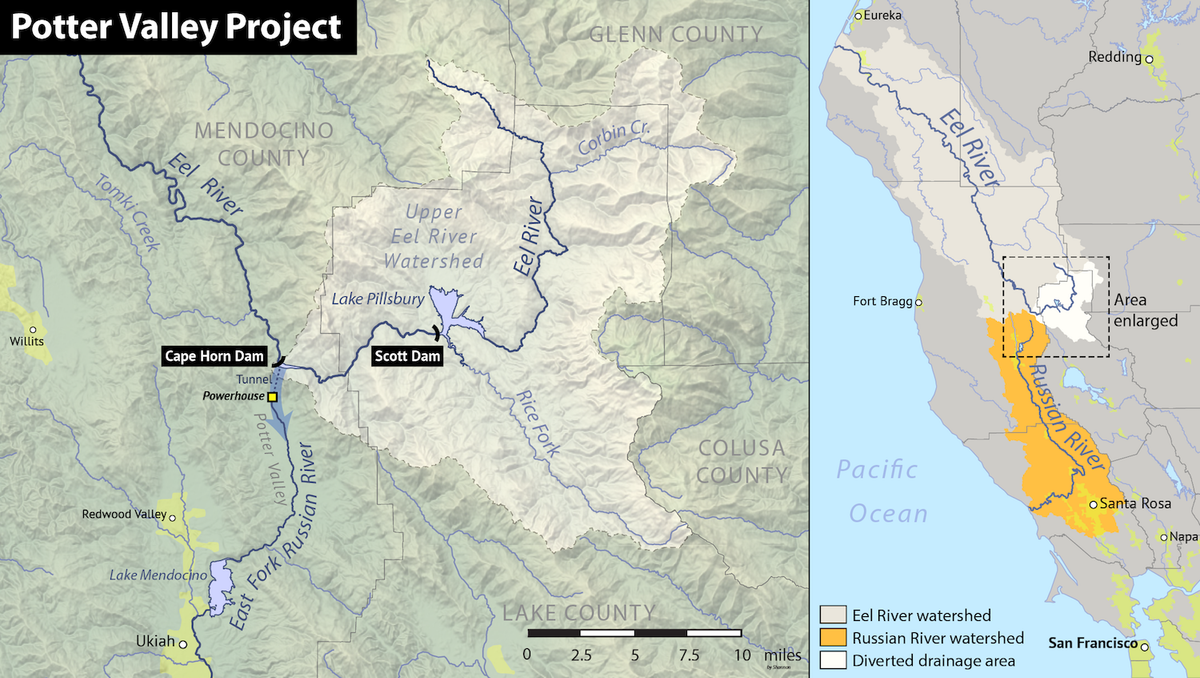
A Southern California water district’s bid to acquire PG&E’s water rights to the Potter Valley Project hit a setback this week, when a federal agency blocked the district from intervening in the proceeding that will decide whether and how the project’s dams are removed.
In a one-page notice issued July 27, the Federal Energy Regulatory Commission denied Elsinore Valley Municipal Water District’s motion to intervene in PG&E’s application to surrender its license and decommission the century-old hydroelectric project on the Eel and East Fork Russian rivers.
The district filed its motion July 9 — more than seven months after FERC’s Dec. 1 intervention deadline. Parties who miss that deadline must “show good cause why the time limitation should be waived,” the commission wrote. Elsinore Valley Municipal Water District (EVMWD), however, “did not provide any explanation for the untimeliness of its motion.” FERC said it would still consider the written comments the district filed the same day.
By denying intervention, FERC stripped EVMWD of the right to seek rehearing or challenge the commission’s eventual decommissioning order in court. The notice “constitutes final agency action,” leaving the district 30 days, until roughly Aug. 26, to ask the commission to reconsider the denial.
EVMWD — headquartered in Lake Elsinore roughly 600 miles south of the Eel River — has spent months building a case to take over the project rather than see it dismantled. The effort traces to a Dec. 4 memo from EVMWD board Vice President Darcy Burke to the district’s general manager, Greg Thomas, laying out what Burke described as “a Federal Water-Security Issue” and valuing the project’s senior, pre-1914 water rights at $500 million to $850 million. Burke wrote those rights would become “functionally worthless” once the dams are removed. The memo and other internal records were obtained by MendoLocal.News through a California Public Records Act request.
The district’s campaign became public this spring after U.S. Agriculture Secretary Brooke Rollins posted on X that she supported saving the project and transferring it to “a legitimate buyer” — EVMWD. By the district’s own account, the announcement caught it off guard. “These things are to be expected after the USDA Secretary[’s] post, but it took all of us by surprise,” Thomas wrote to a colleague in April, in an email among the records the district released. “Would have been nice to [be] included on the plan.”
In a statement, EVMWD spokeswoman Sylvia Ornelas said the district had “just received information regarding the denial” and that “it is imperative that EVMWD continue to do the required due diligence and evaluate all options available,” adding that “it would be premature to comment any further at this time.”
The parties on the other side welcomed the ruling. “We are pleased that FERC rejected Elsinore Valley’s late attempt to intervene in this proceeding,” Round Valley Indian Tribes President Joseph Parker said in a statement. “This decommissioning process should be guided by the communities and Tribal Nations that live with its consequences, not by interests seeking to reshape it from outside the region.”
Charlie Schneider of CalTrout said there was “no basis to allow an agency hundreds of miles away with no connection to the project to participate. It’s time for this process to move forward.”
But Friends of the Eel River Conservation Director Scott Greacen cautioned that the procedural setback does little to end Elsinore Valley’s pursuit. The denial, he said, was “the normal and expected outcome,” given that FERC had turned away late filings from the Round Valley and Wiyot tribes earlier in the same docket. Elsinore Valley, he said, is “coming very late to the party, didn’t bring a covered dish, just bought a bag of chips.”
The FERC proceeding, Greacen argued, was never where the district could win. “This process is not where Elsinore goes to get the result it wants,” he said. “The last chance for that was in 2019.” Instead, Greacen said, the district’s goal is to persuade — or pressure — PG&E to abandon decommissioning and instead transfer the project — including its dams, tunnels, penstocks and, most importantly, its water rights — to EVMWD and its partner, the San Gorgonio Pass Water Agency.
“It’s the water right that PG&E has held since it bought the project in the 1930s,” Greacen said. If the district can get PG&E to convey the project, he said, “they can change the facts on the ground” and return to FERC as the new owner “and say, hey, we are the owner, and we have a different idea.”
PG&E said no such deal is on the table. The company “received one proposal from a diverse group of stakeholders” for the New Eel-Russian Facility — the replacement diversion at the center of the negotiated Two-Basin Solution — and “has not received any proposal from EVMWD,” spokeswoman Megan McFarland said. Nor, she said, has PG&E entered into a nondisclosure agreement with the district. Any sale, McFarland added, “would need to include support of diverse regional stakeholders, and the future owner would need to have the financial and technical capability to own and operate the project.”
For now, Greacen said he is closely watching FERC’s recent decision, made at the request of the U.S. Department of the Interior to extend the scoping comment period. “Why does the U.S. Department of the Interior need extra time for a scoping period for a state dam in California that they have repeatedly said they don’t have an interest in?” he asked. “There’s going to be something ugly coming down the pike.”