

Fair Political Practices Commission Targets Water Treatment Expert in Response to Anonymous Complaint
“I don’t volunteer for boards anymore,” Donna Feiner said.

Donna Feiner, owner of Feiner Fixings, thought she was doing the right thing when she agreed to serve on the board of the Mendocino City Community Services District. A licensed contractor who specializes in operating small community water systems, Feiner said she believed she could contribute. “I thought I could help,” she said.
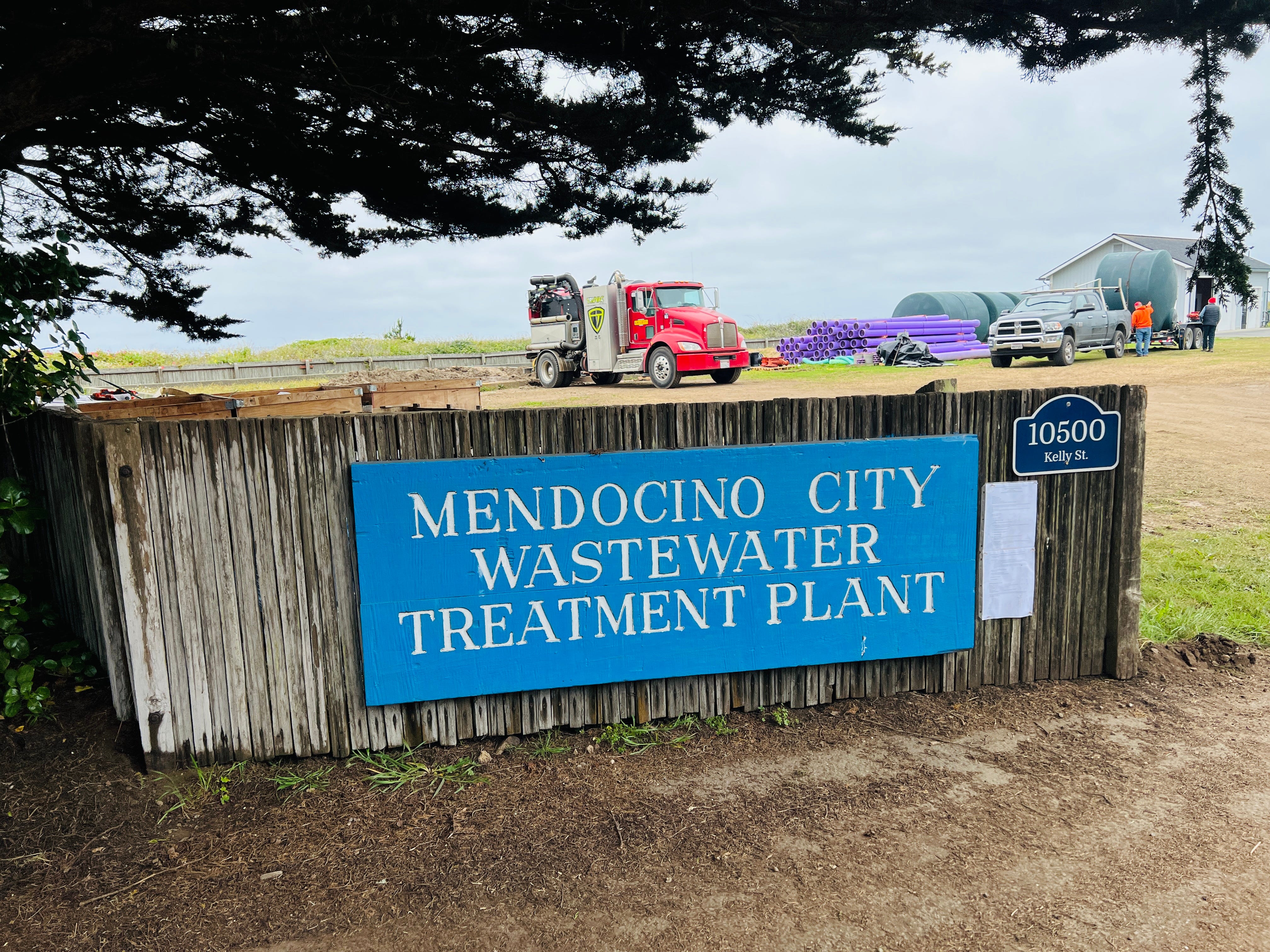
The district is responsible for wastewater collections and treatment in the town of Mendocino, groundwater management, and street lighting. In the wake of the severe droughts of 2020-2022, the community services district began working with the school district on the need for improved water security.
This is about the time that Feiner joined the board. Like other appointed officials and candidates for office, Feiner was required to disclose her financial interests on a Form 700.
According to an enforcement order submitted to the California Fair Political Practices Commission one year ago, Feiner filed her Statement of Economic Interests on time on Aug. 11, 2022. She disclosed sources of income to her company, Feiner Fixings, including payments from the Mendocino Unified School District. She also disclosed income from the school district in 2023 and 2024, along with her ownership interest in Feiner Fixings.
But there was an issue with her initial filing. While she disclosed the income received by Feiner Fixings, she did not specifically disclose her ownership interest in the business. Feiner said she made a mistake and corrected it, which is reflected in her annual paperwork for 2022 and for the following years.
Then, on Aug. 29 — about three weeks after she was appointed to the district board — she made another error.
The board of the Mendocino City Community Services District was asked to approve a memorandum of understanding between the district and the school district. The memo outlined a joint project to improve water security and storage, including by drilling up to ten new groundwater wells. Feiner joined the other four directors in unanimously approving the MOU.
District Superintendent Ryan Rhoades said the project alarmed some of the neighbors who were concerned by how it might affect the wells they relied upon. Their opposition to the project included filing an appeal with the California Coastal Commission, which was effectively denied after the staff found “no substantial issue.”
The California Fair Political Practices Commission came to a different conclusion when Feiner’s August 29 vote on the MOU was brought to their attention by an anonymous complaint, along with additional MOU-related votes on October 3, 2024. The complainant pointed out that Feiner held a water treatment contract with the school district.
According to the California Fair Political Practices Commission, Feiner should have recused herself.
“The MOU was in regards to ‘a project involving the planning, design and construction of new potable water wells, a water storage tank and water system interconnection on the MUSD property for the benefit of the village of Mendocino,’” the order states. “It was reasonably foreseeable that the approval of an MOU with MUSD would have a financial effect on MUSD.”
Because the school district employed Feiner, the commission concluded the MOU had a “unique effect” on her that was “disproportionate to the effect on the public generally.”
Feiner said it never crossed her mind that approving the MOU would benefit her financially. “I’m trying to retire,” she said. “I’m not looking for more work.” She also noted that she did not participate in negotiations surrounding the agreement.
Feiner’s oversight was costly. The commission fined her $4,000. Feiner said there was no hearing where she could have asked for leniency. Although an appeals process existed, she said pursuing it would have cost more than paying the fine itself.
Rhoades said the penalty seemed high for what he believes was an innocent mistake — the responsibility for which was shared by district staff and their legal counsel. “I don't think Donna was aware of any potential conflict,” he said. “I don't think staff was aware, and I don't think board members at that time were aware, nor our legal counsel.
“Once we realized that there was a potential conflict or mistake, the situation was remedied. She recused herself of of any further discussion that had relations with the school.”
The FPPC’s explanation of its zealousness is contained in the enforcement order itself, which points to The Political Reform Act, which was passed by California voters in 1974 and created the California Fair Political Practices Commission. “When enacting the Act, California voters specifically found and declared that previous laws regulating political practices had suffered from inadequate enforcement, and it was their purpose to ensure that the Act be vigorously enforced,” the order states. “For this reason, the Act is to be construed liberally to accomplish its purposes.”
Feiner later left the board, stopped working for the school district, and moved to Fort Bragg.
The experience, she said, left her disillusioned. “I don’t volunteer for boards anymore,” Feiner said. She now cautions anyone serving on a public board to make sure someone familiar with conflict-of-interest rules carefully reviews their financial disclosure forms.
Great Balanced Reporting.
Making the facts easy to understand.
Thank You
One of the persons who filed the complaint was on the board and left it. The reason I know this is the FPPC disclosed the anonymous complainants' names by mistake.
It is people like this who discourage great people, like Donna, from volunteering their time and contributing their extensive expertise. So instead you may get people who may have far more extensive conflicts that may not be as provable (as in people who serve on a board knowing they'll soon have business before it, and do recuse themselves when their project comes up, but still benefit from having gotten closer to fellow board members). This is a very small town, and it's HARD to find people who have something to contribute but absolutely no conflicts of interests.
You can be legally perfectly correct, but still absolutely WRONG. That is the case here. Shows a lack of judgment/discernment and ethics. Feeling smuggy?