
As CAL FIRE Seeks Public Comment on Forest Plan, Community Demands Stronger Protections and Accountability
Some say the time has passed to justify commercial timber sales with research
There are just days left before the public comment period closes on the state’s proposed 2026 Forest Management Plan for Jackson Demonstration State Forest. For many residents, this remaining window represents one of the last chances to influence how the 48,652-acre public forest will be managed for the next decade. Whether CAL FIRE’s revisions narrow the divide with the community — or deepen long-standing disagreements over logging and land stewardship — remains an open question.
Jackson, the largest of California’s public demonstration state forests, operates under a contradictory statutory mandate: The Public Resources Code requires “maximum sustained production of high-quality forest products,” while state policy also calls for compatibility with recreation, wildlife, watershed health, cultural values, and aesthetics. Each 10-year forest plan attempts to reconcile those competing directives, and each has sparked conflict on the Mendocino Coast, where many residents oppose commercial logging on public land.

Work on the new plan began in late 2024, with CAL FIRE hosting public meetings on the coast and inland, posting agendas, presentations, and consolidated input online, and engaging tribal nations separately. A workshop was also held with the Jackson Advisory Group, created under the 2008 plan to advise the Board of Forestry and CAL FIRE leadership.
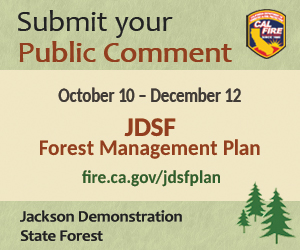
The draft plan, released in October 2025, drew comments from tribal representatives, scientists, and residents. CAL FIRE announced the comment period in local outlets, including Mendo Local (see above).
A Plan Aiming to Modernize — and a Community Wanting More
CAL FIRE officials describe the draft 2026 plan as a “goals-based” overhaul grounded in updated science, legal requirements, and evolving social priorities. A central change, they said, is an expanded commitment to tribal co-management.
“In 2019, Governor Newsom apologized for over a century of poor treatment of our Native American communities,” State Forests Program Manager Kevin Conway said at an October meeting in Caspar, noting that CAL FIRE now brings proposed actions “first to our tribal communities, then to the public through the Jackson Advisory Group before we decide what actions we’re going to take.”
Conway added that “climate change has come to the forefront of forest management,” and that the agency is “challenged to reintroduce beneficial fire” through cultural and prescribed burning.
But those updates did little to reassure critics, including scientists who said the plan lacks clarity and financially literate stakeholders who called for more budgetary detail and data to support economic claims.
“We see considerable potential to improve the draft plan’s rigor and its clarity,” said environmental scientist Evan Mills, arguing that the public cannot fully evaluate the plan without the context of what has been learned over the past decade. He also called for more transparency around spending: “For example, the costs associated with generating timber revenues should be separated from those that are legitimate costs for demonstration, for recreation, and for research.”
A resident named Fairyann asked CAL FIRE to open its books and share accounting that supported claims from earlier plans such as the forest generated $4.3 million in local wages or that eight jobs were created for every million board feet (MMBF) of harvest. “Are those books open to the public?” she asked.
CAL FIRE’s Balancing Act
CAL FIRE officials did not say whether the agency intends to scale back timber production at Jackson in response to community input. Instead, they emphasized process — public meetings, tribal consultations, and assurances that all comments, including those delivered at the Caspar forum, will be transcribed and addressed in the next draft.
But many residents remain unconvinced that process alone can shift a management model built on commercial harvest.
“I really appreciate CAL FIRE for saving us from wild fires,” said a resident who identified himself as Sequoia. “But I do not appreciate CAL FIRE for approving sales of our timber.” He described the forest as a healthy, breathing organism and questioned the morality of cutting centuries-old trees to build “decks in Tennessee.”
Another resident, Ellen Buechner, echoed appreciation for CAL FIRE’s firefighting role but questioned the economic and ecological logic of continued logging. She urged the agency to conduct a cost-benefit analysis comparing who profits from timber removal to the benefits the living forest provides. “We have learned enough to know that there is a heart and spirit to that forest,” she said, “and that all species who live here should be interacting with it in vastly different ways than exploiting it, conquering it, extracting its very life blood.”
Buechner said the paradigm that guides the forest management plan — that timber sales will pay for research into forest management — is outdated. “We don’t have time for that anymore,” she said. “And anyone who walks in the forest can feel it and know it.”
The debate underscores a fundamental tension: CAL FIRE is updating a management plan built on statutory timber production requirements that many residents no longer accept.
Next Steps
Public comments on the draft 2026 Forest Management Plan are due December 12 via CAL FIRE’s website. The agency says it will release a revised draft in March 2026, followed by another comment period. The final plan is expected in May 2026.