
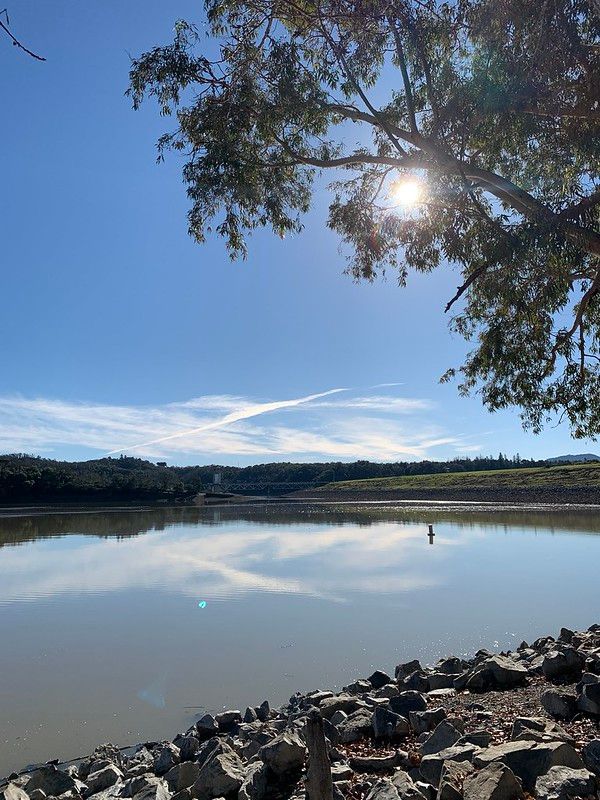
Modern forecasting technology saved an additional 30,000 acre-feet of water in the Russian River watershed over the last three years, a volume nearly equivalent to the total capacity of Lake Mendocino, officials said during a regional water wrap-up webinar last month.
The inaugural "Rainfall and Reservoirs" event, hosted by Sonoma Water, marked the close of Water Year 2025 on September 30. The 2026 cycle began on Oct. 1. The Russian River system provides drinking water to more than 600,000 residents in Sonoma and Marin counties.
Experts from the U.S. Army Corps of Engineers, Sonoma Water, and the California Department of Water Resources discussed how dynamic management strategies are helping the region navigate climate change.
Improved Reservoir Management
A new management strategy known as Forecast-Informed Reservoir Operations (FIRO) is responsible for the increase in water availability. Unlike traditional methods that only consider water already on the ground, FIRO allows managers to use 10-day weather forecasts to make proactive decisions.
Nick Malasavage, chief of the operations and readiness division for the U.S. Army Corps of Engineers, explained that FIRO enables "pre-releases," where water is discharged before a storm hits to create "flood control airspace." Conversely, if a dry forecast is predicted, operators can "let it ride" and hold water above traditional limits to bolster the regional supply.
"We are informed by the forecast, not controlled by it," Malasavage said, noting that the technology leads to less frequent and less intense flood control releases.
Highlights from Water Year 2025
October marked the end of the third consecutive "above normal" wet year for Mendocino and Sonoma counties. Rainfall was well-distributed, beginning in mid-November and continuing through April. While the city of Ukiah met its 30-year average, the Santa Rosa area saw rainfall 23% to 24% higher than the average.
Don Seymour, Sonoma Water’s deputy director of engineering, highlighted the importance of these conditions given the decline of the Potter Valley Project. Historically, that project transferred an average of 150,000 acre-feet of water from the Eel River into the Russian River system annually, but infrastructure and licensing issues have reduced that flow to roughly 39,000 to 40,000 acre-feet.
The increased efficiency from FIRO has helped offset these losses, ending the year with deep pools at Lake Mendocino and Lake Sonoma. This results in higher water quality and colder temperatures, which are critical for local fisheries and hatchery programs.
“It’s like over the last three years, we created another Lake Mendocino,” Seymour said.
Forecasters Struggle with Complex Weather Patterns
Despite local successes, which hinge on more accurate, short-term forecasts, reliable mid-to-longer-range weather prediction remains a challenge. Jeanine Jones, interstate resources manager for the California Department of Water Resources, stated that current Sub-seasonal to Seasonal (S2S) NOAA forecasts—which look six weeks to several months ahead—currently have "no skill" in predicting California's complex weather patterns.
“In particular, we can look at past water years, like 2023, and see that they got it completely wrong,” Jones said. “This is why you really don’t take the NOAA outlooks seriously, because they are simply not accurate.”
More accurate longer-term forecasts would enable better long-term planning for water storage.
Jones said that the state has entered a La Niña pattern, which typically suggests drier conditions for Southern California but offers no reliable signal for the North Coast. To address this, state officials are advocating for federal legislation, which would fund pilot projects to improve S2S forecasting for western water management.
"California has the largest variability in average annual precipitation of any state," Jones said. "Plan for the worst, but hope for the best."
Mendo Local’s previous coverage of the decommissioning of the Potter Valley Project:
USDA Steps Into Potter Valley Project Decommissioning Fight (12/23/2025)
USDA to PG&E: Mitigation is Required for Potter Valley Decommissioning (12/23/2025)
PG&E Statement on USDA Intervention (12/23/2025)