
Can Mendocino County Afford Two Recreation Centers in Fort Bragg?
The Mendocino Coast Recreation and Park District will discuss acquiring the former Rite Aid building at a meeting on Tuesday
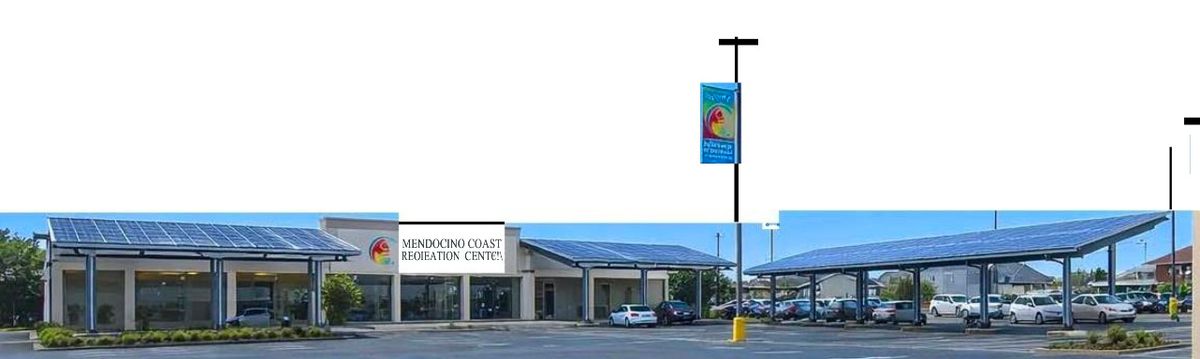
Editor’s Note: We’ve clarified that the location of the proposed second recreational setting is the former Rite Aid building (May 11, 2026, 12:48 p.m.)
An effort by the Mendocino Coast Recreation and Park District to build a second recreation center in Fort Bragg is raising concerns among some residents and taxpayers about duplication of services and the future of the city-owned C.V. Starr Community Center.
According to the agenda for a May 12 meeting of the district’s Capital Building Ad-Hoc Committee, the district is in preliminary discussions regarding property located at 490 S. Main Street in Fort Bragg — the location of the former Rite Aid. The agenda packet includes a conceptual rendering labeled “Mendocino Coast Recreation Center.”
The proposed facility comes as the district pursues a broader review of its operations and funding structure through a municipal service review (MSR) and sphere of influence (SOI) study being conducted through the Mendocino Local Agency Formation Commission.
At a May 4 LAFCO meeting, district board chair David Shpak asked commissioners to expand the scope of the review to include property tax allocation data. Shpak said the district needs a better understanding of where property tax revenues originate across its 77-mile service area in order to make long-term decisions about recreation services and potential capital investments.
“The more we can learn about how funds move through our landscape, the better we can understand how to actively serve that landscape,” Shpak told commissioners. “Right now, we’re really flying blind.”
The request prompted questions from commissioners and public commenters alike, particularly regarding whether the district’s interest in tax allocation data and how that might eventually affect the longstanding tax-sharing agreement that helps fund the C.V. Starr center.
Fort Bragg resident Dennis Miller urged greater transparency from the district and reminded commissioners that voters have stipulated that a portion of included tax revenues collected to support the special district be directed to supporting C.V. Starr.
“My wife and I moved here from Reno because of CV Starr,” Miller said. “That’s my concern and my neighbors’ concern.”
Jacob Patterson, another public commenter, argued that confusion in the community has blurred the distinction between the district-wide MSR process and the contractual agreement supporting C.V. Starr.
“People have suggested that MCRPD wants to cancel that agreement or alter it to keep more of the money, which would have a very detrimental impact on CV Starr, probably forcing it to close,” Patterson said. “There shouldn’t be any impact on how much money the district contractually has to support the CV Starr center with.”
Shpak responded directly to those concerns during the meeting, stating that the district is not seeking to alter its agreement with the city of Fort Bragg.
“The district’s commitment to the city of Fort Bragg’s park and recreation program is stipulated in an agreement,” Shpak said. “The district is not seeking, either through a sphere of influence adjustment or some other kind of action, any adjustment of that agreement.”
Instead, Shpak described the district’s interest in understanding how revenues correlate geographically with recreation needs and service delivery costs across the sprawling district. He said some remote areas may ultimately be better served through fixed recreational assets, such as parks or facilities, rather than traveling programming staff. He cited Bower Park in Gualala as an example. “It’s very expensive for district to provide personnel [and] active programming in that geography,” Shpak said.
Commissioners expressed confusion about the need for property tax allocation data. “Frankly, where your revenues come from seem irrelevant to me,” said Commissioner Mari Rodin, who serves on the Ukiah City Council
Rodin suggested the district would be better served by surveying residents across the district to determine recreational needs and priorities, rather than focusing on tax geography. “It’s really about what the needs are and what people want and then how you’re going to allocate, how you’re going to meet the needs with the funding that you have, no matter where the funding’s from,” she said.
She also pointed out that population centers naturally generate more tax revenue than sparsely populated areas, but argued that services should still be distributed based on community need and equity rather than revenue contribution. “You’re probably not [going to] distribute your services based on revenue. You want to do it equitably to where the population centers are and where the kids are or the needs.”
Commissioners, including Rodin, ultimately voted 6-1 to direct staff to incorporate available property tax allocation summaries into the MSR and SOI process and return with a draft report, potentially as early as June.
The district’s Capital Building Ad-Hoc Committee meeting is scheduled for 8:30 a.m. on May 12 at 579 S. Franklin Street in Fort Bragg.