
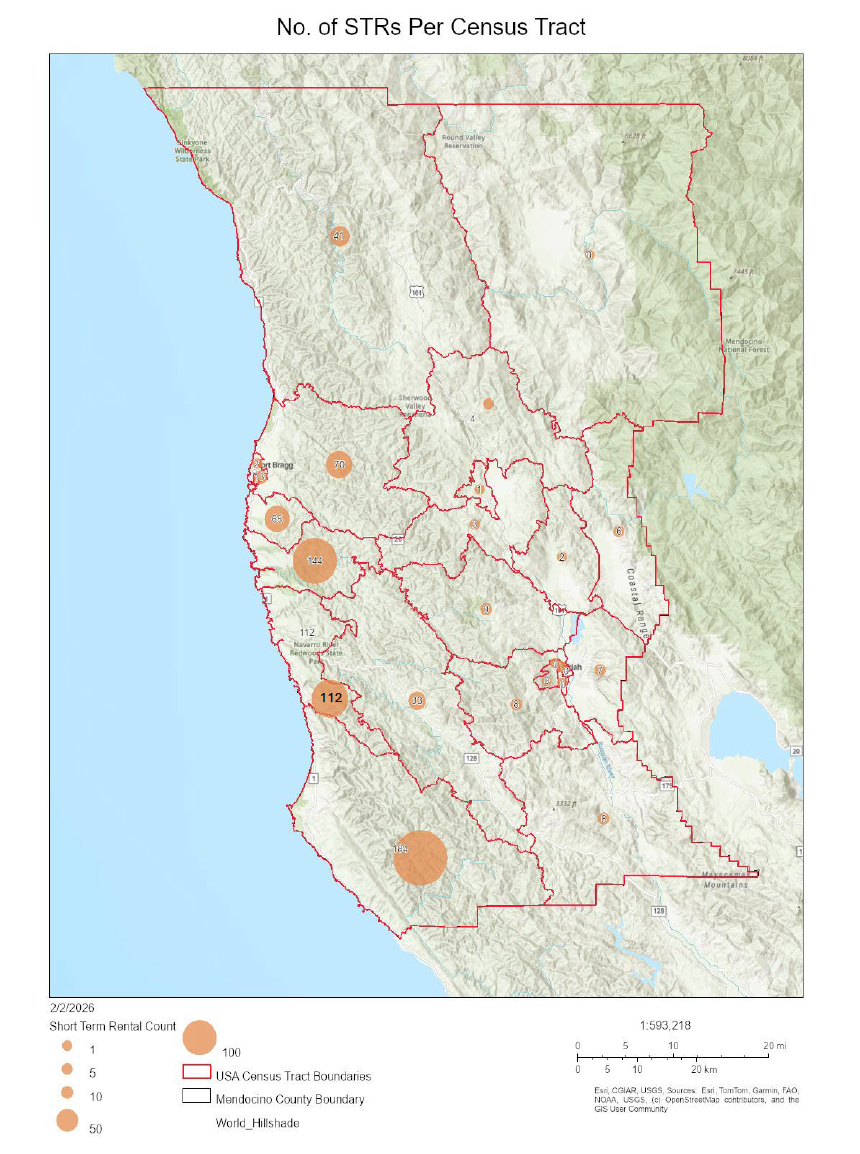
After years of debate over how to regulate short-term rentals such as Airbnbs, the Mendocino County Board of Supervisors on Tuesday directed staff to prepare a new, countywide ordinance while rejecting nearly all proposed limits on the industry. The board also agreed to cap enforcement at three verified violations within a 12-month period. Multiple violations in one visit by county staff would count as a single violation.
The direction clears the way for continued expansion of short-term rentals in residential neighborhoods, despite concerns raised about impacts on housing availability, community stability, the additional load on emergency services, and fire risk.
“I think something we need to recognize is that the incentives for property owners to convert from long-term rentals to short-term rentals are extremely high,” said Patrick Hickey, a local representative of the SEIU. “You can make a lot more money renting a place through short-term rentals in most jurisdictions than you can with long-term rentals.”
During the meeting, Planning and Building Services staff described the proposed ordinance as applying to “inland” areas — meaning unincorporated areas outside city limits and the coastal zone. This extends the definition of “inland” to neighborhoods within two miles of the coast. A map presented by staff showed that the vast majority of existing short-term rentals are located in these coastal communities.
According to county data, the distribution of short-term rentals is as follows:
- Fort Bragg/Mendocino: 279
- South County: 184
- Anderson Valley: 112
- Westport/Laytonville: 41
- Ukiah area: 15
- Hopland: 8
- Potter Valley: 6
- Redwood Valley: 2
- Covelo: 1
- Willits: 1
Based on stakeholder meetings held throughout the county — including Fort Bragg, Anderson Valley, Ukiah, Willits and Covelo — staff asked the board for direction on a range of potential policy options.
Among them was a proposed “Good Neighbor Policy,” which would require short-term rental operators to provide guests and nearby residents with information addressing noise, trash, parking, pets, emergency contacts, behavioral expectations, and how to file complaints with the county. There was consensus among the board that this was a good idea.
Staff also proposed a series of potential limits, including restrictions on corporate ownership, caps in areas with high concentrations of short-term rentals, protections for workforce housing near major employers, and limits in neighborhoods with smaller parcel sizes. These were rejected.
Additional recommendations addressed permit terms and enforcement, including 10-year permit lengths, renewals based on complaint and violation history, discretionary reviews for unhosted rentals or properties on private roads, graduated fines, safety requirements, and the creation of a housing offset fund supported by short-term rental revenue.
Supervisor Madeline Cline, who represents District One — which includes Potter Valley and Hopland, which together have just 14 short-term rentals — was the only supervisor to offer detailed feedback. She rejected all proposed limits on short-term rentals and opposed conditioning permit renewals on complaint or violation history. She supported discretionary review for private roads and a narrowly defined three-strikes enforcement policy.
Supervisors Maureen Mulheren (District Two, including Ukiah) said they agreed with Cline’s position. Supervisor Bernie Norvell (District Four, centered on Fort Bragg) initially offered no comments. Ted Williams (District Five, the coastal district with the highest concentration of short-term rentals) spoke generally about the need for additional housing for both working residents and visitors and he offered a short comment in favor of three strikes.
He later clarified that he supported limiting enforcement to three verified violations within a 12-month period.
Following public comment, Supervisor John Haschak (District Three) asked for clearer direction from his colleagues. “I think there is agreement, but there are also some points where we want more clarification,” he said.
As the board worked through the recommendations, supervisors formally rejected limits on the number or location of short-term rentals, rejected a housing offset fund, and rejected any owner-occupancy requirement. They agreed that short-term rental permits should be transferable to new owners and that properties on private roads should be subject to discretionary review.
Supervisors agreed that renewals should consider complaint and violation history but did not set a specific permit term. They also directed staff to design a simple, over-the-counter administrative permitting process.
On enforcement, the board agreed that violations would not transfer to a new owner if a property changed hands and that the three-strikes policy would apply only to three verified violations within a 12-month period.
Haschak expressed concern that operators could be penalized for the behavior of guests during a single weekend. Planning Director Julia Krog noted that if staff responded to a property and found multiple issues at the same time, “that would count as one verified violation consisting of multiple issues.” Krog also noted that staff would only be available to verify violations on a weekday.
Norvell briefly raised the possibility of limiting short-term rentals in areas with high concentrations, citing complaints from residents who live near multiple rentals. The idea was quickly dismissed.
“I wouldn’t want to limit people that have existing businesses with a new policy,” Mulheren said.
Cline also opposed the idea. “I guess it sounds like we have three your way,” Norvell said, before dropping the issue.
Williams raised concerns about noise enforcement, noting that the county lacks a noise ordinance and that Sheriff Matt Kendall has told the board he does not have sufficient staffing to enforce one. Williams suggested routing noise complaints directly to property owners.
“If that doesn’t solve it, then it becomes a strike and law enforcement has to handle it,” he said, without addressing how enforcement would occur without additional resources.
Krog said beyond routing complaints to platform operators like Airbnb – enforcement remains unresolved. “We would have to have a pretty detailed conversation with the sheriff’s office surrounding this topic and enforcement in general,” she said.
Williams also questioned whether short-term rentals should be allowed in locations that have not undergone CAL FIRE inspections. Staff responded that fire safety requirements are reviewed when structures are built, not when they are later used as lodging.
During public comment, a longtime resident and business owner identified as “Spencer” described the Airbnb he operates on his property as a financial lifeline. “Over the past 15 years, hosting has allowed us to remain financially stable while contributing directly to the local economy,” he said, urging the county to avoid adopting costly regulations.
Dee Pallesen urged supervisors to proceed cautiously and ensure adequate enforcement resources. “Our code enforcement division has made it very clear that they do not have the resources to address the workload they already have,” she said. “Now we’re going to add this to their responsibilities and expect they’ll be able to address additional complaints in a timely and thorough manner? The last time we heard from them, they told you their workload can’t even handle anonymous complaints.”
Pallesen pointed out that the proposed approach would disproportionately benefit a small group. “This is another instance where it benefits a few instead of the many,” she said. “The industry should shoulder the burden of implementation and enforcement.”