
Another Casualty: Gray Whale Die-Off Continues on the Mendocino Coast
Scientists say the large marine mammals are in "precipitous decline" as ecological changes reduce their food supply
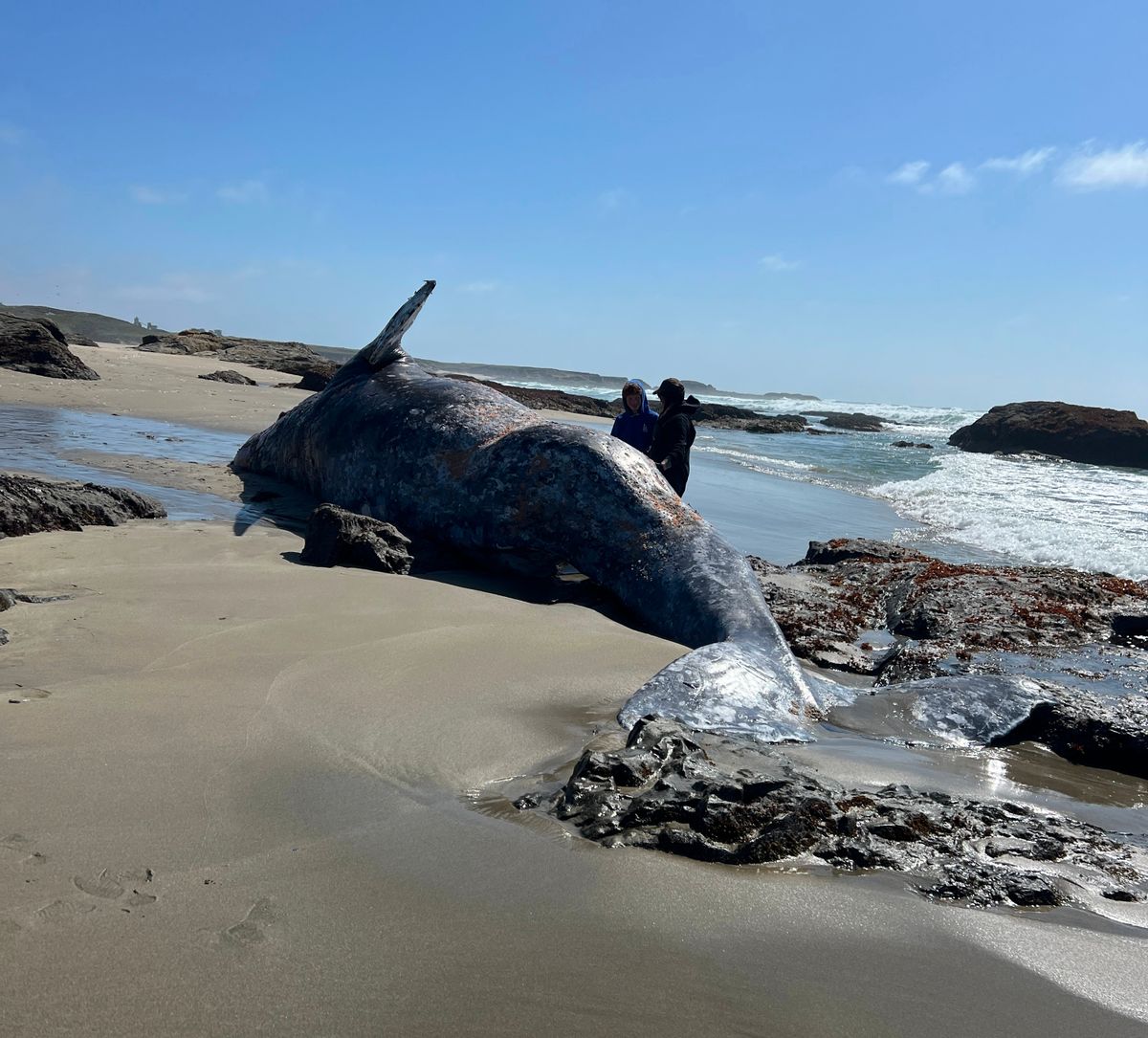
A female gray whale was found dead on the beach near Virgin Creek in Mendocino County around mid-morning on April 29.
Sarah Grimes, marine mammal stranding coordinator and educator for the Noyo Center for Marine Science, said the death is part of a troubling trend.
An increasing number of gray whales are appearing undernourished and dying along the West Coast. Last year, 21 gray whales were found dead in San Francisco Bay; so far this year, seven have been reported there. The whale found near Virgin Creek is the first recorded dead in Mendocino County this year.
Grimes was on the beach Wednesday afternoon with an intern and another scientist taking measurements. If the whale remains accessible, the team plans to conduct a full necropsy.
She said the whale was a subadult — close to full size but not yet sexually mature.
Gray whales are baleen whales, meaning they have flexible plates of keratin hanging from their upper jaws that act like a sieve to filter small fish and krill. They undertake the longest migration of any mammal, traveling up to 14,000 miles round trip between feeding grounds in the Arctic and breeding grounds in Mexico.
Gray whales in the Atlantic Ocean went extinct in the 1700s. They are considered critically endangered in the western North Pacific, but until recently, the eastern North Pacific population was regarded as a conservation success. Although hunted to near extinction in the 19th and early 20th centuries, gray whales were protected by the International Whaling Commission in 1946. By the mid-1990s, they were removed from endangered species lists under the U.S. Endangered Species Act and by the International Union for Conservation of Nature.
But an “unusual mortality event” from 2019 to 2023 has raised alarm among whale biologists, who say the population may no longer be sustainable.
“The gray whales are in precipitous decline, with significant range-wide die-offs, malnourished ‘skinny’ individuals, and reduced reproductive rates,” scientists James Darling, Jorge Urban Ramirez and Steven Swartz wrote in an open letter published by the Whale Trust. “The best available analysis suggests a decrease in critical food species resulting from large-scale ecological changes in traditional Arctic feeding grounds.”
Unable to consume enough food during the summer feeding season, whales — which fast during the winter — may not have the energy reserves needed to reproduce. The scientists are calling for an international review and reassessment of the whales’ protection status.


