
A New Vision for Mendocino College Gets Lost in the Fine Print
Officials are struggling to communicate a master plan to modernize campuses around the county
Tim Karas has spent six years watching young people leave Mendocino County
They drive north to Humboldt County or south to Sonoma, chasing nursing degrees and other certifications that Mendocino College does not offer.
“Everyone wants us to expand nursing,” said Karas, the superintendent/president of the Mendocino-Lake Community College District. “Fire, marine science, the trades. That’s what people ask me about when I go around the community. Why don’t we have more nurses? Why don’t we have more paramedics? Why don’t we have more plumbers?”
The answer, he has concluded, is concrete and steel, as well as up-to-date laboratories and electronic infrastructure — or rather, their absence.
Now, Karas has pinned his hopes on Measure A, a $98 million bond measure on the June primary ballot that would fund new and renovated facilities at the district’s campuses in Ukiah, Fort Bragg, and Willits. If approved by 55 percent of voters, the measure would authorize the district to borrow from bond investors, with taxpayers repaying the principal and interest — a total of roughly $210 million — over the life of the bonds.
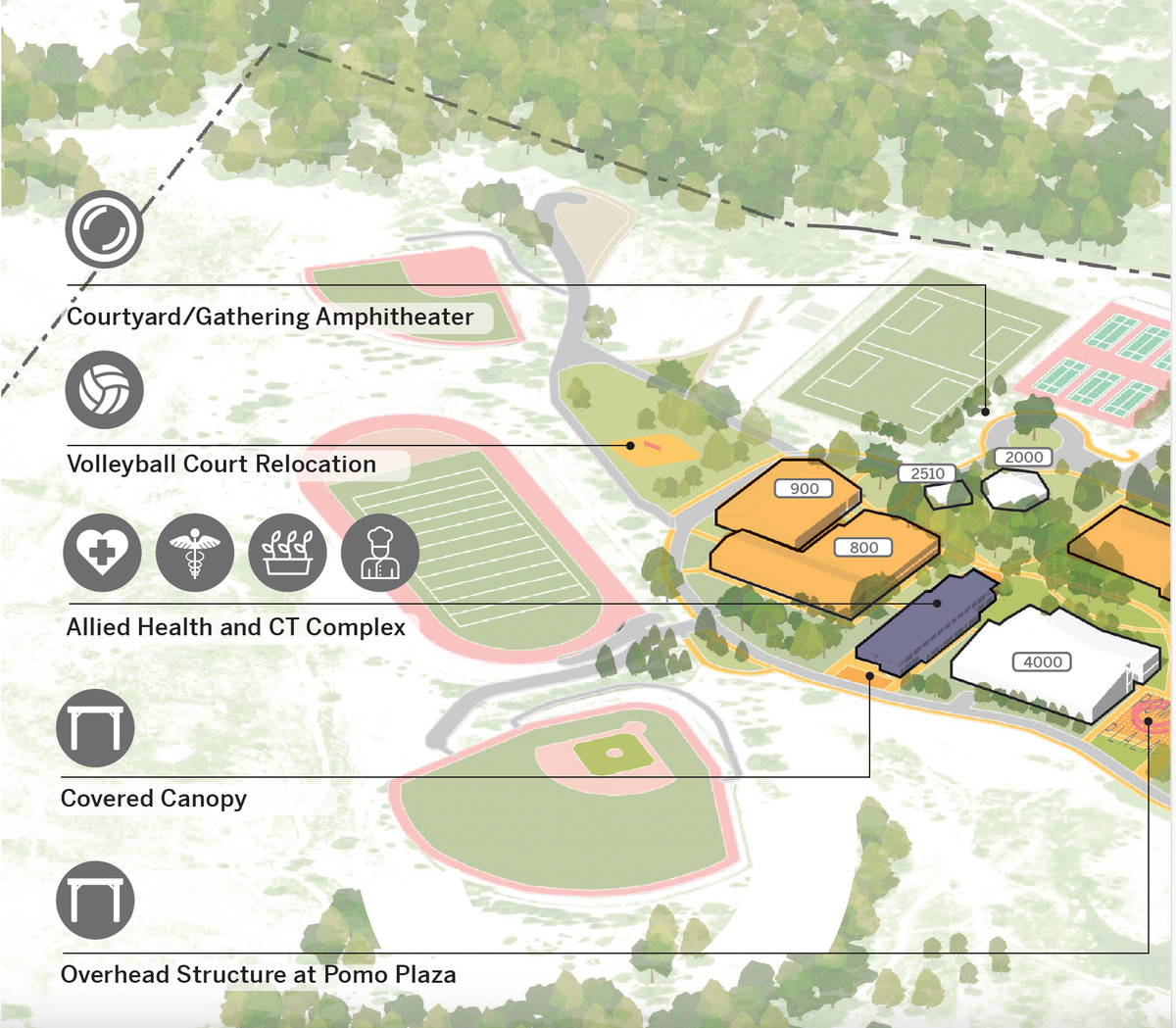
The vision is straightforward: build the specialized facilities that would allow Mendocino and Lake County residents to train for well-paying careers without leaving home. A new Allied Health and Career Technical Education Complex in Ukiah. A rebuilt Mendocino Coast College Center outside Fort Bragg. An expanded North County Center in Willits, housing programs in Fire Science, Sustainable Construction and Lab Science.
But there is a problem. Almost none of that appears in the materials voters are actually reading.
Lost in the boilerplate
The full text of Measure A, as it appears in the voter guide, reads less like a mindful plan to steward public monies for the greatest impact and more like a laundry list of projects drafted by a committee determined to spend tens of millions of dollars because they can.
The money, it states, can be used to build or renovate “science buildings, advanced technology buildings, wellness/allied health facilities, culinary arts facilities, arts and woodworking buildings and facilities, nursing and physical therapy facilities, agricultural facilities and buildings, early childhood education center ... student services and welcome centers, bookstore, dining, food services, physical education facilities, visual and performing arts facilities including theaters and galleries, classrooms, and buildings, bus stops, parking lots ... affordable student and workforce housing units ... the construction and installation of on-premises, cloud-based, or hybrid data center and related infrastructure.”
The list runs to well over one hundred items.
“Why are you going to fund a parking lot?” Karas acknowledged voters have asked. “We’re not. But that’s where the hard part is — the list is like a legal form. You have to put all the stuff there as boilerplate.”
The language is standard practice for California community college bonds, which are governed by strict constitutional requirements. Bond attorneys routinely include exhaustive lists of permissible expenditures to protect districts from legal challenges. But the effect, in a rural county with few reporters and a skeptical electorate, has been to obscure the very projects the measure was designed to fund.
“The ballot language doesn’t say ‘Willits Center’ or ‘Ukiah Allied Health Building,’” Karas conceded. “It highlighted programs more than places. And I know what that means because I’m in the weeds. But voters aren’t.”
Three campuses, one chance
The district’s case for Measure A is rooted in a Comprehensive Facilities Master Plan covering 2025 to 2035 — a 250-plus page document that lays out, in granular detail, what the bond money would actually build.
In Ukiah, the centerpiece is a new 17,800-square-foot Allied Health and Career Education Complex designed to replace a cluster of aging temporary buildings and consolidate signature programs — nursing, culinary arts, middle college — into the heart of campus. Several of the district’s main buildings, including MacMillan Hall and Lowery Hall, are candidates for deep renovation or outright replacement. The campus’s original structures date to the 1970s, built for an era when nursing shortages and fire science academies were not among the college’s central missions.
“Those programs didn’t even exist when the campuses were built,” Karas said. “They were all added in the 2000s.” The buildings, he added, were never designed for them.
On the Mendocino Coast, the plan calls for demolishing the existing main and art buildings at the Fort Bragg center and replacing them with a single, consolidated 28,750-square-foot facility housing academic, scientific and arts programs, including a dedicated Environmental and Biological Sciences Center. The Krenov School for Fine Woodworking — a program with a national reputation — would be relocated and expanded on the same campus.
In Willits, the situation carries particular urgency. The district has already secured approximately $20 million in grants for the North County Center expansion — $12 million from California’s Proposition 2, roughly $4 million from a federal Economic Development Administration grant, and $4 million in non-reimbursable funds. The planned 18,500-square-foot building would house career technical education programs in Fire Science, Sustainable Construction and Lab Science.
But nearly all of those grants are reimbursement-based: the district must spend the money before it can recover it. The bond money will provide the initial cash flow to pay construction workers and contractors. It’s critical to moving forward.
The federal portion carries additional uncertainty. With the current administration’s posture toward federal spending in flux, Karas said he feels pressure to break ground before the political climate shifts further. “Our project somehow made its way through both administrations,” he said. “Both lenses still found value in it. Maybe we have a unicorn. But the best thing I can do once we have money is to actually do the construction.”
A communication gap
The disconnect between Measure A’s ambitions and its public presentation has not gone unnoticed.
Critics have focused on the bond mechanism itself — pointing out that of the roughly $210 million voters would ultimately pay, more than half represents financing charges and interest to bond investors. The cost of the bond are also not equally distributed. Newcomers who purchased properties following the run-up in values during the pandemic will pay multiples more than their neighbors, compounding gross inequalities in public services funding created by Proposition 13.
Karas does not dispute the math. But he argues the framing misses the point. Community colleges in California have no general fund allocation for capital construction. Bonds are not merely the conventional path — they are, under the state constitution, essentially the only path. “I do not know an example of a community college district in California that used something other than bonds for facility construction,” he said.
What he acknowledges more readily is that the case for those bonds was never clearly made to the public. The district’s voter outreach materials — mailers, a website, a FAQ page — describe the bond in general terms but fail to connect the dots between upgraded classrooms and a 35-year tax on property owners.
“The ballot language maybe could have had a better pointer to the facility master plan, which is the driver,” Karas said.
The Mendocino College Foundation, a separate nonprofit entity, has funded the campaign in favor of Measure A. The district, as a public agency, is legally constrained in its campaign activities — a distinction that has contributed to fragmented messaging.
A vote that comes down to trust
Measure A needs 55 percent approval to pass — the threshold California sets for local school and community college bonds. Karas said that if the measure fails in June, the district is unlikely to return to voters with another attempt anytime soon.
A $120 million bond measure proposed in Humboldt County in 2024 underscores the stakes — the bond fell short of the required threshold with just 52.6% support.
Julie McGovern, executive director of the Mendocino College Foundation, wants voters to understand the level of accountability that is baked into Measure A.
She pointed to the district’s last bond measure, Measure W, passed in 2006, as a model of what rigorous stewardship looks like in practice. A report to the community, published in 2015 after all Measure W funds had been expended, documented spending down to the cent. An independent citizens’ oversight committee — composed not of college employees but of community members with an interest in responsible use of public funds — reviewed the books annually throughout the life of the bond.
“I don’t think anybody wakes up in the morning and says, ‘Yay, I want to pay more taxes,’” McGovern said. “But we do have to see the long-term picture. If every other college district in California is putting out a bond measure to improve their facilities and we are not, then our students and our community will be left behind.”
It is, she acknowledged, an argument that depends on trust — trust that the specific projects described in the facilities master plan will actually be built and that the oversight mechanisms will function as designed.
Whether voters in Mendocino and Lake counties are prepared to extend that trust, at a cost of roughly $210 million over the life of the bonds, is a question the June ballot will answer.