
A Meadow Beneath the Water Vanishes, and With It, the Foundation of an Ecosystem
The eelgrass beds of the Albion River Estuary have disappeared. Scientists say the loss may signal something larger is going wrong along the Northern California coast.
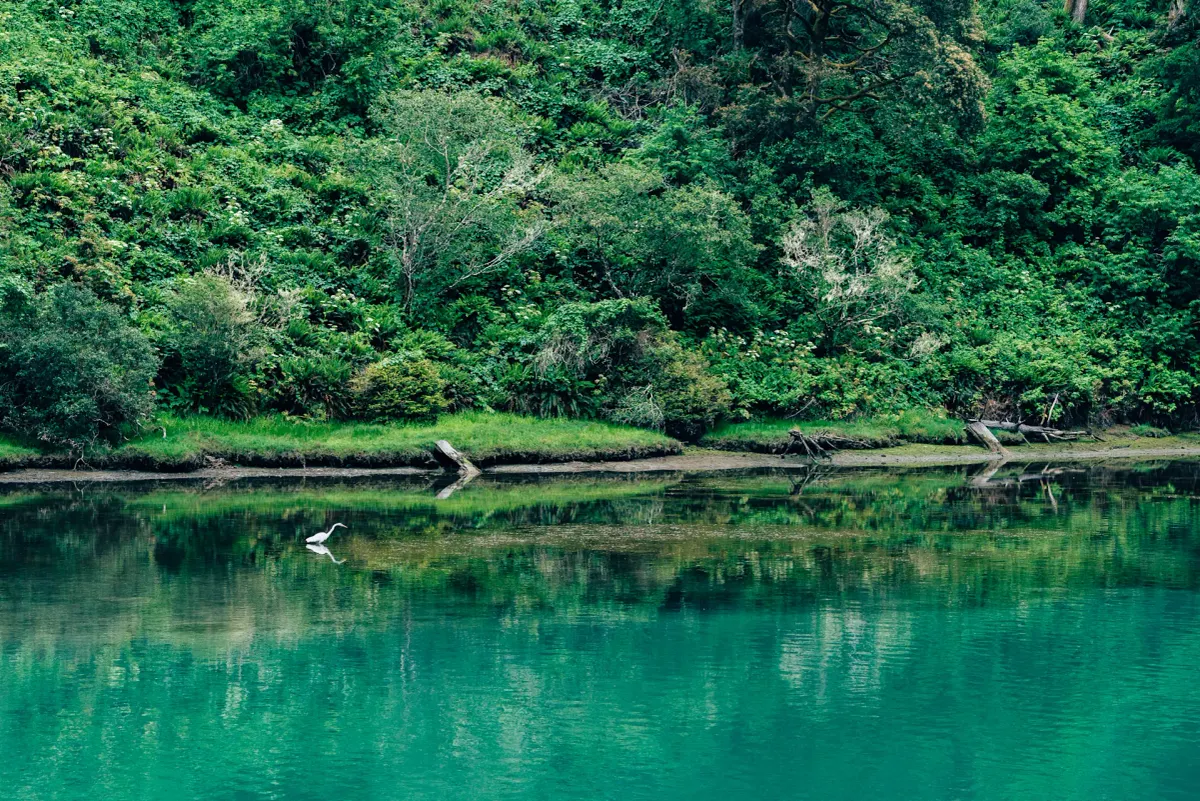
Gabrielle Levine was not particularly alarmed when she first noticed the eelgrass beds in the Albion River estuary were getting smaller. Eelgrass beds typically expand and contract from year to year in response to water temperature, sediment, nutrient availability and a whole host of factors. But the beds kept shrinking. And this year, they were gone entirely.
Levine, a retired physician who has spent years tending the river and donating land along this stretch of the Mendocino County coast to a local conservancy, had watched over the estuary long enough to know the difference between a bad season and something more serious. What she was seeing, she believed, was something more serious.
She was right to worry.
Marine ecologists from Sonoma State University who stay regularly at the nearby Albion Field Station — and who have maintained an informal watch over the estuary for years — confirmed this spring that the eelgrass beds were no longer there. Field crews who visited the site recently observed the loss themselves and also received corroboration from locals.
“Anytime you see a decline that’s rapid and substantial, it’s a big concern,” said Brent Hughes, an associate professor of marine ecology at Sonoma State University whose research lab monitors estuaries throughout Northern California.
What caused the disappearance is not yet known. But the list of possibilities — green crabs, sedimentation, disease, pollution, warming waters, ocean acidification, sea level rise, excess nutrients — reflects a broader crisis unfolding in coastal waters up and down the West Coast, where eelgrass meadows that have anchored marine ecosystems for thousands of years are vanishing faster than scientists can study them.
‘The Canary in the Coal Mine’
To understand why the disappearance of eelgrass from a small estuary on the Northern California coast matters, it helps to understand what eelgrass actually does.
Zostera marina, the species of seagrass that grows along the Pacific Coast of the United States, is not seaweed. It is a flowering plant — one of the few that can live entirely submerged in saltwater. Its dense underwater meadows function as one of the most productive and ecologically complex habitats in the marine world, providing services that scientists say are difficult to overstate and nearly impossible to replace.
Juvenile salmon and Dungeness crab use eelgrass beds as nurseries, sheltering among the blades during the most vulnerable stages of their lives. Migratory waterfowl and shorebirds forage in and around eelgrass flats. Pacific herring spawn directly on eelgrass leaves. The meadows slow currents and absorb wave energy, protecting shorelines from erosion. They filter contaminants and trap sediments, improving water quality for everything that lives nearby.
Perhaps most remarkably, eelgrass sequesters carbon at a rate researchers estimate is 40 times faster than terrestrial forests. The plants can actually raise the pH of surrounding water, because they are so efficient at absorbing carbon dioxide and releasing oxygen. This makes them a buffer against ocean acidification. In Tomales Bay, researchers have found that eelgrass beds provide measurable benefits to oyster aquaculture by moderating the acidity of the water.
Economists have estimated that seagrass meadows can provide roughly $29,000 per hectare per year in ecosystem services — a figure that includes fishery support, food production, carbon storage, and recreation. The Dungeness crab fishery alone can generate $30 to $90 million in California alone, and eelgrass is foundational to that fishery’s survival.
“You could go on and on about the ecosystem services that seagrasses provide,” Hughes said. “When you lose them, it’s kind of like the canary in the coal mine that there’s probably a larger issue going on.”
A Crisis Hiding in Plain Sight
The decline of seagrass worldwide has been underway for more than a century, but it has received a fraction of the public attention devoted to coral reefs or, in California, kelp forests.
Since 1900, an estimated 5,602 square kilometers of known and surveyed seagrass meadows have been lost globally, according to research cited in a 2024 restoration handbook funded by The Anthropocene Institute and authored by Hughes and colleagues from the University of California Santa Barbara, San Francisco State University and UC Davis. Only approximately 554 square kilometers have recovered during that same period. According to one study, oceans are losing a football-field sized meadow of seagrass every thirty minutes.
The causes are varied and often compounding. Coastal development has directly destroyed seagrass habitat by paving over it, shading it with docks and piers, or burying it under sediment stirred up by construction. Agricultural runoff delivers excess nutrients to estuaries, fueling algal blooms that form dense mats over seagrass beds and cut off the sunlight the plants need to survive. Motorized boats scar seagrass beds with their propellers and disturb sediment with their anchors. Climate change is warming the water, stressing the plants and potentially pushing the range of viable seagrass habitat northward.
“Seagrass ecosystems are among the most threatened on our planet,” the handbook states.
NOAA Fisheries has designated eelgrass a Habitat Area of Particular Concern for Pacific Coast groundfish and salmon, noting that it “is subject to adverse effects from development, reductions in water quality, and vessel activity.” The agency published the California Eelgrass Mitigation Policy in 2014, establishing a goal of no net loss of eelgrass habitat function throughout the state and requiring developers whose projects affect eelgrass beds to restore 1.2 times the affected area elsewhere.
But the policy has been inconsistently applied. A NOAA Fisheries review of surveys submitted between 2014 and 2021 found that only 1.7 percent of 120 survey and monitoring reports fully followed all recommended guidelines. Approximately 44.6 percent failed to follow the guidelines in ways that made it difficult to meaningfully assess eelgrass impacts at all.
“The uncertainty associated with reporting and survey compliance suggests the potential for additional impacts that are not being explicitly and/or accurately accounted for,” the agency stated in its review.
What Happened at Albion?
The Albion River estuary cuts through a fold in the coastal hills of Mendocino County before emptying into the Pacific Ocean, its mouth sheltered from the open sea by rocky cliffs and offshore reefs. It is a small system by the standards of California’s major estuaries — nothing like San Francisco Bay or Humboldt Bay — but it has historically supported one of the larger eelgrass beds in the county.
“For Mendocino County, it’s a concern for the region for sure,” Hughes said. “There are only a handful of estuaries in Mendocino County that actually have eelgrass.”
The estuary is not a marine protected area, and it is not currently part of any formal monitoring program. The Sonoma State research team’s awareness of conditions there comes largely from their proximity: they use the Albion Field Station as a base for fieldwork in the region and have maintained informal contact with Sheldon Schultz, the station’s caretaker, who has served as their eyes and ears on the ground.
What caused the eelgrass to disappear remains an open question. Hughes said the investigation would need to work through a list of potential culprits before any conclusions could be drawn.
Wasting disease — a pathogen that causes dark lesions on eelgrass leaves and can trigger rapid dieback, particularly in warmer water — is one possibility. A major wasting disease event in the 1930s is believed to have wiped out large swaths of eelgrass along the East Coast. Researchers at UC Davis’s Bodega Marine Laboratory have been studying wasting disease in Northern California seagrass, and Hughes said it would be relatively straightforward to check the remaining eelgrass patches at Albion River for the telltale signs.
Sedimentation is another possibility. The Albion River carries sediment from its watershed, and if that load has increased — due to land use changes, storm events or altered hydrology — it could bury eelgrass beds or reduce the water clarity the plants need for photosynthesis. A similar dynamic played out at Morro Bay, on the Central California coast, where eelgrass largely disappeared in the mid-2010s before recovering after land use restrictions reduced sediment loads in the watershed.
Nutrient enrichment, algal blooms, changes in water temperature and disruptions to the local food web are also on the list. So is simple bad luck — a confluence of stressors that individually might not have been fatal but together proved too much for the meadow to withstand.
“Seagrasses, when they’re not stressed out, they’re pretty stable ecosystems,” Hughes said. “Some of the oldest organisms on the planet are clonal seagrasses — they can be 10,000 years old. But they can be very sensitive to environmental change.”
The Monitoring Gap
One of the most significant obstacles to understanding what happened at the Albion River — and to protecting eelgrass across California more broadly — is the absence of consistent, systematic monitoring.
Hughes said the state lacks the kind of year-by-year acreage data that would allow scientists to track changes in eelgrass beds over time and identify declines before they become catastrophic. The most recent comprehensive survey of eelgrass in Mendocino County, he said, was conducted roughly a decade ago.
“That’s critical information that we just don’t have,” he said. “The surveys are sporadic. They’re not very frequent.”
Mapping eelgrass has become significantly more accessible in recent years. Drone technology, satellite imagery and aerial photography can all be used to identify eelgrass beds, particularly at low tide when the shallow-growing plants are most visible. Commercial satellite services like PlanetScope offer high-resolution imagery that can detect changes in eelgrass coverage over time, and free satellite data from programs like Landsat, while lower in resolution, can provide a rough baseline.
NOAA Fisheries directs the public to a web-based mapping tool called EcoAtlas for spatial data on eelgrass distribution in California, but cautions that “the data for this website are not comprehensive.”
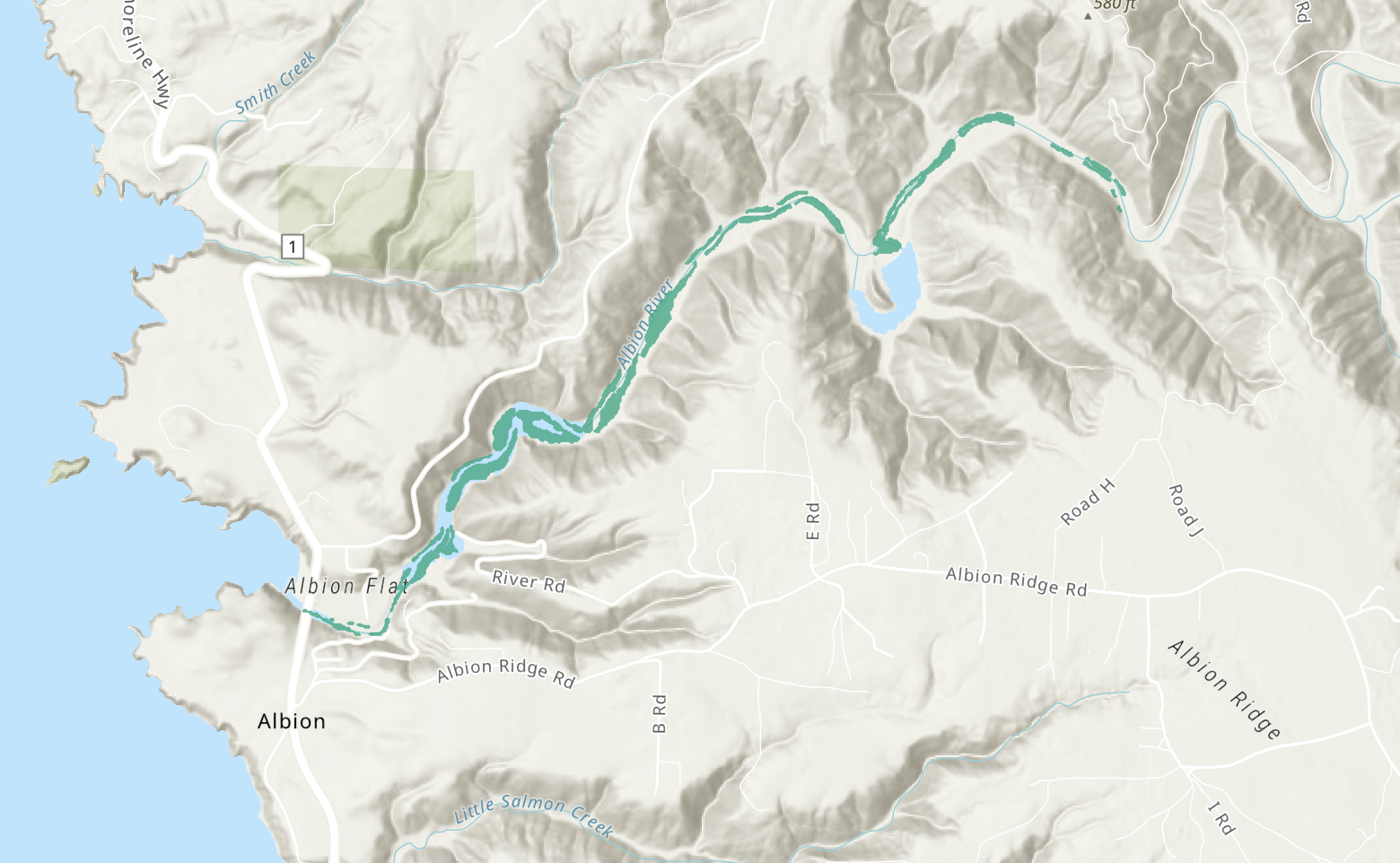
The California Department of Fish and Wildlife included the Albion River Estuary and the eelgrass there in a 2022 survey and a visual representation of the data is available through the Biogeographic Information and Observation System (BIOS).
‘There is So Much Less Life’
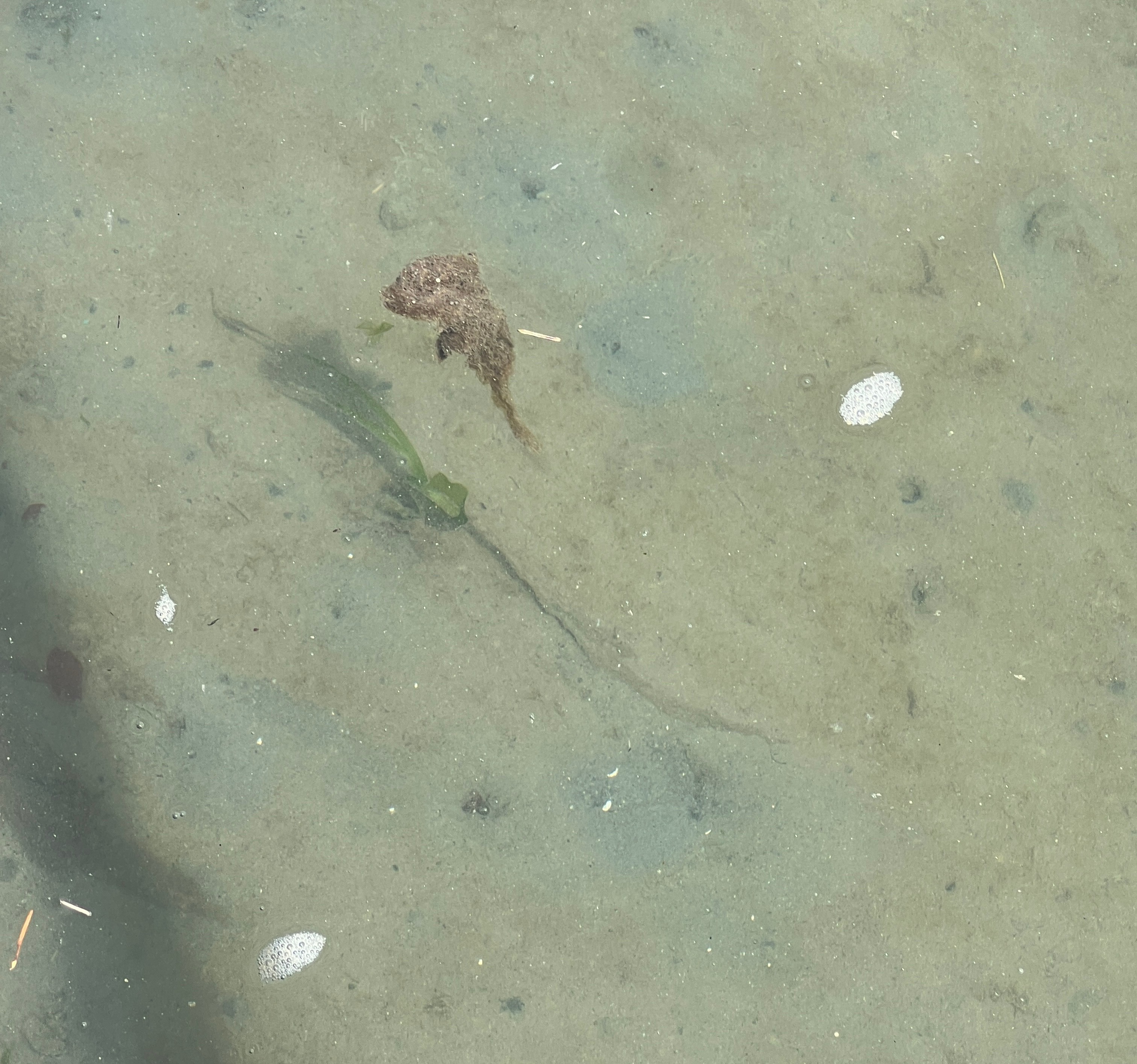
Checking in on that survey and looking back through her own old photos, Levine is struck by how different the river looks today. Gone is the vibrant palette of blue, green, and turquoise created by the meadow that seemed to change by the minute. In its place are dull brown mud flats.
The rainbow colors used to make her heart sing, Levine said. Today, the muddy water makes her want to weep. “We used to see a whole flocks of birds, a mixed flock of herons, cormorants, and egrets all together, “ she says. Today, ‘there is so much less life here.”
With her background in medical science, Levine is better equipped than most to observe the changes. She has some ideas about who and what may be behind the eelgrass’ disappearance.
While the sea level is rising, the additional water is not enough to make up for the added load of sediment. “More and more, I have noticed the mud flats exposed at low tide, baking in the sun,” she said.
There was a time when the meadow could sustain countless life forms — including invasive green crabs that slice and uproot eelgrass when they are foraging. Recent research indicates the juvenile crabs also eat eelgrass. As the eelgrass beds retreated in recent years, the crabs multiplied.
“The green crabs eat eelgrass like the purple urchin eats kelp,” Levine said.
Levine believes the introduction of sea otters, which feed on the crabs, could help. The otters have helped eelgrass recover elsewhere.
What Recovery Looks Like
Elkhorn Slough, an estuary in Monterey Bay that once supported 26 hectares of eelgrass, had declined to ~15 hectares by the early 1980s, driven by agricultural runoff and nutrient pollution. Beginning in 2015, Hughes and his colleagues undertook a restoration project that, by 2018, had expanded planted eelgrass plots from 29 square meters to more than 2,500 square meters — an increase of approximately 8,500 percent.
The key, Hughes said, was not just the planting itself but understanding the conditions that allowed the plants to thrive. The recovery of sea otter populations in Elkhorn Slough turned out to be crucial: the otters controlled crab populations that would otherwise have disturbed newly planted shoots before they could take root. A 5 mph speed limit for all watercraft in the estuary protected the transplants from propeller damage. And researchers learned, through a painful first-year failure in which algal blooms smothered their plantings, that timing mattered enormously — planting in February and March, rather than later in the spring, gave the eelgrass a two-month head start before the algae arrived.
“These systems can recover, as long as you figure out what those stressors are,” Hughes said. “But I probably wouldn’t go just trying to plant a bunch of seagrass without knowing exactly what’s going on.”
Morro Bay offers another example. After its eelgrass largely disappeared, restrictions on sediment loads in the watershed allowed the beds to begin recovering on their own, with only modest intervention from restoration crews.
The lesson from both cases, Hughes said, is that eelgrass is resilient — but only if the underlying stressors are addressed. Planting into a system that is still being degraded by pollution, warming water or disease is unlikely to succeed.
What Comes Next
For now, the immediate priority at Albion is diagnosis.
Hughes said the next steps should include alerting the California Department of Fish and Wildlife and NOAA Fisheries to the observed decline, asking both agencies whether they have conducted any monitoring of the site and what it would take for them to do so. A field survey to check remaining eelgrass patches for signs of wasting disease could begin ruling out — or confirming — one of the most likely culprits. Water temperature data, if available, could shed light on whether warming is a factor.
Who will do the alerting? Hughes said that’s up to the residents of Mendocino County. The NOAA Fisheries goal of “no net loss” is designed to be applied in the context of development. “So if somebody wants to build a dock or build a bridge, for example, and there’s a seagrass bed in that footprint, then they need to find another area that doesn’t have seagrass.” Assuming the area is a suitable habitat, they have to plant 1.2 times the amount that they are affecting to ensure that direct human development is fully mitigated.”
But in the case of the Albion River, where the destroyer of sea grass could be green crabs, sedimentation, or multiple factors, there’s no such mandate. “That’s really a society-driven, community-driven kind of thing,” Hughes said. The rescuers of sea grass, those who are sounding the alarm, could be anyone who cares to look and, ideally, take a measurement.
Hughes described the role citizen scientists can play by simply documenting changes in the temperature or the river bottom. And then, Hughes, said it’s critical to communicate with agencies like the California Department of Fish and Wildlife and NOAA Fisheries. “There are certain legal frameworks that do mandate restoration or mitigation in this case,” he said.
MendoLocal.News’ initial contact with the agencies was not encouraging, however. A spokesperson for NOAA responded with a two-line note: “We do not have regional monitoring for eelgrass so this is not something we would report on. Eelgrass can decline in response to ocean conditions, in which case the mitigation policy would not apply.”
Peter Tira, a spokesperson for the California Department of Fish and Wildlife, said he reached out to half a dozen CDFW biologists, and none could recall an eelgrass survey. “It’s not clear what role, if any, CDFW has with the California Eelgrass Mitigation Policy,” he wrote in an email. Tira encouraged community members interested in eelgrass restoration to look into available grants.
Closer to home, Sheila Semans, the executive director of the Noyo Center for Marine Science said she’d like to work in one of Mendocino County’s estuaries one day.
What Levine and others who care about the Albion River estuary are up against is a system of protection that, by federal regulators’ own accounting, is being overwhelmed. Federal and state monitoring infrastructure has left one of the county’s most significant marine habitats essentially unwatched for a decade. Meanwhile, a set of unrelenting environmental pressures — warming oceans, altered watersheds, increasing coastal development — are intensifying.
Hughes, who is simultaneously working on kelp forest restoration in Mendocino County and monitoring estuaries across Northern California, said he is holding out hope for eelgrass restoration in the Albion River — but his hope is qualified by how much support local people will give to the river. “This will probably be a story that continues,” he said. “This is just the beginning.”
For Levine, standing at the edge of an estuary that no longer holds the meadow she has spent years watching over, the beginning goes back a little further. She and her partner, Dan Gates, have been working tirelessly on restoration projects aimed at giving the river back to itself for years.
But she’s ready for a new chapter that will bring more attention and additional resources. She directs her gaze to the few strands of eelgrass that are left at the bottom of river, just an arms’ length away. “It’s still trying,” she said. “So it could be saved.”