
Board of Supes Sends Proposal to Approve 100 Hipcamps to the Planning Commission
Haschak's quiet lobbying effort pays off.
Takeaway: County could gain $75,000 in transient occupancy taxes, while incurring additional administrative, enforcement and infrastructure costs.
Editor’s note: Two typos were fixed on February 11, 2026 at 2:57 p.m.
Ten months after quietly lobbying state lawmakers to make it easier to approve small commercial campgrounds regardless of existing zoning, the Mendocino County Board of Supervisors voted Tuesday to advance a proposal that could legalize up to 900 individual commercial camping areas on 100 properties countywide.
Supervisors did not discuss whether the placement of campsites could be optimized to reduce infrastructure costs, minimize wear and tear on county roads, or ensure adequate access to emergency services. Nor did they debate restrictions that might address concerns repeatedly raised by residents in prior public comment, including heightened wildfire risk, increased insurance premiums, potential groundwater contamination, impacts to sensitive habitats, and late-night noise and traffic on rural roads.
Supervisor John Haschak, who has communicated directly with Hipcamp representatives, estimated there are roughly 80 small commercial campgrounds operating without permits in Mendocino County. That estimate aligns with material Hipcamp provided to this reporter in 2024, when the company said its Mendocino County hosts earned an average of $7,500 annually — or roughly $600,000 total. Extending the county’s Transient Occupancy Tax to those operations would generate approximately $60,000, an amount unlikely to meaningfully offset road maintenance costs or fund enforcement of a new ordinance.
Haschak placed a letter supporting Assembly Bill 518 on the consent calendar on April 22, 2025. Despite strong public interest in the issue, the letter received no public comment, suggesting many residents were unaware of the proposed action. Items on the consent calendar are supposed to be routine and noncontroversial.
Haschak’s letter did not cite any shortage of available campsites in Mendocino County. However, it did repeat Hipcamp-approved talking points: “In 2022, outdoor recreation reached a record high, with more than 19 million Californians enjoying the outdoors. California’s outdoor recreation economy, one of the state’s largest economic sectors, is valued at an estimated $73.8 billion. However, nearly half of all campers report difficulty finding and booking available campsites across the state.”
The language echoes the statements San Diego Assemblyperson Chris Ward made when he introduced the A.B. 518 on April 9, 2025 with “two of our co-sponsors, Hip Camp Head of Government and Community Relations Mitra Rosener and Lexi Gritlefeld, the Director of California Outdoor Recreation Partnership.”
At the hearing Ward said: “Outdoor recreation hit a record high post pandemic in 2022 with more than 19 million Californians getting outside. They provided an estimated $74 billion for our state’s outdoor recreation. However, nearly half of all campers reported difficulty finding and booking available campsites statewide.”
Ward also asserted that it cost nearly $100,000 for a landowner to set up their property and share it with the public.
Chris Rogers, a Democrat who represents Mendocino County, Liz Ortega, a Democrat from Hayward, and Damon Connolly, a Democrat from San Rafael, joined Ward in co-sponsoring the bill.
The bill passed the state Senate on Sept. 9, 2025 with 35 votes. Four Democrats — Ben Allen from El Segundo, John Laird from Santa Cruz, Akilah Weber Pierson from San Diego, and Angelique Ashby from Sacramento — voted no. The Assembly approved the bill the following day 67 – 13 with eleven Republicans and two Democrats opposed.
Governor Gavin Newsom signed AB 518 on Oct. 1, 2025.
The legislation marked a significant victory for Hipcamp and its investors, who have poured more than $100 million into the San Francisco startup. According to CJ Gustafson of Mostly Metrics, the company would need to generate roughly $500 million in revenue to support a successful initial public offering for institutional investors such as Andreessen Horowitz, who contributed $25 million to the company in 2019, or Index Ventures and Bond Capital, which led a $57 million fundraising round in 2021.
Introducing the local proposal Tuesday, Haschak said AB 518 allows counties to opt in and adopt their own ordinances without going through “the state bureaucracy.”
“This is our opportunity to streamline the process and move it forward,” Haschak said. “We’ve been dealing with this for the last four years.”
Haschak said that he and Supervisor Ted Williams had met with planning department staff and wanted to propose limiting permits to seven campsites per property — fewer than the nine allowed by the state law — and capping the initial rollout to 100 permits.
Supervisor Madeline Cline questioned how that limit was determined. “What kind of engagement did you do with property owners who may be interested in low-impact campsites, particularly around the difference between seven and nine sites?” she asked.
Supervisor Mo Mulheren opposed reducing the number of sites. “I don’t know why we would reduce it to seven,” he said. “I’m fine with a cap of 100 to see how it goes.”
Supervisor Bernie Norvell raised concerns about existing unpermited camps. “What does this do to hipcamps that are already operating illegally, particularly in residential neighborhoods?” he asked, citing a problematic site in his coastal district.
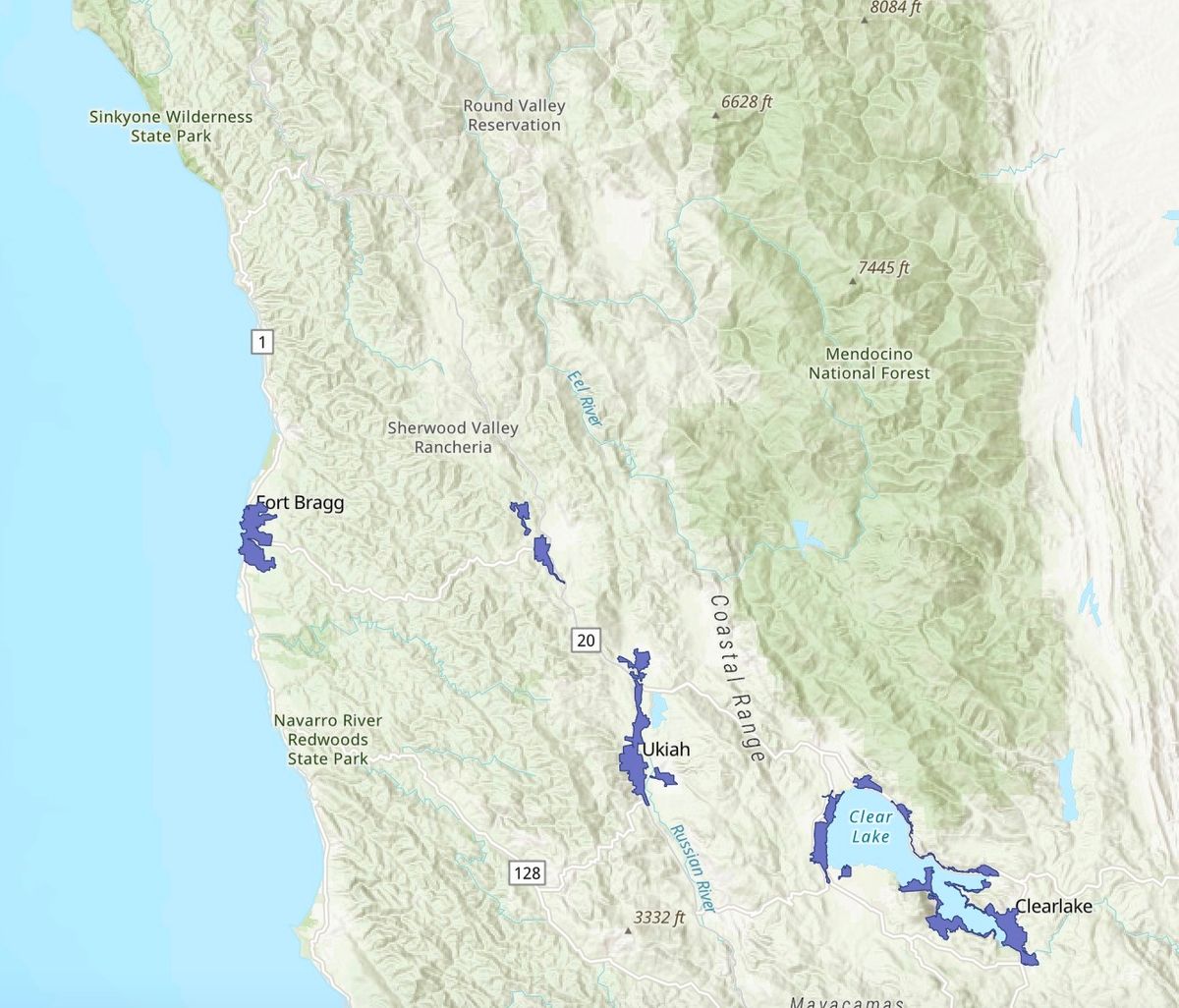
Planning and Building Services Director Julia Krog said properties located in areas designated as urban clusters by the U.S. Census would not qualify under AB 518. Sites surrounded by at least 75% urban uses are excluded from the program. These include three areas in Mendocino County: Fort Bragg, Willits, and Ukiah.
Williams argued for lower permit fees, a move that could further limit the county’s ability to recover costs associated with increased enforcement and infrastructure impacts.
Public comment highlighted additional concerns. Dee Pallesen, speaking from District 5, warned that allowing campsites on private roads with multiple owners and easements could create “a mess of problems.”
Jenny Shattuck of Fort Bragg raised safety concerns, citing limited cell service in rural areas and the possibility that emergency responders might be unable to reach campsites.
She also objected to allowing commercial campgrounds outside commercial zones. “If we wanted to live next to a campground or a commercial area, we would have bought or rented there,” Shattuck said. “This is a disservice to residents.”
After discussion, the board voted to forward the proposal — amended to allow up to nine campsites per permit and incorporating AB 518 standards — to the Planning Commission for review, bypassing additional board hearings. Supervisors said the goal was to expedite implementation and begin collecting the approximately $75,000 in transient occupancy taxes sooner.
Data on urban clusters: https://tigerweb.geo.census.gov/arcgis/rest/services/TIGERweb/Urban/MapServer